
Textbook Question
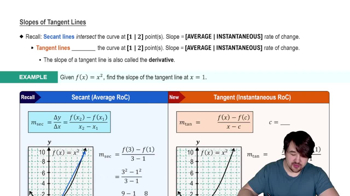
Given that f(1)=2 and f′(1)=2 , find the slope of the curve y=xf(x) at the point (1, 2).
306
views

 Verified step by step guidance
 05:13
05:13 05:13
05:13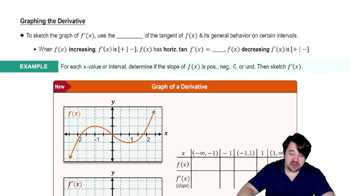 06:15
06:15Given that f(1)=2 and f′(1)=2 , find the slope of the curve y=xf(x) at the point (1, 2).
Parabolic motion An arrow is shot into the air and moves along the parabolic path y=x(50−x) (see figure). The horizontal component of velocity is always 30 ft/s. What is the vertical component of velocity when (a) x=10 and (b) x=40? <IMAGE>
Find the function The following limits represent the slope of a curve y = f(x) at the point (a,f(a)). Determine a possible function f and number a; then calculate the limit.
(lim x🠂1) 3x²+4x-7 / x-1
Two boats leave a port at the same time, one traveling west at 20 mi/hr and the other traveling southwest ( 45° south of west) at 15 mi/hr. After 30 minutes, how far apart are the boats and at what rate is the distance between them changing? (Hint: Use the Law of Cosines.)
Another method for proving lim x→0 cos x−1/x = 0 Use the half-angle formula sin²x = 1− cos 2x/2 to prove that lim x→0 cos x−1/x=0.
Find the derivative of the following functions.
y = In(e^x + e^-x)