

Ch. 3 - Derivatives
Briggs - Calculus: Early Transcendentals 3rd Edition
Briggs3rd EditionCalculus: Early TranscendentalsISBN: 9780136847243Not the one you use?Change textbook
Chapter 3, Problem 3.9.32

Find the derivative of the following functions.
y = In(e^x + e^-x)

Verified step by step guidance
1
Step 1: Recognize that the function y = ln(e^x + e^-x) is a composition of functions, where the outer function is the natural logarithm ln(u) and the inner function is u = e^x + e^-x.
Step 2: Apply the chain rule for differentiation, which states that if y = ln(u), then the derivative dy/dx = (1/u) * (du/dx).
Step 3: Differentiate the inner function u = e^x + e^-x with respect to x. The derivative of e^x is e^x, and the derivative of e^-x is -e^-x.
Step 4: Substitute the derivative of the inner function back into the chain rule formula. This gives dy/dx = (1/(e^x + e^-x)) * (e^x - e^-x).
Step 5: Simplify the expression if possible. The derivative of y with respect to x is dy/dx = (e^x - e^-x) / (e^x + e^-x).

Verified video answer for a similar problem:

This video solution was recommended by our tutors as helpful for the problem above.
Video duration:
5m
Was this helpful?

Key Concepts

Here are the essential concepts you must grasp in order to answer the question correctly.

Derivative

The derivative of a function measures how the function's output value changes as its input value changes. It is a fundamental concept in calculus, representing the slope of the tangent line to the curve of the function at any given point. The derivative is denoted as f'(x) or dy/dx, and it can be calculated using various rules such as the power rule, product rule, and chain rule.
Recommended video:
05:44
Derivatives

Natural Logarithm

The natural logarithm, denoted as ln(x), is the logarithm to the base e, where e is approximately equal to 2.71828. It is the inverse function of the exponential function e^x. Understanding the properties of natural logarithms, such as ln(a*b) = ln(a) + ln(b) and ln(a^b) = b*ln(a), is essential for differentiating functions that involve logarithmic expressions.
Recommended video:
05:18
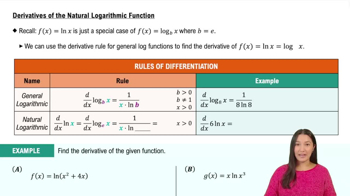
Derivative of the Natural Logarithmic Function

Exponential Functions

Exponential functions are mathematical functions of the form f(x) = a * e^(bx), where a and b are constants, and e is the base of the natural logarithm. These functions exhibit rapid growth or decay and are characterized by their unique property that the derivative of e^x is e^x. In the context of the given function, recognizing how to differentiate expressions involving e^x and e^(-x) is crucial for finding the derivative.
Recommended video:
6:13
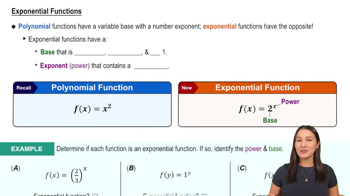
Exponential Functions
Related Practice
Textbook Question

Two boats leave a port at the same time, one traveling west at 20 mi/hr and the other traveling southwest ( 45° south of west) at 15 mi/hr. After 30 minutes, how far apart are the boats and at what rate is the distance between them changing? (Hint: Use the Law of Cosines.)

326
views
Textbook Question

Another method for proving lim x→0 cos x−1/x = 0 Use the half-angle formula sin²x = 1− cos 2x/2 to prove that lim x→0 cos x−1/x=0.

370
views
Textbook Question

The line tangent to the graph of f at x=5 is y = 1/10x-2. Find d/dx (4f(x)) |x+5

232
views
Textbook Question

90–93. {Use of Tech} Work carefully Proceed with caution when using implicit differentiation to find points at which a curve has a specified slope. For the following curves, find the points on the curve (if they exist) at which the tangent line is horizontal or vertical. Once you have found possible points, make sure that they actually lie on the curve. Confirm your results with a graph.

x²(3y²−2y³) = 4

371
views
Textbook Question

The speed of sound (in m/s) in dry air is approximated the function v(T) = 331 + 0.6T, where T is the air temperature (in degrees Celsius). Evaluate v' (T) and interpret its meaning.

339
views
Textbook Question

73–78. {Use of Tech} Normal lines A normal line at a point P on a curve passes through P and is perpendicular to the line tangent to the curve at P (see figure). Use the following equations and graphs to determine an equation of the normal line at the given point. Illustrate your work by graphing the curve with the normal line. <IMAGE>


Exercise 48

231
views