
Ch. 3 - Derivatives
Briggs - Calculus: Early Transcendentals 3rd Edition
Briggs3rd EditionCalculus: Early TranscendentalsISBN: 9780136847243Not the one you use?Change textbook
Chapter 3, Problem 3.10.46b

{Use of Tech} Angle of elevation A small plane, moving at 70 m/s, flies horizontally on a line 400 meters directly above an observer. Let θ be the angle of elevation of the plane (see figure). <IMAGE>


b. Graph dθ/dx as a function of x and determine the point at which θ changes most rapidly.

Verified step by step guidance
1
First, understand the relationship between the angle of elevation θ and the horizontal distance x from the observer to the point directly below the plane. The angle θ can be expressed using the tangent function: tan(θ) = 400/x, where 400 meters is the height of the plane above the observer.
To find how θ changes with respect to x, differentiate the equation tan(θ) = 400/x with respect to x. This involves implicit differentiation. Recall that the derivative of tan(θ) with respect to θ is sec²(θ) dθ/dx.
Apply implicit differentiation: differentiate both sides of the equation tan(θ) = 400/x with respect to x. The left side becomes sec²(θ) dθ/dx, and the right side becomes -400/x².
Solve for dθ/dx: rearrange the differentiated equation to isolate dθ/dx. This gives dθ/dx = (-400/x²) / sec²(θ). Since sec²(θ) = 1 + tan²(θ), substitute tan(θ) = 400/x into sec²(θ) to express dθ/dx entirely in terms of x.
Graph dθ/dx as a function of x to visualize how the rate of change of the angle θ varies with x. The point at which θ changes most rapidly corresponds to the maximum value of |dθ/dx|. Analyze the graph to determine this point.

Verified video answer for a similar problem:

This video solution was recommended by our tutors as helpful for the problem above.
Video duration:
7m
Was this helpful?

Key Concepts

Here are the essential concepts you must grasp in order to answer the question correctly.

Angle of Elevation

The angle of elevation is the angle formed between the horizontal line from an observer's eye to an object above them and the line of sight to that object. In this context, it helps determine how high the plane appears to the observer as it moves horizontally. Understanding this concept is crucial for analyzing how the angle changes with respect to the plane's position.
Recommended video:
8:22
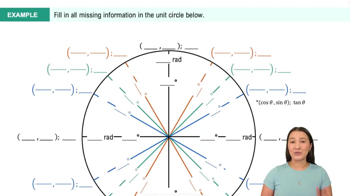
Trig Values in Quadrants II, III, & IV Example 2

Derivative and Rate of Change

The derivative represents the rate of change of a function with respect to a variable. In this scenario, dθ/dx indicates how the angle of elevation θ changes as the horizontal distance x from the observer to the plane changes. This concept is essential for finding the point where the angle changes most rapidly, which corresponds to the maximum value of the derivative.
Recommended video:
04:16
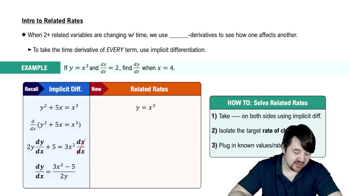
Intro To Related Rates

Graphing Functions

Graphing functions involves plotting the relationship between two variables on a coordinate system. For this problem, graphing dθ/dx as a function of x allows us to visualize how the angle of elevation changes with distance. Analyzing the graph helps identify critical points, such as where the angle changes most rapidly, which is key to solving the problem.
Recommended video:
5:53
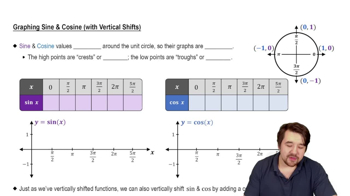
Graph of Sine and Cosine Function
Related Practice
Textbook Question

An object oscillates along a vertical line, and its position in centimeters is given by y(t) = 30(sint - 1), where t ≥ 0 is measured in seconds and y is positive in the upward direction.

Find the velocity of the oscillator, v(t) =y′(t).

274
views
Textbook Question

13-26 Implicit differentiation Carry out the following steps.

b. Find the slope of the curve at the given point.

tan xy = x+y; (0,0)

184
views
Textbook Question

Derivatives using tables Let h(x)=f(g(x))h(x)=f(g(x)) and p(x)=g(f(x))p(x)=g(f(x)). Use the table to compute the following derivatives.

<IMAGE>

b. h(2)h^{\(\prime\)}\(\left\)(2\(\right\))

278
views
Textbook Question

The energy (in joules) released by an earthquake of magnitude M is given by the equation E=25,000 ⋅ 101.5M. (This equation can be solved for M to define the magnitude of a given earthquake; it is a refinement of the original Richter scale created by Charles Richter in 1935.)

Compute dE/dM and evaluate it for M=3. What does this derivative mean? (M has no units, so the units of the derivative are J per change in magnitude.)

267
views
Textbook Question

109-112 {Use of Tech} Calculating limits The following limits are the derivatives of a composite function g at a point a.

b. Use the Chain Rule to find each limit. Verify your answer by using a calculator.

limx04+sin(x)2x{\(\displaystyle\]\lim\)_{x\(\to\)0}}\(\frac{\sqrt{4+\sin\left(x\right)}\)-2}{x}

263
views
Textbook Question

{Use of Tech} Fuel economy Suppose you own a fuel-efficient hybrid automobile with a monitor on the dashboard that displays the mileage and gas consumption. The number of miles you can drive with g gallons of gas remaining in the tank on a particular stretch of highway is given by m(g) = 50g−25.8g²+12.5g³−1.6g⁴, for 0≤g≤4.

b. Graph and interpret the gas mileage m(g)/g. 

241
views