Ch. 4 - Applications of the Derivative
Briggs - Calculus: Early Transcendentals 3rd Edition
Briggs3rd EditionCalculus: Early TranscendentalsISBN: 9780136847243Not the one you use?Change textbook
Chapter 4, Problem 4.9.17

Finding antiderivatives. Find all the antiderivatives of the following functions. Check your work by taking derivatives.


ƒ(y) = - 2/y³

Verified step by step guidance
1
Step 1: Recall the general rule for finding antiderivatives. The antiderivative of a function is the reverse process of differentiation. For power functions, the antiderivative of yⁿ is (y^(n+1))/(n+1), provided n ≠ -1.
Step 2: Rewrite the given function ƒ(y) = -2/y³ using exponents. Since 1/y³ is equivalent to y⁻³, the function becomes ƒ(y) = -2y⁻³.
Step 3: Apply the antiderivative rule to -2y⁻³. Increase the exponent by 1 (from -3 to -2) and divide by the new exponent (-2). This gives the antiderivative as (-2 * y⁻²)/(-2).
Step 4: Simplify the expression obtained in Step 3. The -2 in the numerator and denominator cancel out, leaving y⁻² or 1/y². Add the constant of integration, C, to account for all antiderivatives. The result is F(y) = 1/y² + C.
Step 5: Verify your work by differentiating F(y). Differentiate F(y) = 1/y² + C using the power rule and confirm that the derivative is ƒ(y) = -2/y³, which matches the original function.

Verified video answer for a similar problem:

This video solution was recommended by our tutors as helpful for the problem above.
Video duration:
4m
Was this helpful?

Key Concepts

Here are the essential concepts you must grasp in order to answer the question correctly.

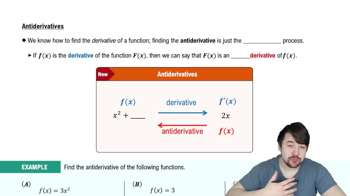
Antiderivative

An antiderivative of a function is another function whose derivative is the original function. In calculus, finding antiderivatives is essential for solving problems related to integration. The process involves determining a function F(y) such that F'(y) = f(y). Antiderivatives are not unique; they can differ by a constant, represented as F(y) + C, where C is any constant.
Recommended video:
05:50
Antiderivatives

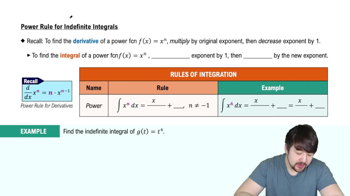
Power Rule for Integration

The Power Rule for Integration is a fundamental technique used to find antiderivatives of polynomial functions. It states that the integral of y^n, where n is not equal to -1, is (y^(n+1))/(n+1) + C. This rule simplifies the process of finding antiderivatives by allowing us to easily handle terms with exponents, making it particularly useful for functions like f(y) = -2/y³.
Recommended video:
04:04
Power Rule for Indefinite Integrals

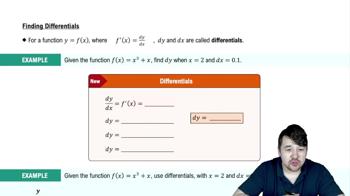
Verification by Differentiation

Verification by differentiation involves checking the correctness of an antiderivative by taking its derivative. If the derivative of the antiderivative matches the original function, the solution is confirmed. This step is crucial in calculus to ensure that the integration process was performed correctly and helps reinforce the relationship between differentiation and integration.
Recommended video:
05:53
Finding Differentials
Related Practice
Textbook Question

Suppose f is differentiable on (-∞,∞) and the equation of the line tangent to the graph of f at x = 2 is y = 5x -3. Use the linear approximation to f at x = 2 to approximate f(2.01).

266
views

Textbook Question

Tree notch (Putnam Exam 1938, rephrased) A notch is cut in a cylindrical vertical tree trunk (see figure). The notch penetrates to the axis of the cylinder and is bounded by two half-planes that intersect on a diameter D of the tree. The angle between the two half-planes is Θ. Prove that for a given tree and fixed angle Θ, the volume of the notch is minimized by taking the bounding planes at equal angles to the horizontal plane that also passes through D.

216
views
Textbook Question

{Use of Tech} Growth rate of spotted owlets The rate of growth (in g/week) of the body mass of Indian spotted owlets is modeled by the function r(t) = 10,147.9e⁻²·²ᵗ/(37.98e⁻²·² + 1), where t is the age (in weeks) of the owlets. What value of t > 0 maximizes r? What is the physical meaning of the maximum value?

260
views
Textbook Question

{Use of Tech} Finding all roots Use Newton’s method to find all the roots of the following functions. Use preliminary analysis and graphing to determine good initial approximations.


f(x) = x⁵/5 - x³/4 - 1/20

210
views
Textbook Question

{Use of Tech} Finding all roots Use Newton’s method to find all the roots of the following functions. Use preliminary analysis and graphing to determine good initial approximations.


f(x) = x²(x - 100) + 1

296
views
Textbook Question

Maximum-area rectangles Of all rectangles with a fixed perimeter of P, which one has the maximum area? (Give the dimensions in terms of P.)

1037
views