Ch. 4 - Applications of the Derivative
Briggs - Calculus: Early Transcendentals 3rd Edition
Briggs3rd EditionCalculus: Early TranscendentalsISBN: 9780136847243Not the one you use?Change textbook
Chapter 4, Problem 4.24.1

{Use of Tech} Finding all roots Use Newton’s method to find all the roots of the following functions. Use preliminary analysis and graphing to determine good initial approximations.


f(x) = x⁵/5 - x³/4 - 1/20

Verified step by step guidance
1
Step 1: Begin by analyzing the function f(x) = x⁵/5 - x³/4 - 1/20. Identify the degree of the polynomial, which is 5, indicating there could be up to 5 real roots. Consider the behavior of the function as x approaches positive and negative infinity.
Step 2: Graph the function f(x) to visually inspect where the roots might be located. Look for points where the graph crosses the x-axis, as these are potential roots. This will help in choosing good initial approximations for Newton's method.
Step 3: Choose initial approximations for the roots based on the graph. For example, if the graph crosses the x-axis at x = a, x = b, and x = c, these values can be used as starting points for Newton's method.
Step 4: Apply Newton's method, which uses the formula x_{n+1} = x_n - f(x_n)/f'(x_n). First, compute the derivative f'(x) = x⁴ - 3x²/4. Use this derivative in the formula to iteratively find more accurate approximations of the roots.
Step 5: Continue iterating using Newton's method until the approximations converge to a satisfactory level of accuracy. Check the results by substituting back into the original function to ensure f(x) is close to zero, confirming the roots.

Verified video answer for a similar problem:

This video solution was recommended by our tutors as helpful for the problem above.
Video duration:
6m
Was this helpful?

Key Concepts

Here are the essential concepts you must grasp in order to answer the question correctly.

Newton's Method

Newton's Method is an iterative numerical technique used to find approximate roots of a real-valued function. It starts with an initial guess and refines it using the formula x_{n+1} = x_n - f(x_n)/f'(x_n), where f' is the derivative of f. This method converges quickly under suitable conditions, making it effective for finding roots when the function is well-behaved near the root.
Recommended video:
4:26
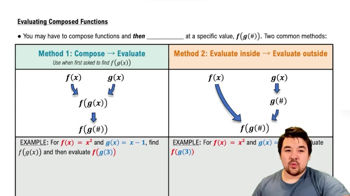
Evaluating Composed Functions

Preliminary Analysis

Preliminary analysis involves examining the function's behavior to identify potential roots before applying numerical methods. This can include evaluating the function at various points, analyzing its derivative, and determining intervals where the function changes sign. This step is crucial for selecting good initial approximations for Newton's Method, as it can significantly affect convergence.
Recommended video:
06:29
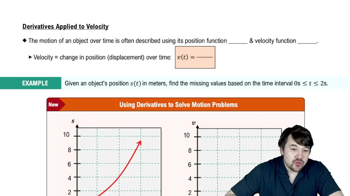
Derivatives Applied To Velocity

Graphing Functions

Graphing functions provides a visual representation of their behavior, helping to identify roots and understand their characteristics. By plotting the function, one can observe where it intersects the x-axis, indicating potential roots. This visual approach complements analytical methods and aids in selecting effective initial guesses for iterative methods like Newton's Method.
Recommended video:
5:53
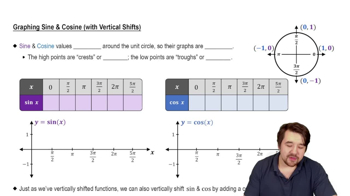
Graph of Sine and Cosine Function
Related Practice
Textbook Question

Graphing functions Use the guidelines of this section to make a complete graph of f.


f(x) = ln (x² + 1)

254
views

Textbook Question

Tree notch (Putnam Exam 1938, rephrased) A notch is cut in a cylindrical vertical tree trunk (see figure). The notch penetrates to the axis of the cylinder and is bounded by two half-planes that intersect on a diameter D of the tree. The angle between the two half-planes is Θ. Prove that for a given tree and fixed angle Θ, the volume of the notch is minimized by taking the bounding planes at equal angles to the horizontal plane that also passes through D.

216
views
Textbook Question

{Use of Tech} Growth rate of spotted owlets The rate of growth (in g/week) of the body mass of Indian spotted owlets is modeled by the function r(t) = 10,147.9e⁻²·²ᵗ/(37.98e⁻²·² + 1), where t is the age (in weeks) of the owlets. What value of t > 0 maximizes r? What is the physical meaning of the maximum value?

260
views
Textbook Question

{Use of Tech} Finding all roots Use Newton’s method to find all the roots of the following functions. Use preliminary analysis and graphing to determine good initial approximations.


f(x) = x²(x - 100) + 1

296
views
Textbook Question

Finding antiderivatives. Find all the antiderivatives of the following functions. Check your work by taking derivatives.


ƒ(y) = - 2/y³

71
views
Textbook Question

Maximum-area rectangles Of all rectangles with a fixed perimeter of P, which one has the maximum area? (Give the dimensions in terms of P.)

1037
views