
Ch. 4 - Applications of the Derivative
Briggs - Calculus: Early Transcendentals 3rd Edition
Briggs3rd EditionCalculus: Early TranscendentalsISBN: 9780136847243Not the one you use?Change textbook
Chapter 4, Problem 4.5.35.a

Optimal soda can


a. Classical problem Find the radius and height of a cylindrical soda can with a volume of 354 cm³ that minimize the surface area.

Verified step by step guidance
1
Start by identifying the formulas involved: The volume of a cylinder is given by \( V = \pi r^2 h \) and the surface area is given by \( A = 2\pi r^2 + 2\pi rh \).
Given that the volume \( V = 354 \text{ cm}^3 \), express the height \( h \) in terms of the radius \( r \) using the volume formula: \( h = \frac{354}{\pi r^2} \).
Substitute \( h \) from the volume equation into the surface area formula to express the surface area \( A \) solely in terms of \( r \): \( A = 2\pi r^2 + \frac{708}{r} \).
To find the radius that minimizes the surface area, take the derivative of \( A \) with respect to \( r \), set it equal to zero, and solve for \( r \). This involves finding \( \frac{dA}{dr} = 4\pi r - \frac{708}{r^2} \) and setting \( \frac{dA}{dr} = 0 \).
Solve the equation \( 4\pi r - \frac{708}{r^2} = 0 \) to find the critical points. Then, use the second derivative test or analyze the behavior of \( \frac{dA}{dr} \) to confirm that the solution gives a minimum surface area. Finally, use the value of \( r \) to find \( h \) using the expression \( h = \frac{354}{\pi r^2} \).

Verified video answer for a similar problem:

This video solution was recommended by our tutors as helpful for the problem above.
Video duration:
8m
Was this helpful?

Key Concepts

Here are the essential concepts you must grasp in order to answer the question correctly.

Volume of a Cylinder

The volume of a cylinder is calculated using the formula V = πr²h, where r is the radius and h is the height. In this problem, the volume is given as 354 cm³, which serves as a constraint for determining the optimal dimensions of the can.
Recommended video:
08:29
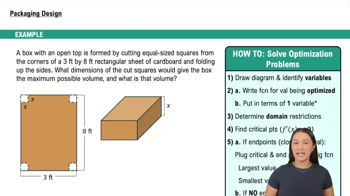
Example 5: Packaging Design

Surface Area of a Cylinder

The surface area of a cylinder is given by the formula A = 2πr² + 2πrh, where the first term accounts for the areas of the two circular bases and the second term accounts for the lateral surface area. Minimizing this surface area while maintaining a fixed volume is the core objective of the problem.
Recommended video:
09:07
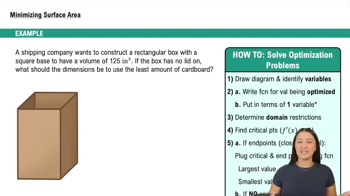
Example 1: Minimizing Surface Area

Optimization Techniques

Optimization in calculus involves finding the maximum or minimum values of a function. In this case, techniques such as setting up a function for surface area in terms of one variable (using the volume constraint) and applying derivatives to find critical points are essential for solving the problem.
Recommended video:
10:13
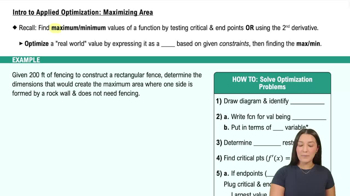
Intro to Applied Optimization: Maximizing Area
Related Practice
Textbook Question

Maximizing profit Suppose a tour guide has a bus that holds a maximum of 100 people. Assume his profit (in dollars) for taking people on a city tour is P(n) = n(50 - 0.5n) - 100. (Although P is defined only for positive integers, treat it as a continuous function.)


a. How many people should the guide take on a tour to maximize the profit?

342
views
Textbook Question

Values of related functions Suppose f is differentiable on (-∞,∞) and assume it has a local extreme value at the point x = 2, where f(2) = 0. Let g(x) = xf(x) + 1 and let h(x) = xf(x) + x +1, for all values of x.


a. Evaluate g(2), h(2), g'(2), and h'(2).

240
views
Textbook Question

Sketch a graph of a function f with the following properties.


f' < 0 and f" < 0, for x < 3

347
views
Textbook Question

Do dogs know calculus? A mathematician stands on a beach with his dog at point A. He throws a tennis ball so that it hits the water at point B. The dog, wanting to get to the tennis ball as quickly as possible, runs along the straight beach line to point D and then swims from point D to point B to retrieve his ball. Assume C is the point on the edge of the beach closest to the tennis ball (see figure). <IMAGE>


a. Assume the dog runs at speed r and swims at speed s, where r > s and both are measured in meters per second. Also assume the lengths of BC, CD, and AC are x, y, and z, respectively. Find a function T(y) representing the total time it takes for the dog to get to the ball. 

346
views
Textbook Question

{Use of Tech} Investment problem A one-time investment of \(2500 is deposited in a 5-year savings account paying a fixed annual interest rate r, with monthly compounding. The amount of money in the account after 5 years is a(r) = 2500(1 + r/12)⁶⁰. 


a. Use Newton’s method to find the value of r if the goal is to have \)3200 in the account after 5 years.

173
views
Textbook Question

107–110. {Use of Tech} Motion with gravity Consider the following descriptions of the vertical motion of an object subject only to the acceleration due to gravity. Begin with the acceleration equation a(t) = v' (t) = -g , where g = 9.8 m/s² .

a. Find the velocity of the object for all relevant times. 

A payload is released at an elevation of 400 m from a hot-air balloon that is rising at a rate of 10 m/s.

57
views