
Ch. 4 - Applications of the Derivative
Briggs - Calculus: Early Transcendentals 3rd Edition
Briggs3rd EditionCalculus: Early TranscendentalsISBN: 9780136847243Not the one you use?Change textbook
Chapter 4, Problem 4.1.89a

Values of related functions Suppose f is differentiable on (-∞,∞) and assume it has a local extreme value at the point x = 2, where f(2) = 0. Let g(x) = xf(x) + 1 and let h(x) = xf(x) + x +1, for all values of x.


a. Evaluate g(2), h(2), g'(2), and h'(2).

Verified step by step guidance
1
First, evaluate g(2) by substituting x = 2 into the function g(x) = xf(x) + 1. Since f(2) = 0, g(2) = 2 * f(2) + 1 = 2 * 0 + 1 = 1.
Next, evaluate h(2) by substituting x = 2 into the function h(x) = xf(x) + x + 1. Again, since f(2) = 0, h(2) = 2 * f(2) + 2 + 1 = 0 + 2 + 1 = 3.
To find g'(x), use the product rule for differentiation. The function g(x) = xf(x) + 1 can be differentiated as g'(x) = f(x) + x * f'(x). Substitute x = 2 to find g'(2).
For h'(x), differentiate h(x) = xf(x) + x + 1. Using the product rule and the sum rule, h'(x) = f(x) + x * f'(x) + 1. Substitute x = 2 to find h'(2).
Since f has a local extreme value at x = 2, f'(2) = 0. Use this information to simplify g'(2) and h'(2) further by substituting f'(2) = 0 into the expressions obtained in the previous steps.

Verified video answer for a similar problem:

This video solution was recommended by our tutors as helpful for the problem above.
Video duration:
6m
Was this helpful?

Key Concepts

Here are the essential concepts you must grasp in order to answer the question correctly.

Differentiability and Local Extrema

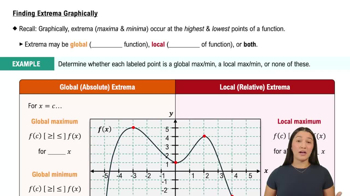
A function is differentiable at a point if it has a defined derivative there, which implies it is smooth and has no sharp corners. A local extreme value occurs at a point where the function reaches a maximum or minimum compared to nearby points. For a differentiable function, local extrema can be identified using the first derivative test, where the derivative changes sign around the point.
Recommended video:
05:58
Finding Extrema Graphically

Function Evaluation

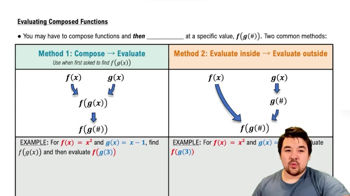
Function evaluation involves substituting a specific value into a function to determine its output. For example, to evaluate g(2) or h(2), we substitute x = 2 into the respective function definitions. This process is essential for finding specific values of functions at given points, which is a fundamental skill in calculus.
Recommended video:
4:26
Evaluating Composed Functions

Derivative of a Product

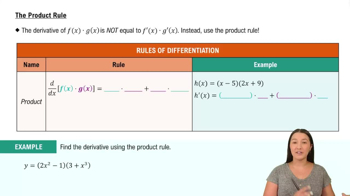
The derivative of a product of two functions can be found using the product rule, which states that if u(x) and v(x) are functions, then the derivative of their product u(x)v(x) is u'(x)v(x) + u(x)v'(x). This rule is crucial when differentiating functions like g(x) and h(x), which are defined as products of x and f(x), allowing us to compute g'(2) and h'(2) effectively.
Recommended video:
05:18
The Product Rule
Related Practice
Textbook Question

Folded boxes


a. Squares with sides of length x are cut out of each corner of a rectangular piece of cardboard measuring 5 ft by 8 ft. The resulting piece of cardboard is then folded into a box without a lid. Find the volume of the largest box that can be formed in this way.

319
views
Textbook Question

Optimal soda can


a. Classical problem Find the radius and height of a cylindrical soda can with a volume of 354 cm³ that minimize the surface area.

292
views
Textbook Question

Maximizing profit Suppose a tour guide has a bus that holds a maximum of 100 people. Assume his profit (in dollars) for taking people on a city tour is P(n) = n(50 - 0.5n) - 100. (Although P is defined only for positive integers, treat it as a continuous function.)


a. How many people should the guide take on a tour to maximize the profit?

342
views
Textbook Question

Sketch a graph of a function f with the following properties.


f' < 0 and f" < 0, for x < 3

347
views
Textbook Question

{Use of Tech} Investment problem A one-time investment of \(2500 is deposited in a 5-year savings account paying a fixed annual interest rate r, with monthly compounding. The amount of money in the account after 5 years is a(r) = 2500(1 + r/12)⁶⁰. 


a. Use Newton’s method to find the value of r if the goal is to have \)3200 in the account after 5 years.

173
views
Textbook Question

107–110. {Use of Tech} Motion with gravity Consider the following descriptions of the vertical motion of an object subject only to the acceleration due to gravity. Begin with the acceleration equation a(t) = v' (t) = -g , where g = 9.8 m/s² .

a. Find the velocity of the object for all relevant times. 

A payload is released at an elevation of 400 m from a hot-air balloon that is rising at a rate of 10 m/s.

57
views