Ch. 5 - Integration
Briggs - Calculus: Early Transcendentals 3rd Edition
Briggs3rd EditionCalculus: Early TranscendentalsISBN: 9780136847243Not the one you use?Change textbook
Chapter 5, Problem 5.3.31

Definite integrals Evaluate the following integrals using the Fundamental Theorem of Calculus


βˆ«β‚βΈ 8𝓍¹/Β³ d𝓍

Verified step by step guidance
1
Step 1: Recognize that the integral βˆ«β‚βΈ 8𝓍¹/Β³ d𝓍 is a definite integral, and we will use the Fundamental Theorem of Calculus to evaluate it. The Fundamental Theorem states that if F'(𝓍) = f(𝓍), then βˆ«β‚α΅‡ f(𝓍) d𝓍 = F(b) - F(a).
Step 2: Identify the function to integrate, which is f(𝓍) = 8𝓍¹/Β³. To find the antiderivative, recall the power rule for integration: βˆ«π“βΏ d𝓍 = (𝓍ⁿ⁺¹)/(n+1) + C, where n β‰  -1.
Step 3: Apply the power rule to the term 𝓍¹/Β³. The antiderivative of 𝓍¹/Β³ is (𝓍⁴/Β³)/(4/3) = (3/4)𝓍⁴/Β³. Multiply this by the constant 8 to get the antiderivative of the entire function: F(𝓍) = 8 * (3/4)𝓍⁴/Β³ = 6𝓍⁴/Β³.
Step 4: Use the Fundamental Theorem of Calculus to evaluate the definite integral. Substitute the upper limit (𝓍 = 8) and the lower limit (𝓍 = 1) into the antiderivative F(𝓍). This gives F(8) - F(1), where F(𝓍) = 6𝓍⁴/Β³.
Step 5: Write the expression for the result: F(8) - F(1) = 6(8⁴/³) - 6(1⁴/³). Simplify each term separately to find the final value of the definite integral.

Verified video answer for a similar problem:

This video solution was recommended by our tutors as helpful for the problem above.
Video duration:
3m
Was this helpful?

Key Concepts

Here are the essential concepts you must grasp in order to answer the question correctly.

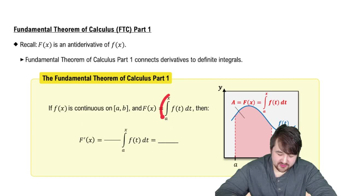
Fundamental Theorem of Calculus

The Fundamental Theorem of Calculus links the concept of differentiation with integration, stating that if a function is continuous on an interval [a, b], then the integral of its derivative over that interval equals the difference in the values of the function at the endpoints. This theorem allows us to evaluate definite integrals by finding an antiderivative of the integrand.
Recommended video:
06:11
Fundamental Theorem of Calculus Part 1

Definite Integral

A definite integral represents the signed area under a curve defined by a function over a specific interval [a, b]. It is calculated using the limits of integration, which specify the interval, and provides a numerical value that reflects the accumulation of quantities, such as area, volume, or total change, over that interval.
Recommended video:
05:43
Definition of the Definite Integral

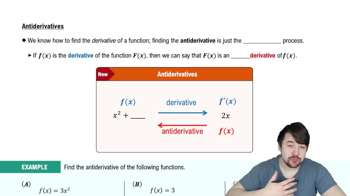
Antiderivative

An antiderivative of a function is another function whose derivative is the original function. In the context of the Fundamental Theorem of Calculus, finding the antiderivative is essential for evaluating definite integrals, as it allows us to compute the integral by substituting the limits of integration into the antiderivative and calculating the difference.
Recommended video:
05:50
Antiderivatives
Related Practice
Textbook Question

Definite integrals Use geometry (not Riemann sums) to evaluate the following definite integrals. Sketch a graph of the integrand, show the region in question, and interpret your result.                                                                                                                                      


 βˆ«β‚€β΄ (8―2𝓍) d𝓍

86
views
Textbook Question

The linear function Ζ’(𝓍) = 3 ― 𝓍 is decreasing on the interval [0, 3]. Is its area function for Ζ’ (with left endpoint 0) increasing or decreasing on the interval [0, 3]? Draw a picture and explain. 

75
views
Textbook Question

Explain why or why not Determine whether the following statements are true and give an explanation or counterexample. Assume Ζ’ and Ζ’' are continuous functions for all real numbers.

(c) βˆ«β‚α΅‡ Ζ’'(𝓍) d𝓍 = Ζ’(b) ―ƒ(a) .

51
views
Textbook Question

Definite integrals Evaluate the following integrals using the Fundamental Theorem of Calculus. Explain why your result is consistent with the figure.


βˆ«β‚€ΒΉ (𝓍² β€• 2𝓍 + 3) d𝓍


132
views
Textbook Question

Definite integrals Evaluate the following integrals using the Fundamental Theorem of Calculus


βˆ«β‚‹β‚‚β»ΒΉ 𝓍⁻³ d𝓍

86
views
Textbook Question

Explain why or why not Determine whether the following statements are true and give an explanation or counterexample. Assume Ζ’ and Ζ’' are continuous functions for all real numbers.

(d) If Ζ’ is continuous on [a,b] and βˆ«β‚α΅‡ |Ζ’(𝓍)| d𝓍 = 0 , then Ζ’(𝓍) = 0 on [a,b] .

64
views