Ch. 5 - Integration
Briggs - Calculus: Early Transcendentals 3rd Edition
Briggs3rd EditionCalculus: Early TranscendentalsISBN: 9780136847243Not the one you use?Change textbook
Chapter 5, Problem 5.R.1f

Explain why or why not Determine whether the following statements are true and give an explanation or counterexample. Assume ƒ and ƒ' are continuous functions for all real numbers.
(f) ∫ₐᵇ (2 ƒ(𝓍) ―3g (𝓍)) d𝓍 = 2 ∫ₐᵇ ƒ(𝓍) d𝓍 + 3 ∫₆ᵃ g(𝓍) d𝓍 .

Verified step by step guidance
1
Step 1: Begin by recalling the linearity property of definite integrals. This property states that for any continuous functions ƒ(𝓍) and g(𝓍), and constants c₁ and c₂, the integral of their linear combination can be expressed as: ∫ₐᵇ [c₁ƒ(𝓍) + c₂g(𝓍)] d𝓍 = c₁∫ₐᵇ ƒ(𝓍) d𝓍 + c₂∫ₐᵇ g(𝓍) d𝓍.
Step 2: Analyze the given statement: ∫ₐᵇ (2ƒ(𝓍) ― 3g(𝓍)) d𝓍 = 2∫ₐᵇ ƒ(𝓍) d𝓍 + 3∫₆ᵃ g(𝓍) d𝓍. Notice that the integral on the left-hand side involves a linear combination of ƒ(𝓍) and g(𝓍), which suggests the linearity property might apply.
Step 3: Compare the right-hand side of the equation. The term 2∫ₐᵇ ƒ(𝓍) d𝓍 is consistent with the linearity property. However, the term 3∫₆ᵃ g(𝓍) d𝓍 is problematic because the limits of integration are reversed (from 6 to a instead of a to b). Recall that reversing the limits of integration introduces a negative sign: ∫₆ᵃ g(𝓍) d𝓍 = -∫ₐ⁶ g(𝓍) d𝓍.
Step 4: Rewrite the right-hand side using the corrected limits of integration for g(𝓍). The equation should now read: ∫ₐᵇ (2ƒ(𝓍) ― 3g(𝓍)) d𝓍 = 2∫ₐᵇ ƒ(𝓍) d𝓍 - 3∫ₐ⁶ g(𝓍) d𝓍. This matches the linearity property of integrals.
Step 5: Conclude that the original statement is false because the limits of integration for g(𝓍) were incorrectly reversed in the given equation. The correct form of the equation should respect the linearity property and properly handle the limits of integration.

Verified video answer for a similar problem:

This video solution was recommended by our tutors as helpful for the problem above.
Video duration:
3m
Was this helpful?

Key Concepts

Here are the essential concepts you must grasp in order to answer the question correctly.

Properties of Definite Integrals

Definite integrals have specific properties that allow for the manipulation of integrals involving sums and constants. One key property is that the integral of a sum of functions can be expressed as the sum of their integrals. Additionally, constants can be factored out of the integral, which is crucial for simplifying expressions involving integrals.
Recommended video:
05:43
Definition of the Definite Integral

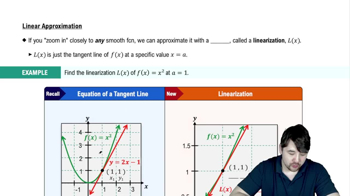
Linearity of Integration

The linearity of integration states that for any two functions ƒ and g, and constants a and b, the integral of a linear combination of these functions can be expressed as the linear combination of their integrals. This means that ∫(aƒ(x) + b g(x)) dx = a∫ƒ(x) dx + b∫g(x) dx, which is essential for evaluating integrals involving multiple functions.
Recommended video:
07:17
Linearization

Continuity of Functions

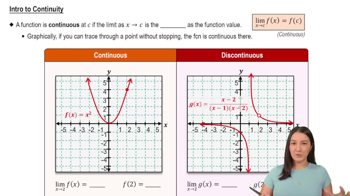
Continuity of functions is a fundamental concept in calculus that ensures the behavior of functions is predictable over their domains. If ƒ and ƒ' are continuous, it implies that the functions do not have any breaks, jumps, or asymptotes, which is important for applying the Fundamental Theorem of Calculus and ensuring that the properties of integrals hold true.
Recommended video:
05:34
Intro to Continuity
Related Practice
Textbook Question

Function defined by an integral Let H (𝓍) = ∫₀ˣ √(4 ― t²) dt, for ― 2 ≤ 𝓍 ≤ 2.

(a) Evaluate H (0) .

61
views

Textbook Question

Area by geometry Use geometry to evaluate the following definite integrals, where the graph of ƒ is given in the figure.

(a) ∫₀⁴ ƒ(𝓍) d𝓍

96
views
Textbook Question

Use geometry and properties of integrals to evaluate the following definite integrals.

∫₄⁰ (2𝓍 + √(16―𝓍²)) d𝓍 . (Hint: Write the integral as sum of two integrals.)

114
views
Textbook Question

Area functions and the Fundamental Theorem Consider the function

ƒ(t) = { t      if  ―2 ≤ t < 0

t²/2    if    0 ≤ t ≤ 2

and its graph shown below. Let F(𝓍) = ∫₋₁ˣ ƒ(t) dt and G(𝓍) = ∫₋₂ˣ ƒ(t) dt.

(b) Use the Fundamental Theorem to find an expression for F '(𝓍) for ―2 ≤ 𝓍 < 0.

60
views
Textbook Question

Integration by Riemann sums Consider the integral ∫₁⁴ (3𝓍― 2) d𝓍.


(c) Evaluate the definite integral by taking the limit as n →∞ of the Riemann sum in part (b).

77
views
Textbook Question

Evaluating integrals Evaluate the following integrals.                                                                                                                                         


 ∫ y² /(y³ + 27) dy

70
views