Ch. 6 - Applications of Integration
Briggs - Calculus: Early Transcendentals 3rd Edition
Briggs3rd EditionCalculus: Early TranscendentalsISBN: 9780136847243Not the one you use?Change textbook
Chapter 6, Problem 6.R.27

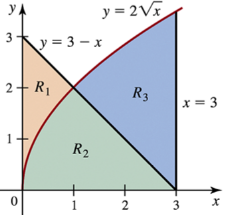
27–33. Multiple regions The regions R₁,R₂, and R₃ (see figure) are formed by the graphs of y = 2√x,y = 3−x,and x=3.
Find the area of each of the regions R₁,R₂, and R₃.
Graph showing regions R₁, R₂, and R₃ formed by curves and lines, with labels indicating their areas.

Verified step by step guidance
1
Identify the curves and lines that bound each region R₁, R₂, and R₃. From the graph, R₁ is bounded by y = 3 - x and y = 2\(\sqrt{x}\), R₂ is bounded by y = 2\(\sqrt{x}\) and y = 3 - x, and R₃ is bounded by y = 2\(\sqrt{x}\) and the vertical line x = 3.
Find the points of intersection between the curves to determine the limits of integration. Solve for x where y = 2\(\sqrt{x}\) equals y = 3 - x by setting 2\(\sqrt{x}\) = 3 - x and solving for x.
For region R₁, set up the integral for the area between y = 3 - x (upper curve) and y = 2\(\sqrt{x}\) (lower curve) from x = 0 to the intersection point found in step 2. The area is given by \(\int_0^{x_1} [(3 - x) - 2\sqrt{x}] \, dx\).
For region R₂, set up the integral for the area between y = 2\(\sqrt{x}\) (upper curve) and y = 3 - x (lower curve) from the intersection point found in step 2 to x = 3. The area is given by \(\int_{x_1}^3 [2\sqrt{x} - (3 - x)] \, dx\).
For region R₃, observe that it is bounded by y = 2\(\sqrt{x}\) and the vertical line x = 3, and the x-axis (y=0). Set up the integral for the area under y = 2\(\sqrt{x}\) from x = 3 to the upper boundary (which is the line x=3, so the vertical boundary). Since the region is a vertical slice, the area is \(\int_3^{x_2} 2\sqrt{x} \, dx\), where x_2 is the upper limit determined by the graph (likely x=3). Confirm the exact limits from the graph and set up the integral accordingly.

Verified video answer for a similar problem:

This video solution was recommended by our tutors as helpful for the problem above.
Video duration:
7m
Was this helpful?

Key Concepts

Here are the essential concepts you must grasp in order to answer the question correctly.

Finding Points of Intersection

To determine the boundaries of the regions, it is essential to find the points where the curves intersect. This involves solving equations like 2√x = 3 - x to find x-values where the graphs meet, which define the limits of integration for calculating areas.
Recommended video:
04:50
Critical Points

Definite Integrals for Area Calculation

The area between curves is found by integrating the difference of the functions over the interval defined by their points of intersection. For example, the area between y = 3 - x and y = 2√x from one intersection point to another is given by the integral of their difference.
Recommended video:
05:43
Definition of the Definite Integral

Partitioning the Plane into Regions

The problem involves multiple regions formed by the intersection of curves and lines. Understanding how to partition the plane into distinct regions (R₁, R₂, R₃) and setting up separate integrals for each is crucial for correctly computing their individual areas.
Recommended video:
07:45
Area of Polar Regions