
Textbook Question
{Use of Tech} Decreasing velocity A projectile is fired upward, and its velocity in m/s is given by v(t) = 200e^−t/10, for t≥0.
a. Graph the velocity function, for t≥0.
230
views

 Verified step by step guidance
 04:48
04:48
 05:59
05:59 11:11
11:11{Use of Tech} Decreasing velocity A projectile is fired upward, and its velocity in m/s is given by v(t) = 200e^−t/10, for t≥0.
a. Graph the velocity function, for t≥0.
14–25. {Use of Tech} Areas of regions Determine the area of the given region.
The region in the first quadrant bounded by y = x/6 and y = 1−|x/2−1|
27–33. Multiple regions The regions R₁,R₂, and R₃ (see figure) are formed by the graphs of y = 2√x,y = 3−x,and x=3.
Find the area of each of the regions R₁,R₂, and R₃.
Force on a dam Find the total force on the face of a semicircular dam with a radius of 20 m when its reservoir is full of water. The diameter of the semicircle is the top of the dam.
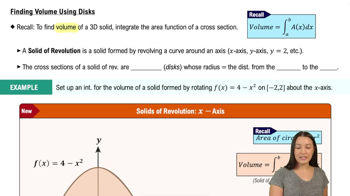
Two methods The region R in the first quadrant bounded by the parabola y = 4-x² and coordinate axes is revolved about the y-axis to produce a dome-shaped solid. Find the volume of the solid in the following ways:
a. Apply the disk method and integrate with respect to y.
27–33. Multiple regions The regions R₁,R₂, and R₃ (see figure) are formed by the graphs of y = 2√x,y = 3−x,and x=3.
Use the shell method to find an integral, or sum of integrals, that equals the volume of the solid obtained by revolving region R₃ about the line x=3. Do not evaluate the integral.