Ch. 6 - Applications of Integration
Briggs - Calculus: Early Transcendentals 3rd Edition
Briggs3rd EditionCalculus: Early TranscendentalsISBN: 9780136847243Not the one you use?Change textbook
Chapter 6, Problem 6.R.47

43–55. Volumes of solids Choose the general slicing method, the disk/washer method, or the shell method to answer the following questions.


The region bounded by the curve y = 1+√x, the curve y = 1−√x, and the line x=1 is revolved about the y-axis. Find the volume of the resulting solid by (a) integrating with respect to x and (b) integrating with respect to y. Be sure your answers agree.

Verified step by step guidance
1
First, understand the region bounded by the curves: \(y = 1 + \sqrt{x}\), \(y = 1 - \sqrt{x}\), and the vertical line \(x = 1\). Sketching the region helps visualize the area to be revolved around the y-axis.
For part (a), integrating with respect to \(x\): Since the solid is formed by revolving around the y-axis, use the shell method. The shell radius is the distance from the y-axis, which is \(x\), and the shell height is the difference between the upper and lower curves, \(\left( (1 + \sqrt{x}) - (1 - \sqrt{x}) \right) = 2\sqrt{x}\). The volume integral is then \(V = \int_0^1 2\pi \cdot (\text{radius}) \cdot (\text{height}) \, dx\).
Set up the integral for part (a): \(V = \int_0^1 2\pi x \cdot 2\sqrt{x} \, dx = \int_0^1 4\pi x \sqrt{x} \, dx\). Simplify the integrand before integrating.
For part (b), integrating with respect to \(y\): Express \(x\) in terms of \(y\) from the given curves. From \(y = 1 + \sqrt{x}\), solve for \(x\) to get \(x = (y - 1)^2\). Similarly, from \(y = 1 - \sqrt{x}\), \(x = (1 - y)^2\). The region in \(y\) goes from \(y = 0\) to \(y = 2\) (since at \(x=1\), \(y\) ranges between \(1 - 1 = 0\) and \(1 + 1 = 2\)).
Use the disk/washer method for part (b): The radius of the washers is the horizontal distance from the y-axis to the outer curve minus the inner curve, which is \(R(y) = 1\) (since \(x=1\) is the boundary) and \(r(y) = (1 - y)^2\) or \((y - 1)^2\) depending on the side. Set up the volume integral as \(V = \int_0^2 \pi \left( R(y)^2 - r(y)^2 \right) dy\). Evaluate this integral to find the volume.

Verified video answer for a similar problem:

This video solution was recommended by our tutors as helpful for the problem above.
Video duration:
5m
Was this helpful?

Key Concepts

Here are the essential concepts you must grasp in order to answer the question correctly.

Volume of Solids of Revolution

This concept involves finding the volume of a 3D solid formed by rotating a 2D region around an axis. The volume can be computed using integral calculus by summing infinitesimal cross-sectional areas perpendicular to the axis of rotation.
Recommended video:
04:48
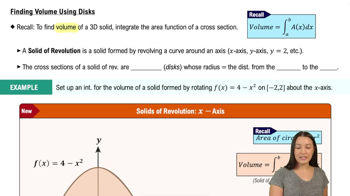
Finding Volume Using Disks

Disk/Washer and Shell Methods

These are two common techniques for finding volumes of solids of revolution. The disk/washer method slices perpendicular to the axis, using circular cross-sections, while the shell method uses cylindrical shells by slicing parallel to the axis. Choosing the appropriate method simplifies integration.
Recommended video:
06:30
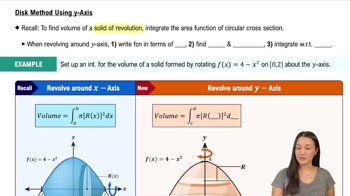
Disk Method Using y-Axis

Integration with Respect to Different Variables

Integrating with respect to x or y changes the approach to setting up the integral, affecting limits and expressions for radii or heights. Understanding how to express the region and boundaries in terms of each variable is essential to ensure consistent volume calculations.
Recommended video:
04:27
Substitution With an Extra Variable
Related Practice
Textbook Question

Force on a dam Find the total force on the face of a semicircular dam with a radius of 20 m when its reservoir is full of water. The diameter of the semicircle is the top of the dam.

63
views

Textbook Question

Two methods The region R in the first quadrant bounded by the parabola y = 4-x² and coordinate axes is revolved about the y-axis to produce a dome-shaped solid. Find the volume of the solid in the following ways:


a. Apply the disk method and integrate with respect to y.

97
views
Textbook Question

27–33. Multiple regions The regions R₁,R₂, and R₃ (see figure) are formed by the graphs of y = 2√x,y = 3−x,and x=3.


Use the shell method to find an integral, or sum of integrals, that equals the volume of the solid obtained by revolving region R₃ about the line x=3. Do not evaluate the integral.

48
views
Textbook Question

43–55. Volumes of solids Choose the general slicing method, the disk/washer method, or the shell method to answer the following questions.


The region bounded by the graphs of y = 2x,y = 6−x, and y = 0 is revolved about the line y = −2 and the line x = −2. Find the volumes of the resulting solids. Which one is greater?

79
views
Textbook Question

58–61. Arc length Find the length of the following curves.

y = x³/6 + 1/2x on [1,2]

77
views
Textbook Question

Lifting problem A 4-kg mass is attached to the bottom of a 5-m, 15-kg chain. If the chain hangs from a platform, how much work is required to pull the chain and the mass onto the platform?

68
views