

Ch. 6 - Applications of Integration
Briggs - Calculus: Early Transcendentals 3rd Edition
Briggs3rd EditionCalculus: Early TranscendentalsISBN: 9780136847243Not the one you use?Change textbook
Chapter 6, Problem 6.R.60

58–61. Arc length Find the length of the following curves.
y = x³/6 + 1/2x on [1,2]

Verified step by step guidance
1
Identify the function given: \(y = \frac{x^3}{6} + \frac{1}{2}x\) and the interval \([1, 2]\) over which we want to find the arc length.
Recall the formula for the arc length \(L\) of a curve \(y = f(x)\) from \(x = a\) to \(x = b\): \(L = \int_a^b \sqrt{1 + \left(\frac{dy}{dx}\right)^2} \, dx\).
Compute the derivative \(\frac{dy}{dx}\) of the function: \(\frac{dy}{dx} = \frac{d}{dx} \left( \frac{x^3}{6} + \frac{1}{2}x \right)\).
Square the derivative to get \(\left(\frac{dy}{dx}\right)^2\) and then add 1 inside the square root: \(1 + \left(\frac{dy}{dx}\right)^2\).
Set up the integral for the arc length: \(L = \int_1^2 \sqrt{1 + \left(\frac{dy}{dx}\right)^2} \, dx\) and prepare to evaluate or simplify this integral.

Verified video answer for a similar problem:

This video solution was recommended by our tutors as helpful for the problem above.
Video duration:
10m
Was this helpful?

Key Concepts

Here are the essential concepts you must grasp in order to answer the question correctly.

Arc Length Formula

The arc length of a curve y = f(x) from x = a to x = b is found using the integral formula L = ∫_a^b √(1 + (dy/dx)²) dx. This formula sums the lengths of infinitesimal line segments along the curve, providing the total distance traveled along it.
Recommended video:
06:29
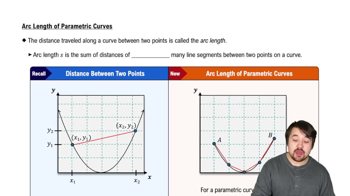
Arc Length of Parametric Curves

Derivative of the Function

To apply the arc length formula, you need the derivative dy/dx of the function y = x³/6 + 1/2 x. The derivative represents the slope of the curve at any point and is essential for calculating the integrand √(1 + (dy/dx)²).
Recommended video:
06:30
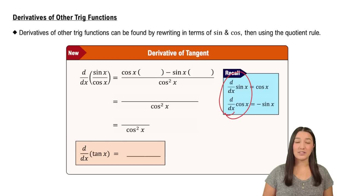
Derivatives of Other Trig Functions

Definite Integration

After finding the integrand, you evaluate the definite integral from x = 1 to x = 2. This process involves integrating the function √(1 + (dy/dx)²) over the interval to compute the exact length of the curve segment.
Recommended video:
05:43
Definition of the Definite Integral
Related Practice
Textbook Question

43–55. Volumes of solids Choose the general slicing method, the disk/washer method, or the shell method to answer the following questions.


The region bounded by the curve y = 1+√x, the curve y = 1−√x, and the line x=1 is revolved about the y-axis. Find the volume of the resulting solid by (a) integrating with respect to x and (b) integrating with respect to y. Be sure your answers agree.

39
views
Textbook Question

Force on a dam Find the total force on the face of a semicircular dam with a radius of 20 m when its reservoir is full of water. The diameter of the semicircle is the top of the dam.

63
views
Textbook Question

Two methods The region R in the first quadrant bounded by the parabola y = 4-x² and coordinate axes is revolved about the y-axis to produce a dome-shaped solid. Find the volume of the solid in the following ways:


a. Apply the disk method and integrate with respect to y.

97
views
Textbook Question

Pumping water A water tank has the shape of a box that is 2 m wide, 4 m long, and 6 m high.


b. If the water in the tank is 2 m deep, how much work is required to pump the water to a level of 1 m above the top of the tank?

47
views
Textbook Question

43–55. Volumes of solids Choose the general slicing method, the disk/washer method, or the shell method to answer the following questions.


The region bounded by the graphs of y = 2x,y = 6−x, and y = 0 is revolved about the line y = −2 and the line x = −2. Find the volumes of the resulting solids. Which one is greater?

79
views
Textbook Question

Lifting problem A 4-kg mass is attached to the bottom of a 5-m, 15-kg chain. If the chain hangs from a platform, how much work is required to pull the chain and the mass onto the platform?

68
views