
Ch. 6 - Applications of Integration
Briggs - Calculus: Early Transcendentals 3rd Edition
Briggs3rd EditionCalculus: Early TranscendentalsISBN: 9780136847243Not the one you use?Change textbook
Chapter 6, Problem 6.4.1

Assume f and g are continuous, with f(x) ≥ g(x) ≥ 0 on [a, b]. The region bounded by the graphs of f and g and the lines x=a and x=b is revolved about the y-axis. Write the integral given by the shell method that equals the volume of the resulting solid.

Verified step by step guidance
1
Identify the region bounded by the curves y = f(x) and y = g(x), and the vertical lines x = a and x = b, where f(x) ≥ g(x) ≥ 0 on the interval [a, b].
Since the solid is formed by revolving this region about the y-axis, use the shell method, which involves cylindrical shells with radius equal to the distance from the y-axis, height equal to the difference between the functions, and thickness dx.
Express the radius of a typical shell as the x-value itself, since the distance from the y-axis to the shell at position x is simply x.
Express the height of the shell as the vertical distance between the two curves, which is f(x) - g(x).
Set up the integral for the volume using the shell method formula: \(V = \int_{a}^{b} 2\pi \times (\text{radius}) \times (\text{height}) \, dx = \int_{a}^{b} 2\pi x (f(x) - g(x)) \, dx\).

Verified video answer for a similar problem:

This video solution was recommended by our tutors as helpful for the problem above.
Video duration:
3m
Was this helpful?

Key Concepts

Here are the essential concepts you must grasp in order to answer the question correctly.

Shell Method for Volume

The shell method calculates the volume of a solid of revolution by integrating cylindrical shells. When revolving around the y-axis, each shell's radius is the x-value, height is the difference between the functions, and thickness is dx. The volume is found by integrating 2π(radius)(height) dx over [a, b].
Recommended video:
04:48
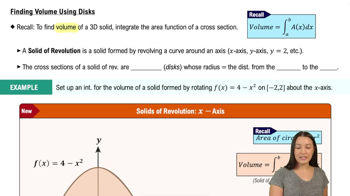
Finding Volume Using Disks

Continuous Functions and Inequalities

Continuity of f and g on [a, b] ensures no gaps or jumps, allowing proper integration. The inequality f(x) ≥ g(x) ≥ 0 guarantees the region between the curves is well-defined and non-negative, which is essential for correctly determining the height of each shell.
Recommended video:
05:34
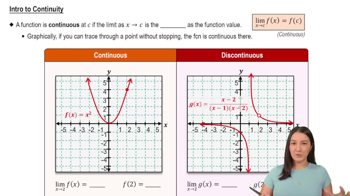
Intro to Continuity

Setting up the Integral Limits and Integrand

The integral limits correspond to the interval [a, b] on the x-axis. The integrand combines the shell radius (x) and height (f(x) - g(x)) multiplied by 2π. Correctly identifying these components is crucial to formulating the integral that represents the volume.
Recommended video:
11:11
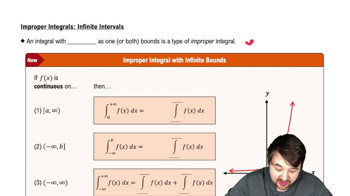
Improper Integrals: Infinite Intervals
Related Practice
Textbook Question

Leaky Bucket A 1-kg bucket resting on the ground contains 3 kg of water. How much work is required to raise the bucket vertically a distance of 10 m if water leaks out of the bucket at a constant rate of 1/5 kg/m? Assume the weight of the rope used to raise the bucket is negligible. (Hint: Use the definition of work, W = ∫a^bF(y) dy, where F is the variable force required to lift an object along a vertical line from y=a to y=b.)

72
views
Textbook Question

For the following regions R, determine which is greater—the volume of the solid generated when R is revolved about the x-axis or about the y-axis.


R is bounded by y=1−x^3, the x-axis, and the y-axis.

100
views
Textbook Question

Let R be the region bounded by the following curves. Find the volume of the solid generated when R is revolved about the given line.


x=2−secy,x=2,y=π/3, and y=0; about x=2

163
views
Textbook Question

39–44. Shell method about other lines Let R be the region bounded by y = x²,x=1, and y=0. Use the shell method to find the volume of the solid generated when R is revolved about the following lines.


x =2

48
views
Textbook Question

13–20. Mass of one-dimensional objects Find the mass of the following thin bars with the given density function.


ρ(x) = {1 if 0≤x≤2 {2 if 2<x≤3

37
views
Textbook Question

Let f(x) = {x   if 0≤x≤2

      2x−2  if 2<x≤5

      −2x+18 if 5<x≤6. 


Find the volume of the solid formed when the region bounded by the graph of f, the x-axis, and the line x=6 is revolved about the x-axis.

49
views