
Ch. 6 - Applications of Integration
Briggs - Calculus: Early Transcendentals 3rd Edition
Briggs3rd EditionCalculus: Early TranscendentalsISBN: 9780136847243Not the one you use?Change textbook
Chapter 6, Problem 6.7.34

Leaky Bucket A 1-kg bucket resting on the ground contains 3 kg of water. How much work is required to raise the bucket vertically a distance of 10 m if water leaks out of the bucket at a constant rate of 1/5 kg/m? Assume the weight of the rope used to raise the bucket is negligible. (Hint: Use the definition of work, W = ∫a^bF(y) dy, where F is the variable force required to lift an object along a vertical line from y=a to y=b.)

Verified step by step guidance
1
Identify the variable force function F(y) that represents the weight of the bucket plus the remaining water at height y. Since water leaks at a constant rate of \( \frac{1}{5} \) kg per meter, the mass of water at height y is \( m(y) = 3 - \frac{1}{5}y \) kg. The total mass being lifted at height y is then \( 1 + m(y) = 1 + 3 - \frac{1}{5}y = 4 - \frac{1}{5}y \) kg.
Express the force F(y) as the weight of the bucket plus water at height y. Since weight is mass times gravitational acceleration \( g \), we have \( F(y) = (4 - \frac{1}{5}y) \times 9.8 \) newtons.
Set up the integral for work using the formula \( W = \int_a^b F(y) \, dy \), where \( a = 0 \) m (starting height) and \( b = 10 \) m (final height). So, \( W = \int_0^{10} (4 - \frac{1}{5}y) \times 9.8 \, dy \).
Simplify the integral by factoring out constants and rewriting the integrand: \( W = 9.8 \int_0^{10} \left(4 - \frac{1}{5}y\right) dy \).
Evaluate the integral by integrating term-by-term: \( \int_0^{10} 4 \, dy \) and \( \int_0^{10} \frac{1}{5}y \, dy \), then multiply the result by 9.8 to find the total work done in lifting the bucket and leaking water.

Verified video answer for a similar problem:

This video solution was recommended by our tutors as helpful for the problem above.
Video duration:
5m
Was this helpful?

Key Concepts

Here are the essential concepts you must grasp in order to answer the question correctly.

Work as an Integral of Variable Force

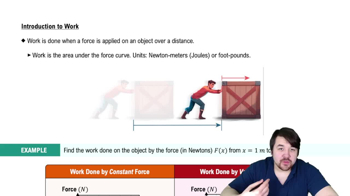
Work done by a variable force is calculated using the integral W = ∫ F(y) dy, where F(y) changes with position y. This approach sums infinitesimal amounts of work over the distance, accounting for forces that vary as the object moves.
Recommended video:
06:22
Introduction To Work

Force Due to Weight and Variable Mass

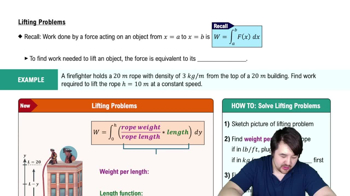
The force required to lift an object vertically equals its weight, which depends on mass and gravity (F = mg). When mass changes with height, as water leaks out, the force becomes a function of position, requiring careful modeling of mass variation.
Recommended video:
09:32
Lifting Problems

Modeling Mass Loss as a Function of Height

When water leaks at a constant rate per meter, the mass decreases linearly with height. Expressing mass as a function of vertical position allows calculation of the changing force and integration over the lifting distance.
Recommended video:
09:32
Lifting Problems
Related Practice
Textbook Question

Assume f and g are continuous, with f(x) ≥ g(x) ≥ 0 on [a, b]. The region bounded by the graphs of f and g and the lines x=a and x=b is revolved about the y-axis. Write the integral given by the shell method that equals the volume of the resulting solid.

46
views
Textbook Question

9–20. Arc length calculations Find the arc length of the following curves on the given interval.

y = −8x−3 on [−2, 6] (Use calculus.)

38
views
Textbook Question

9–12. Consider the cylindrical tank in Example 4 that has a height of 10 m and a radius of 5 m. Recall that if the tank is full of water, then ∫₀¹⁰ 25 π ρg(15−y) dy equals the work required to pump all the water out of the tank, through an outflow pipe that is 15 m above the bottom of the tank. Revise this work integral for the following scenarios. (Do not evaluate the integrals.)


The work required to empty the top half of the tank

91
views
Textbook Question

For the following regions R, determine which is greater—the volume of the solid generated when R is revolved about the x-axis or about the y-axis.


R is bounded by y=1−x^3, the x-axis, and the y-axis.

100
views
Textbook Question

Let R be the region bounded by the following curves. Find the volume of the solid generated when R is revolved about the given line.


x=2−secy,x=2,y=π/3, and y=0; about x=2

163
views
Textbook Question

Let f(x) = {x   if 0≤x≤2

      2x−2  if 2<x≤5

      −2x+18 if 5<x≤6. 


Find the volume of the solid formed when the region bounded by the graph of f, the x-axis, and the line x=6 is revolved about the x-axis.

49
views