
Ch. 6 - Applications of Integration
Briggs - Calculus: Early Transcendentals 3rd Edition
Briggs3rd EditionCalculus: Early TranscendentalsISBN: 9780136847243Not the one you use?Change textbook
Chapter 6, Problem 6.7.24b

Compressing and stretching a spring Suppose a force of 15 N is required to stretch and hold a spring 0.25 m from its equilibrium position.
b. How much work is required to compress the spring 0.2 m from its equilibrium position?

Verified step by step guidance
1
Identify the spring constant \( k \) using Hooke's Law, which states that the force \( F \) required to stretch or compress a spring is proportional to the displacement \( x \) from its equilibrium position: \( F = kx \). Given \( F = 15 \) N and \( x = 0.25 \) m, solve for \( k \) by rearranging the formula to \( k = \frac{F}{x} \).
Recall that the work \( W \) done in compressing or stretching a spring from the equilibrium position to a displacement \( x \) is given by the integral of the force over the distance, which simplifies to the formula \( W = \frac{1}{2}kx^2 \).
Substitute the value of \( k \) found in step 1 and the compression distance \( x = 0.2 \) m into the work formula \( W = \frac{1}{2}kx^2 \).
Set up the expression for the work done: \( W = \frac{1}{2} \times k \times (0.2)^2 \).
Evaluate the expression to find the amount of work required to compress the spring 0.2 m from its equilibrium position (do not calculate the final numeric value here, just set up the expression).

Verified video answer for a similar problem:

This video solution was recommended by our tutors as helpful for the problem above.
Video duration:
2m
Was this helpful?

Key Concepts

Here are the essential concepts you must grasp in order to answer the question correctly.

Hooke's Law

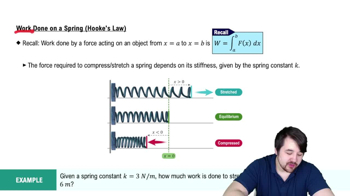
Hooke's Law states that the force needed to stretch or compress a spring is proportional to the displacement from its equilibrium position, expressed as F = kx, where k is the spring constant and x is the displacement. This law helps determine the spring constant from given force and displacement values.
Recommended video:
05:40
Work Done On A Spring (Hooke's Law)

Spring Constant Calculation

The spring constant k measures the stiffness of a spring and is calculated by dividing the applied force by the displacement (k = F/x). Knowing k allows us to analyze forces and work involved in stretching or compressing the spring at different distances.
Recommended video:
05:40
Work Done On A Spring (Hooke's Law)

Work Done on a Spring

The work done to compress or stretch a spring is the energy stored in it, calculated by the integral of force over displacement. For a spring, work W = (1/2)kx², representing the area under the force-displacement curve, which is essential for finding the energy required to compress the spring.
Recommended video:
05:40
Work Done On A Spring (Hooke's Law)
Related Practice
Textbook Question

6–8. Let R be the region bounded by the curves y = 2−√x,y=2, and x=4 in the first quadrant.

Suppose the shell method is used to determine the volume of the solid generated by revolving R about the line x=4.


b. What is the height of a cylindrical shell at a point x in [0, 4]?

88
views
Textbook Question

For the given regions R₁ and R₂, complete the following steps.


b. Find the area of region R₂ using geometry and the answer to part (a).


R₁is the region in the first quadrant bounded by the line x=1 and the curve y=6x(2−x^2)^2; R₂ is the region in the first quadrant bounded the curve y=6x(2−x^2)^2and the line y=6x.

40
views
Textbook Question

Displacement and distance from velocity Consider the velocity function shown below of an object moving along a line. Assume time is measured in seconds and distance is measured in meters. The areas of four regions bounded by the velocity curve and the t-axis are also given.

b. What is the displacement of the object over the interval [2, 6]? 

60
views
Textbook Question

55–58. Marginal cost Consider the following marginal cost functions.


b. Find the additional cost incurred in dollars when production is increased from 500 units to 550 units.


C′(x)=200−0.05x

57
views
Textbook Question

13–16. Displacement from velocity Consider an object moving along a line with the given velocity v. Assume time t is measured in seconds and velocities have units of m/s.


b. Find the displacement over the given interval. 


v(t) = 50e^−2t on [0, 4]

30
views
Textbook Question

Cycling distance A cyclist rides down a long straight road with a velocity (in m/min) given by v(t) = 400−20t, for 0≤t≤10, where t is measured in minutes.


b. How far does the cyclist travel in the first 10 min?

49
views