

Ch. 6 - Applications of Integration
Briggs - Calculus: Early Transcendentals 3rd Edition
Briggs3rd EditionCalculus: Early TranscendentalsISBN: 9780136847243Not the one you use?Change textbook
Chapter 6, Problem 6.1.24b

Cycling distance A cyclist rides down a long straight road with a velocity (in m/min) given by v(t) = 400−20t, for 0≤t≤10, where t is measured in minutes.


b. How far does the cyclist travel in the first 10 min?

Verified step by step guidance
1
Identify the velocity function given: \(v(t) = 400 - 20t\), where \(t\) is in minutes and \(v(t)\) is in meters per minute.
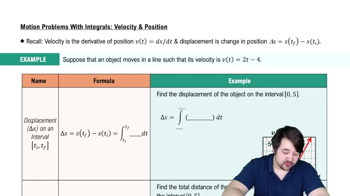
Recall that the distance traveled over a time interval can be found by integrating the velocity function over that interval. So, the distance \(D\) traveled from \(t=0\) to \(t=10\) is given by the definite integral \(D = \int_0^{10} v(t) \, dt\).
Set up the integral explicitly: \(D = \int_0^{10} (400 - 20t) \, dt\).
Integrate the function term-by-term: the integral of \(400\) with respect to \(t\) is \$400t\(, and the integral of \)-20t\( with respect to \)t\( is \)-10t^2$.
Evaluate the resulting expression \(400t - 10t^2\) at the upper limit \(t=10\) and subtract the value at the lower limit \(t=0\) to find the total distance traveled.

Verified video answer for a similar problem:

This video solution was recommended by our tutors as helpful for the problem above.
Video duration:
2m
Was this helpful?

Key Concepts

Here are the essential concepts you must grasp in order to answer the question correctly.

Velocity as a Function of Time

Velocity describes the rate of change of position with respect to time. In this problem, velocity is given as a function v(t) = 400 - 20t, which means the cyclist's speed changes linearly over time from 400 m/min to 200 m/min during the first 10 minutes.
Recommended video:
10:17
Using The Velocity Function

Definite Integral for Displacement

The total distance traveled over a time interval can be found by integrating the velocity function over that interval. The definite integral of v(t) from t=0 to t=10 gives the net displacement, representing how far the cyclist has traveled in those 10 minutes.
Recommended video:
05:43
Definition of the Definite Integral

Limits of Integration and Time Interval

The problem specifies the time interval 0 ≤ t ≤ 10 minutes. Setting the correct limits of integration ensures the calculation covers the entire duration of interest, capturing the cyclist's motion from start to 10 minutes exactly.
Recommended video:
11:11
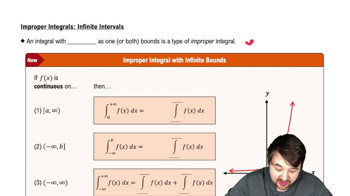
Improper Integrals: Infinite Intervals
Related Practice
Textbook Question

6–8. Let R be the region bounded by the curves y = 2−√x,y=2, and x=4 in the first quadrant.

Suppose the shell method is used to determine the volume of the solid generated by revolving R about the line x=4.


b. What is the height of a cylindrical shell at a point x in [0, 4]?

88
views
Textbook Question

For the given regions R₁ and R₂, complete the following steps.


b. Find the area of region R₂ using geometry and the answer to part (a).


R₁is the region in the first quadrant bounded by the line x=1 and the curve y=6x(2−x^2)^2; R₂ is the region in the first quadrant bounded the curve y=6x(2−x^2)^2and the line y=6x.

40
views
Textbook Question

Variable gravity At Earth’s surface, the acceleration due to gravity is approximately g=9.8 m/s² (with local variations). However, the acceleration decreases with distance from the surface according to Newton’s law of gravitation. At a distance of y meters from Earth’s surface, the acceleration is given by a(y) = - g / (1+y/R)², where R=6.4×10⁶ m is the radius of Earth.


b. Use the Chain Rule to show that dv/dt = 1/2 d/dy(v²).

69
views
Textbook Question

40–43. Population growth


Starting with an initial value of P(0)=55, the population of a prairie dog community grows at a rate of P′(t)=20−t/5 (prairie dogs/month), for 0≤t≤200, where t is measured in months.


b. Find the population P(t), for 0≤t≤200.

22
views
Textbook Question

Compressing and stretching a spring Suppose a force of 15 N is required to stretch and hold a spring 0.25 m from its equilibrium position.

b. How much work is required to compress the spring 0.2 m from its equilibrium position?

62
views
Textbook Question

55–58. Marginal cost Consider the following marginal cost functions.


b. Find the additional cost incurred in dollars when production is increased from 500 units to 550 units.


C′(x) = 300+10x−0.01x²

50
views