
Textbook Question
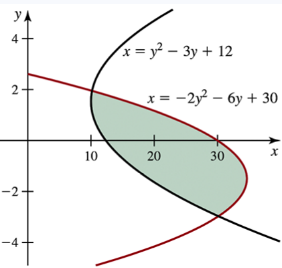
Set up a sum of two integrals that equals the area of the shaded region bounded by the graphs of the functions f and g on [a, c] (see figure). Assume the curves intersect at x=b.
71
views

 Verified step by step guidance

 05:43
05:43
 04:50
04:50 05:23
05:23Set up a sum of two integrals that equals the area of the shaded region bounded by the graphs of the functions f and g on [a, c] (see figure). Assume the curves intersect at x=b.
Assume f is a nonnegative function with a continuous first derivative on [a, b]. The curve y=f(x) on [a, b] is revolved about the x-axis. Explain how to find the area of the surface that is generated.
13–20. Mass of one-dimensional objects Find the mass of the following thin bars with the given density function.
ρ(x) = {x² if 0≤x≤1 {x(2-x) if 1<x≤2
13–20. Mass of one-dimensional objects Find the mass of the following thin bars with the given density function.
ρ(x)=1+sin x, for 0≤x≤π
Work from force How much work is required to move an object from x=0 to x=3 (measured in meters) in the presence of a force (in N) given by F(x)=2x acting along the x-axis?
Drinking juice A glass has circular cross sections that taper (linearly) from a radius of 5 cm at the top of the glass to a radius of 4 cm at the bottom. The glass is 15 cm high and full of orange juice. How much work is required to drink all the juice through a straw if your mouth is 5 cm above the top of the glass? Assume the density of orange juice equals the density of water.