
Textbook Question
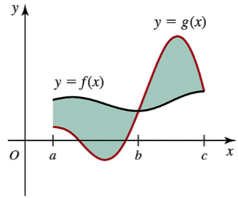
Determine the area of the shaded region in the following figures.
112
views

 Verified step by step guidance

 05:43
05:43
 05:23
05:23 06:18
06:18Determine the area of the shaded region in the following figures.
9–20. Arc length calculations Find the arc length of the following curves on the given interval.
y = (x²+2)^3/2 / 3 on [0, 1]
Assume f is a nonnegative function with a continuous first derivative on [a, b]. The curve y=f(x) on [a, b] is revolved about the x-axis. Explain how to find the area of the surface that is generated.
53–62. Choose your method Let R be the region bounded by the following curves. Use the method of your choice to find the volume of the solid generated when R is revolved about the given axis.
y = x³,y=0, and x=2; about the x-axis
For the following regions R, determine which is greater—the volume of the solid generated when R is revolved about the x-axis or about the y-axis.
R is bounded by y=x^2 and y=√8x.
13–20. Mass of one-dimensional objects Find the mass of the following thin bars with the given density function.
ρ(x)=1+sin x, for 0≤x≤π