
Ch. 6 - Applications of Integration
Briggs - Calculus: Early Transcendentals 3rd Edition
Briggs3rd EditionCalculus: Early TranscendentalsISBN: 9780136847243Not the one you use?Change textbook
Chapter 6, Problem 6.7.39b

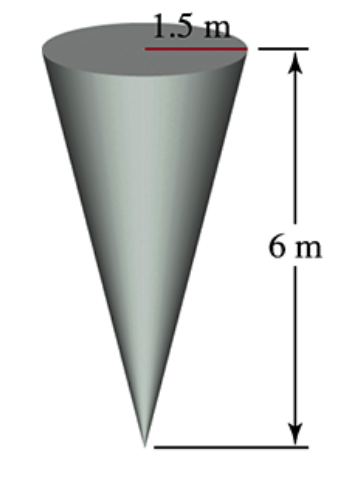
Emptying a conical tank A water tank is shaped like an inverted cone with height 6 m and base radius 1.5 m (see figure).
b. Is it true that it takes half as much work to pump the water out of the tank when it is filled to half its depth as when it is full? Explain.
<IMAGE>

Verified step by step guidance
1
Understand that the work required to pump water out of the tank depends on the volume of water and the distance each water element must be lifted.
Set up the coordinate system with the vertex of the cone at the bottom (y=0) and the top of the tank at y=6 m. The radius of the water surface at height y is proportional to y, given by the similarity ratio \(r(y) = \frac{1.5}{6} y = 0.25 y\).
Express the volume of a thin horizontal slice of water at height y with thickness \(dy\) as \(dV = \pi r(y)^2 dy = \pi (0.25 y)^2 dy = \pi \times 0.0625 y^2 dy\).
The work to lift this slice to the top (y=6) is \(dW = \rho g dV (6 - y)\), where \(\rho\) is the density of water and \(g\) is acceleration due to gravity. Integrate \(dW\) from \(y=0\) to \(y=6\) to find the total work when the tank is full.
Repeat the integration from \(y=0\) to \(y=3\) (half the depth) to find the work when the tank is half full. Compare the two results to determine if the work for half the depth is half the work for the full tank.

Verified video answer for a similar problem:

This video solution was recommended by our tutors as helpful for the problem above.
Video duration:
8m
Was this helpful?

Key Concepts

Here are the essential concepts you must grasp in order to answer the question correctly.

Work Done by Pumping Water

Work in this context is the energy required to move water against gravity from the tank to the top. It is calculated by integrating the force (weight of water) times the distance each water layer is lifted. Since the force depends on volume and height, work is not simply proportional to volume.
Recommended video:
05:40
Work Done On A Spring (Hooke's Law)

Volume of Water in a Conical Tank

The volume of water in a cone depends on the height of the water level. Because the radius changes linearly with height, the volume varies with the cube of the height. This nonlinear relationship affects how much water is present at half the depth compared to full.
Recommended video:
5:33
Parabolas as Conic Sections

Relationship Between Height and Radius in a Cone

In a cone, the radius at any height is proportional to that height due to similar triangles. For this tank, radius r = (1.5/6) * height. This relationship is essential to express volume and work integrals in terms of height, enabling calculation of work done for different water depths.
Recommended video:
05:23
Finding Area Between Curves on a Given Interval
Related Practice
Textbook Question

Two runners At noon (t=0), Alicia starts running along a long straight road at 4 mi/hr. Her velocity decreases according to the function v(t) = 4 / t + 1 for t≥0. At noon, Boris also starts running along the same road with a 2-mi head start on Alicia; his velocity is given by u(t) = 2 / t + 1, for t≥0. Assume t is measured in hours.


b. When, if ever, does Alicia overtake Boris?

44
views
Textbook Question

Filling a tank A 2000-liter cistern is empty when water begins flowing into it (at t=0 at a rate (in L/min) given by Q′(t) = 3√t, where t is measured in minutes.


b. Find the function that gives the amount of water in the tank at any time t≥0.

45
views
Textbook Question

Probe speed A data collection probe is dropped from a stationary balloon, and it falls with a velocity (in m/s) given by v(t) = 9.8t, neglecting air resistance. After 10 s, a chute deploys and the probe immediately slows to a constant speed of 10 m/s, which it maintains until it enters the ocean.


b. How far does the probe fall in the first 30 s after it is released?

43
views
Textbook Question

Volume of a sphere Let R be the region bounded by the upper half of the circle x²+y² = r² and the x-axis. A sphere of radius r is obtained by revolving R about the x-axis.


b. Repeat part (a) using the disk method.

79
views
Textbook Question

A right circular cylinder with height R and radius R has a volume of VC=πR^3 (height = radius).


b. Find the volume of the hemisphere that is inscribed in the cylinder with the same base as the cylinder. Express the volume in terms of VC.

61
views
Textbook Question

A torus (doughnut) A torus is formed when a circle of radius 2 centered at (3, 0) is revolved about the y-axis.


b. Use the washer method to write an integral for the volume of the torus.

63
views