

Ch. 6 - Applications of Integration
Briggs - Calculus: Early Transcendentals 3rd Edition
Briggs3rd EditionCalculus: Early TranscendentalsISBN: 9780136847243Not the one you use?Change textbook
Chapter 6, Problem 6.1.28b

Probe speed A data collection probe is dropped from a stationary balloon, and it falls with a velocity (in m/s) given by v(t) = 9.8t, neglecting air resistance. After 10 s, a chute deploys and the probe immediately slows to a constant speed of 10 m/s, which it maintains until it enters the ocean.


b. How far does the probe fall in the first 30 s after it is released?

Verified step by step guidance
1
Identify the velocity function for the probe in two time intervals: from 0 to 10 seconds, the velocity is given by \(v(t) = 9.8t\), and from 10 to 30 seconds, the velocity is constant at \(v(t) = 10\) m/s.
To find the distance fallen in the first 10 seconds, integrate the velocity function \(v(t) = 9.8t\) with respect to time over the interval \([0, 10]\). This gives the displacement during free fall before the chute deploys: \(\int_0^{10} 9.8t \, dt\).
To find the distance fallen from 10 to 30 seconds, use the constant velocity \(v(t) = 10\) m/s. Since velocity is constant, the distance is velocity multiplied by time: \(10 \times (30 - 10)\).
Add the two distances obtained from the two intervals to get the total distance fallen in the first 30 seconds: \(\text{distance}_1 + \text{distance}_2\).
Express the total distance as the sum of the integral result and the constant velocity distance, which represents the full distance the probe falls in the first 30 seconds after release.

Verified video answer for a similar problem:

This video solution was recommended by our tutors as helpful for the problem above.
Video duration:
3m
Was this helpful?

Key Concepts

Here are the essential concepts you must grasp in order to answer the question correctly.

Velocity and Displacement Relationship

Velocity is the rate of change of displacement with respect to time. To find the distance fallen, you integrate the velocity function over the given time interval. This process accumulates the total displacement from the velocity data.
Recommended video:
06:29
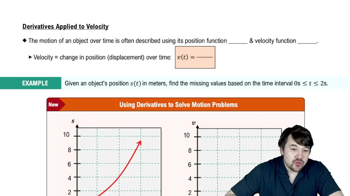
Derivatives Applied To Velocity

Piecewise Functions in Motion

When an object’s velocity changes behavior at a certain time, its motion is described by a piecewise function. Here, velocity changes at 10 seconds, requiring separate integration for each time segment to find total displacement.
Recommended video:
05:36
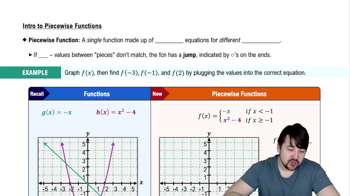
Piecewise Functions

Definite Integration for Distance Calculation

Definite integration of velocity over a time interval gives the exact displacement during that period. For constant velocity, displacement is velocity multiplied by time; for variable velocity, integration is necessary.
Recommended video:
05:43
Definition of the Definite Integral
Related Practice
Textbook Question

In the design of solid objects (both artificial and natural), the ratio of the surface area to the volume of the object is important. Animals typically generate heat at a rate proportional to their volume and lose heat at a rate proportional to their surface area. Therefore, animals with a low SAV ratio tend to retain heat, whereas animals with a high SAV ratio (such as children and hummingbirds) lose heat relatively quickly.


b. What is the SAV ratio of a ball with radius a? 

42
views
Textbook Question

Use the region R that is bounded by the graphs of y=1+√x,x=4, and y=1 complete the exercises.


Region R is revolved about the y-axis to form a solid of revolution whose cross sections are washers.


b. What is the inner radius of a cross section of the solid at a point y in [1, 3]?

51
views
Textbook Question

Emptying a conical tank A water tank is shaped like an inverted cone with height 6 m and base radius 1.5 m (see figure).

b. Is it true that it takes half as much work to pump the water out of the tank when it is filled to half its depth as when it is full? Explain.

101
views
Textbook Question

Consider the following curves on the given intervals.  


b. Use a calculator or software to approximate the surface area.


y=tan x , for 0≤x≤π/4; about the x-axis 

73
views
Textbook Question

Volume of a sphere Let R be the region bounded by the upper half of the circle x²+y² = r² and the x-axis. A sphere of radius r is obtained by revolving R about the x-axis.


b. Repeat part (a) using the disk method.

79
views
Textbook Question

A right circular cylinder with height R and radius R has a volume of VC=πR^3 (height = radius).


b. Find the volume of the hemisphere that is inscribed in the cylinder with the same base as the cylinder. Express the volume in terms of VC.

61
views