
Ch. 6 - Applications of Integration
Briggs - Calculus: Early Transcendentals 3rd Edition
Briggs3rd EditionCalculus: Early TranscendentalsISBN: 9780136847243Not the one you use?Change textbook
Chapter 6, Problem 6.5.33c

Explain why or why not Determine whether the following statements are true and give an explanation or counterexample.


Arc length may be negative if f(x) < 0 on part of the interval in question.

Verified step by step guidance
1
Recall the definition of arc length for a function \(f(x)\) on an interval \([a,b]\): the arc length \(L\) is given by the integral \(L = \int_a^b \sqrt{1 + (f'(x))^2} \, dx\).
Note that the integrand \(\sqrt{1 + (f'(x))^2}\) is always non-negative because it is a square root of a sum of squares, which cannot be negative.
Since the integrand is non-negative and the limits of integration satisfy \(a < b\), the value of the integral (arc length) must be non-negative.
The value of \(f(x)\) itself (whether positive or negative) does not affect the sign of the arc length because the formula depends on \(f'(x)\), the derivative, and the square root expression, not directly on \(f(x)\).
Therefore, arc length cannot be negative even if \(f(x) < 0\) on part of the interval; the statement is false.

Verified video answer for a similar problem:

This video solution was recommended by our tutors as helpful for the problem above.
Video duration:
2m
Was this helpful?

Key Concepts

Here are the essential concepts you must grasp in order to answer the question correctly.

Definition of Arc Length

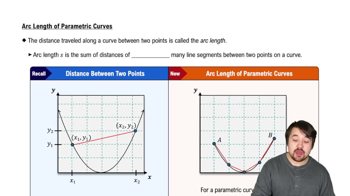
Arc length measures the distance along a curve between two points and is always a non-negative quantity. It is calculated by integrating the square root of 1 plus the derivative squared, ensuring the result represents a length, which cannot be negative.
Recommended video:
06:29
Arc Length of Parametric Curves

Role of the Function's Sign in Arc Length

The sign of the function f(x) does not affect the arc length because arc length depends on the magnitude of the derivative, not the function's value. Even if f(x) is negative, the length along the curve remains positive.
Recommended video:
06:29
Arc Length of Parametric Curves

Integral of Absolute Values and Non-negativity

Arc length involves integrating the square root of the sum of squares, which is always non-negative. This ensures the integral accumulates positive values, preventing the arc length from being negative regardless of the function's behavior.
Recommended video:
05:59
Initial Value Problems Example 2
Related Practice
Textbook Question

A nonlinear spring Hooke’s law is applicable to idealized (linear) springs that are not stretched or compressed too far from their equilibrium positions. Consider a nonlinear spring whose restoring force is given by F(x) = 16x−0.1x³, for |x|≤7. 

c. How much work is done in compressing the spring from its equilibrium position (x=0) to x=−2?

89
views
Textbook Question

Let R be the region in the first quadrant bounded above by the curve y=2−x² and bounded below by the line y=x. Suppose the shell method is used to determine the volume of the solid generated by revolving R about the y-axis.

c. Write an integral for the volume of the solid using the shell method.

59
views
Textbook Question

6–8. Let R be the region bounded by the curves y = 2−√x,y=2, and x=4 in the first quadrant.

Suppose the shell method is used to determine the volume of the solid generated by revolving R about the line x=4.

c. Write an integral for the volume of the solid using the shell method.

68
views
Textbook Question

{Use of Tech} Oscillating motion A mass hanging from a spring is set in motion, and its ensuing velocity is given by v(t) = 2π cos πt, for t≥0. Assume the positive direction is upward and s(0)=0. 


c. At what times does the mass reach its low point the first three times? 

42
views
Textbook Question

Use the region R that is bounded by the graphs of y=1+√x,x=4, and y=1 complete the exercises.


Region R is revolved about the y-axis to form a solid of revolution whose cross sections are washers.


c. What is the area A(y) of a cross section of the solid at a point y in [1, 3]?

52
views
Textbook Question

Acceleration A drag racer accelerates at a(t)=88 ft/s². Assume v(0)=0, s(0)=0, and t is measured in seconds.


c. At this rate, how long will it take the racer to travel 1/4 mi?

46
views