

Ch. 6 - Applications of Integration
Briggs - Calculus: Early Transcendentals 3rd Edition
Briggs3rd EditionCalculus: Early TranscendentalsISBN: 9780136847243Not the one you use?Change textbook
Chapter 6, Problem 6.1.23c

{Use of Tech} Oscillating motion A mass hanging from a spring is set in motion, and its ensuing velocity is given by v(t) = 2π cos πt, for t≥0. Assume the positive direction is upward and s(0)=0. 


c. At what times does the mass reach its low point the first three times? 

Verified step by step guidance
1
Understand that the low points of the oscillating mass correspond to the minimum positions in its motion. Since velocity \(v(t)\) is the derivative of position \(s(t)\), the low points occur when the velocity changes from negative to positive, which means the velocity is zero and the acceleration is positive.
Set the velocity function equal to zero to find critical points: \(v(t) = 2\pi \cos(\pi t) = 0\). Solve for \(t\) such that \(\cos(\pi t) = 0\).
Recall that \(\cos(\theta) = 0\) at \(\theta = \frac{\pi}{2} + n\pi\) for integers \(n\). Substitute \(\theta = \pi t\) to get \(\pi t = \frac{\pi}{2} + n\pi\), which simplifies to \(t = \frac{1}{2} + n\) where \(n\) is an integer \(\geq 0\) because \(t \geq 0\).
Determine which of these times correspond to the mass reaching its low point by checking the sign of the acceleration \(a(t) = v'(t)\). Compute \(a(t) = \frac{d}{dt} v(t) = \frac{d}{dt} (2\pi \cos(\pi t))\) and evaluate \(a(t)\) at each critical time to confirm it is positive (indicating a minimum).
List the first three times \(t\) (starting from \(t \geq 0\)) where \(v(t) = 0\) and \(a(t) > 0\). These times are when the mass reaches its low point for the first three occurrences.

Verified video answer for a similar problem:

This video solution was recommended by our tutors as helpful for the problem above.
Video duration:
4m
Was this helpful?

Key Concepts

Here are the essential concepts you must grasp in order to answer the question correctly.

Relationship Between Velocity and Position in Oscillatory Motion

In oscillatory motion, velocity is the derivative of position with respect to time. To find when the mass reaches its low point, we analyze the velocity and position functions. The low point corresponds to a local minimum in position, which occurs when velocity changes sign from negative to positive.
Recommended video:
06:29
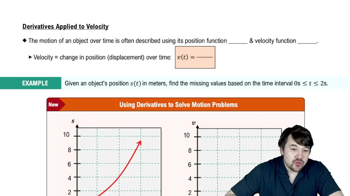
Derivatives Applied To Velocity

Critical Points and Extrema of a Function

Critical points occur where the derivative (velocity) is zero or undefined. For oscillating systems, these points indicate potential maxima or minima in position. Determining whether a critical point is a minimum involves checking the sign changes of velocity or using the second derivative test.
Recommended video:
04:50
Critical Points

Solving Trigonometric Equations

The velocity function involves cosine, so finding times when velocity is zero requires solving trigonometric equations like cos(πt) = 0. Understanding the periodicity and zeros of cosine helps identify specific time values corresponding to turning points in motion.
Recommended video:
5:02
Solving Logarithmic Equations
Related Practice
Textbook Question

Piecewise velocity The velocity of a (fast) automobile on a straight highway is given by the function

v(t)={3t if 0t<2060 if 20t<452404t if t45v(t)= \(\begin{cases}\)3 t & \(\text\) { if } 0 \(\leq\) t<20 \\ 60 & \(\text\) { if } 20 \(\leq\) t<45 \\ 240-4 t & \(\text\) { if } t \(\geq\) 45\(\end{cases}\)

, where is measured in seconds and v has units of m/s. 


c. What is the distance traveled by the automobile in the first 60 s?

68
views
Textbook Question

Let R be the region in the first quadrant bounded above by the curve y=2−x² and bounded below by the line y=x. Suppose the shell method is used to determine the volume of the solid generated by revolving R about the y-axis.

c. Write an integral for the volume of the solid using the shell method.

59
views
Textbook Question

6–8. Let R be the region bounded by the curves y = 2−√x,y=2, and x=4 in the first quadrant.

Suppose the shell method is used to determine the volume of the solid generated by revolving R about the line x=4.

c. Write an integral for the volume of the solid using the shell method.

68
views
Textbook Question

9–10. Velocity graphs The figures show velocity functions for motion along a line. Assume the motion begins with an initial position of s(0)=0. Determine the following.

c. The position at t=5

51
views
Textbook Question

Explain why or why not Determine whether the following statements are true and give an explanation or counterexample.


Arc length may be negative if f(x) < 0 on part of the interval in question.

72
views
Textbook Question

Use the region R that is bounded by the graphs of y=1+√x,x=4, and y=1 complete the exercises.


Region R is revolved about the y-axis to form a solid of revolution whose cross sections are washers.


c. What is the area A(y) of a cross section of the solid at a point y in [1, 3]?

52
views