

40–43. Population growth
A culture of bacteria in a Petri dish has an initial population of 1500 cells and grows at a rate (in cells/day) of N′(t) = 100e^−0.25t. Assume t is measured in days.
a. What is the population after 20 days? After 40 days?
Verified step by step guidance
40–43. Population growth
A culture of bacteria in a Petri dish has an initial population of 1500 cells and grows at a rate (in cells/day) of N′(t) = 100e^−0.25t. Assume t is measured in days.
a. What is the population after 20 days? After 40 days?
Blood flow A typical human heart pumps 70 mL of blood (the stroke volume) with each beat. Assuming a heart rate of 60 beats/min (1 beat/s), a reasonable model for the outflow rate of the heart is V′(t)=70(1+sin 2πt), where V(t) is the amount of blood (in milliliters) pumped over the interval [0,t],V(0)=0 and t is measured in seconds.
a. Verify that the amount of blood pumped over a one-second interval is 70 mL.
Region R is revolved about the line y=1 to form a solid of revolution.
a. What is the radius of a cross section of the solid at a point x in [0, 4]?
Consider the region R in the first quadrant bounded by y=x^1/n and y=x^n, where n>1 is a positive number.
a. Find the volume V(n) of the solid generated when R is revolved about the x-axis. Express your answer in terms of n.
21–30. {Use of Tech} Arc length by calculator
a. Write and simplify the integral that gives the arc length of the following curves on the given interval.
y = x³/3, for −1≤x≤1
For the given regions R₁ and R₂, complete the following steps.
a. Find the area of region R₁.
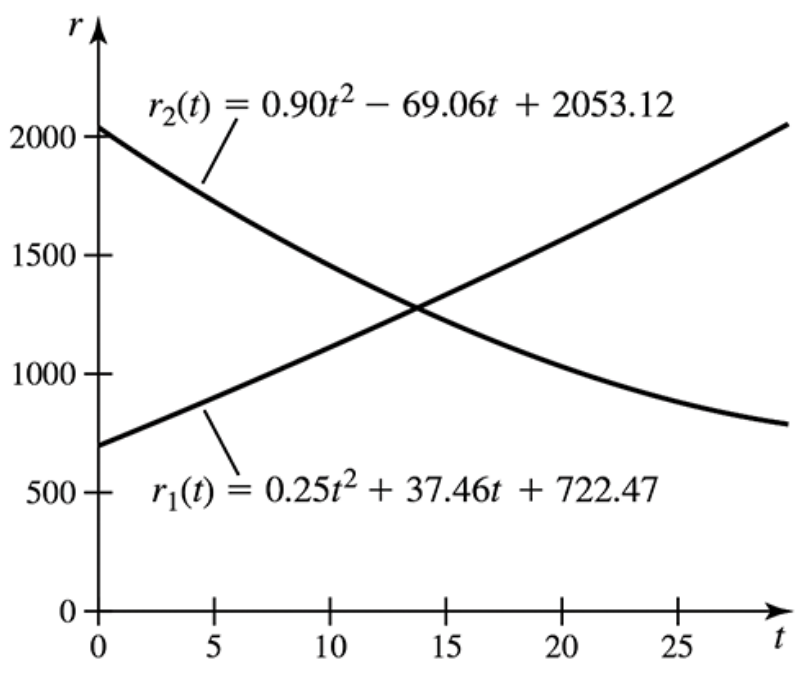
R₁ is the region in the first quadrant bounded by the y-axis and the curves y=2x^2 and y=3−x; R₂ is the region in the first quadrant bounded by the x-axis and the curves y=2x^2 and y=3−x(see figure).