
Ch. 6 - Applications of Integration
Briggs - Calculus: Early Transcendentals 3rd Edition
Briggs3rd EditionCalculus: Early TranscendentalsISBN: 9780136847243Not the one you use?Change textbook
Chapter 6, Problem 6.3.9a

Region R is revolved about the line y=1 to form a solid of revolution.


a. What is the radius of a cross section of the solid at a point x in [0, 4]?

Verified step by step guidance
1
Identify the region R and the axis of rotation. The region R is bounded by the curve, and the axis of rotation is the line y=1.
Determine the formula for the radius of a cross-section. The radius is the vertical distance between the curve and the axis of rotation.
Express the radius mathematically. If the curve is given by y=f(x), the radius at a point x is |1 - f(x)|, since the axis of rotation is y=1.
Verify the domain of x. The problem specifies that x is in the interval [0, 4], so the radius formula applies for all x in this interval.
Conclude that the radius of the cross-section at a point x in [0, 4] is |1 - f(x)|, where f(x) represents the function defining the curve.

Verified video answer for a similar problem:

This video solution was recommended by our tutors as helpful for the problem above.
Video duration:
3m
Was this helpful?

Key Concepts

Here are the essential concepts you must grasp in order to answer the question correctly.

Solid of Revolution

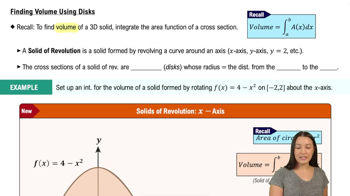
A solid of revolution is a three-dimensional shape created by rotating a two-dimensional area around a straight line (axis of rotation). The shape's volume can be calculated using methods such as the disk or washer method, depending on the distance from the axis of rotation to the function defining the region.
Recommended video:
04:48
Finding Volume Using Disks

Cross Section

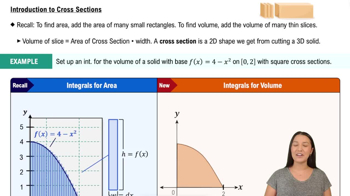
A cross section of a solid is the intersection of the solid with a plane, which reveals a two-dimensional shape. In the context of solids of revolution, the cross section's shape and area depend on the radius at a given point along the axis of rotation, which is determined by the distance from the function to the axis.
Recommended video:
05:38
Introduction to Cross Sections

Radius of Revolution

The radius of revolution at a point x is the perpendicular distance from the function defining the region to the axis of rotation. For the given problem, this radius is calculated as the difference between the function value and the line y=1, which serves as the axis of rotation, allowing for the determination of the area of the cross section.
Recommended video:
07:36
Radius of Convergence
Related Practice
Textbook Question

40–43. Population growth


A culture of bacteria in a Petri dish has an initial population of 1500 cells and grows at a rate (in cells/day) of N′(t) = 100e^−0.25t. Assume t is measured in days.


a. What is the population after 20 days? After 40 days?

42
views
Textbook Question

Flow rates in the Spokane River The daily discharge of the Spokane River as it flows through Spokane, Washington, in April and June is modeled by the functions

r1(t) = 0.25t²+37.46t+722.47 (April) and

r2(t) = 0.90t²−69.06t+2053.12 (June), where the discharge is measured in millions of cubic feet per day, and t=0 corresponds to the beginning of the first day of the month (see figure).

a. Determine the total amount of water that flows through Spokane in April (30 days). 

44
views
Textbook Question

Consider the region R in the first quadrant bounded by y=x^1/n and y=x^n, where n>1 is a positive number.


a. Find the volume V(n) of the solid generated when R is revolved about the x-axis. Express your answer in terms of n.

28
views
Textbook Question

21–30. {Use of Tech} Arc length by calculator


a. Write and simplify the integral that gives the arc length of the following curves on the given interval. 

y = x³/3, for −1≤x≤1

60
views
Textbook Question

A right circular cylinder with height R and radius R has a volume of VC=πR^3 (height = radius).


a. Find the volume of the cone that is inscribed in the cylinder with the same base as the cylinder and height R. Express the volume in terms of VC.

87
views
Textbook Question

For the given regions R₁ and R₂, complete the following steps.


a. Find the area of region R₁.


R₁ is the region in the first quadrant bounded by the y-axis and the curves y=2x^2 and y=3−x; R₂ is the region in the first quadrant bounded by the x-axis and the curves y=2x^2 and y=3−x(see figure).

47
views