Set up a sum of two integrals that equals the area of the shaded region bounded by the graphs of the functions f and g on [a, c] (see figure). Assume the curves intersect at x=b.
Ch. 6 - Applications of Integration
Briggs3rd EditionCalculus: Early TranscendentalsISBN: 9780136847243Not the one you use?Change textbook
Chapter 6, Problem 6.3.48
For the following regions R, determine which is greater—the volume of the solid generated when R is revolved about the x-axis or about the y-axis.
R is bounded by y=x^2 and y=√8x.
Verified step by step guidance1
First, identify the region R bounded by the curves \(y = x^2\) and \(y = \sqrt{8x}\). To do this, find the points of intersection by setting \(x^2 = \sqrt{8x}\).
Solve the equation \(x^2 = \sqrt{8x}\) by squaring both sides to eliminate the square root, resulting in \(x^4 = 8x\). Then, rearrange to \(x^4 - 8x = 0\) and factor to find the intersection points.
Determine the limits of integration (the x-values where the curves intersect) to define the interval over which the region R lies.
Calculate the volume of the solid generated by revolving R about the x-axis using the disk/washer method. The volume is given by \(V_x = \pi \int_{a}^{b} \left( (\text{outer radius})^2 - (\text{inner radius})^2 \right) \, dx\), where the radii are the distances from the x-axis to the curves.
Calculate the volume of the solid generated by revolving R about the y-axis using the shell method. The volume is given by \(V_y = 2\pi \int_{a}^{b} (\text{radius})(\text{height}) \, dx\), where the radius is the distance from the y-axis and the height is the vertical distance between the curves.

Verified video answer for a similar problem:
This video solution was recommended by our tutors as helpful for the problem above.
Video duration:
11mWas this helpful?
Key Concepts
Here are the essential concepts you must grasp in order to answer the question correctly.
Finding the Region of Integration
To analyze the volume generated by revolving a region, first identify the area bounded by the given curves. Here, the region R is enclosed by y = x² and y = √(8x). Finding their points of intersection determines the limits of integration, which is essential for setting up volume integrals.
Recommended video:
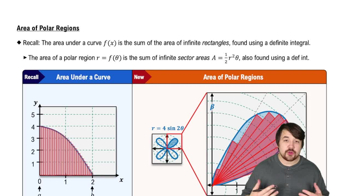
Area of Polar Regions
Volume of Solids of Revolution Using the Disk/Washer Method
The disk/washer method calculates volume by integrating cross-sectional areas perpendicular to the axis of revolution. When revolving around the x-axis, slices are horizontal, and when revolving around the y-axis, slices are vertical. Setting up the correct integral expressions depends on the axis chosen.
Recommended video:
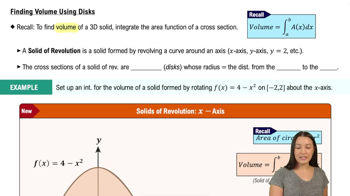
Finding Volume Using Disks
Comparing Volumes Generated by Different Axes of Revolution
Volumes generated by revolving the same region about different axes can differ significantly. Understanding how the shape and orientation of the region relative to the axis affect the radius and height of disks or washers helps compare which volume is larger without necessarily computing exact values.
Recommended video:
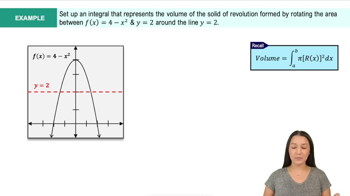
Finding Volume Using Disks Example 4
Related Practice
Textbook Question
71
views
Textbook Question
9–20. Arc length calculations Find the arc length of the following curves on the given interval.
y = (x²+2)^3/2 / 3 on [0, 1]
95
views
Textbook Question
53–62. Choose your method Let R be the region bounded by the following curves. Use the method of your choice to find the volume of the solid generated when R is revolved about the given axis.
y = x³,y=0, and x=2; about the x-axis
92
views
Textbook Question
Find the area of the region described in the following exercises.
The region bounded by y=e^x, y=e^−2x, and x=ln 4
58
views
Textbook Question
Find the area of the region described in the following exercises.
The region bounded by y=2−|x|and y=x^2
127
views
Textbook Question
Determine the area of the shaded region in the following figures.
107
views