Ch. 7 - Logarithmic, Exponential Functions, and Hyperbolic Functions
Briggs - Calculus: Early Transcendentals 3rd Edition
Briggs3rd EditionCalculus: Early TranscendentalsISBN: 9780136847243Not the one you use?Change textbook
Chapter 7, Problem 7.RE.21

Caffeine An adult consumes an espresso containing 75 mg of caffeine. If the caffeine has a half-life of 5.5 hours, when will the amount of caffeine in her bloodstream equal 30 mg?

Verified step by step guidance
1
Identify the exponential decay model for the caffeine amount: \(A(t) = A_0 \times \left(\frac{1}{2}\right)^{\frac{t}{h}}\), where \(A(t)\) is the amount of caffeine at time \(t\), \(A_0\) is the initial amount, and \(h\) is the half-life.
Substitute the known values into the model: initial amount \(A_0 = 75\) mg, half-life \(h = 5.5\) hours, and the amount at time \(t\) is \(A(t) = 30\) mg.
Set up the equation: \(30 = 75 \times \left(\frac{1}{2}\right)^{\frac{t}{5.5}}\) to find the time \(t\) when the caffeine amount reaches 30 mg.
Divide both sides by 75 to isolate the exponential term: \(\frac{30}{75} = \left(\frac{1}{2}\right)^{\frac{t}{5.5}}\).
Take the natural logarithm of both sides to solve for \(t\): \(\ln\left(\frac{30}{75}\right) = \frac{t}{5.5} \ln\left(\frac{1}{2}\right)\), then solve for \(t\) by multiplying both sides by 5.5.

Verified video answer for a similar problem:

This video solution was recommended by our tutors as helpful for the problem above.
Video duration:
4m
Was this helpful?

Key Concepts

Here are the essential concepts you must grasp in order to answer the question correctly.

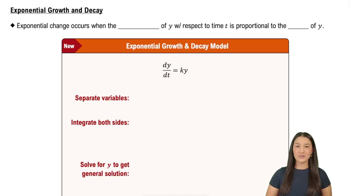
Exponential Decay

Exponential decay describes processes where quantities decrease at rates proportional to their current value. In this context, caffeine concentration decreases over time following an exponential decay model, which can be expressed as A(t) = A_0 * (1/2)^(t / half-life).
Recommended video:
09:29
Exponential Growth & Decay

Half-Life

Half-life is the time required for a substance to reduce to half its initial amount. For caffeine, a half-life of 5.5 hours means every 5.5 hours, the caffeine amount halves, which is crucial for modeling how long it takes to reach a specific concentration.
Recommended video:
6:32
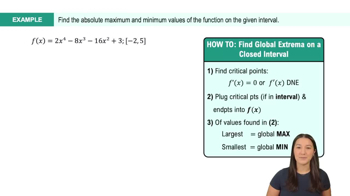
Finding Global Extrema (Extreme Value Theorem) Example 3

Solving Exponential Equations

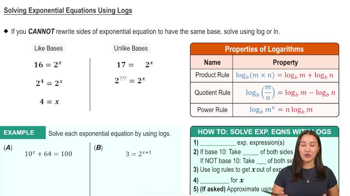
To find the time when caffeine reaches 30 mg, one must solve an exponential equation involving the half-life formula. This typically involves isolating the variable in the exponent and using logarithms to solve for time.
Recommended video:
5:47
Solving Exponential Equations Using Logs
Related Practice
Textbook Question

61–62. Points of intersection and area

a. Sketch the graphs of the functions f and g and find the x-coordinate of the points at which they intersect.


f(x) = sech x, g(x) = tanh x; the region bounded by the graphs of f, g, and the y-axis

67
views
Textbook Question

Moore’s Law In 1965, Gordon Moore observed that the number of transistors that could be placed on an integrated circuit was approximately doubling each year, and he predicted that this trend would continue for another decade. In 1975, Moore revised the doubling time to every two years, and this prediction became known as Moore’s Law.


a. In 1979, Intel introduced the Intel 8088 processor; each of its integrated circuits contained 29,000 transistors. Use Moore’s revised doubling time to find a function y(t) that approximates the number of transistors on an integrated circuit t years after 1979.

85
views
Textbook Question

A power line is attached at the same height to two utility poles that are separated by a distance of 100 ft; the power line follows the curve ƒ(x) = a cosh x/a. Use the following steps to find the value of a that produces a sag of 10 ft midway between the poles. Use a coordinate system that places the poles at x = ±50.


a. Show that a satisfies the equation cosh 50/a − 1 = 10/a.

61
views
Textbook Question

2–9. Integrals Evaluate the following integrals.


∫ dx / √(x² − 9),x > 3

75
views
Textbook Question

2–9. Integrals Evaluate the following integrals.


∫₀¹ (x² / (9 − x⁶)) dx

58
views
Textbook Question

Wave velocity Use Exercise 73 to do the following calculations.

a. Find the velocity of a wave where λ = 50 m and d = 20 m.

53
views