
Ch. 7 - Logarithmic, Exponential Functions, and Hyperbolic Functions
Briggs - Calculus: Early Transcendentals 3rd Edition
Briggs3rd EditionCalculus: Early TranscendentalsISBN: 9780136847243Not the one you use?Change textbook
Chapter 7, Problem 7.RE.7

2–9. Integrals Evaluate the following integrals.


∫ dx / √(x² − 9),x > 3

Verified step by step guidance
1
Recognize that the integral is of the form \(\int \frac{dx}{\sqrt{x^2 - a^2}}\) where \(a = 3\). This is a standard integral involving a square root of a difference of squares.
Recall the standard formula for this integral: \(\int \frac{dx}{\sqrt{x^2 - a^2}} = \ln|x + \sqrt{x^2 - a^2}| + C\), where \(C\) is the constant of integration.
Since the problem states \(x > 3\), the expression inside the logarithm is positive, so the absolute value can be dropped for this domain.
Write the integral solution using the formula with \(a = 3\): \(\int \frac{dx}{\sqrt{x^2 - 9}} = \ln(x + \sqrt{x^2 - 9}) + C\).
Verify the solution by differentiating \(\ln(x + \sqrt{x^2 - 9})\) to ensure it matches the original integrand \(\frac{1}{\sqrt{x^2 - 9}}\).

Verified video answer for a similar problem:

This video solution was recommended by our tutors as helpful for the problem above.
Video duration:
1m
Was this helpful?

Key Concepts

Here are the essential concepts you must grasp in order to answer the question correctly.

Integration of Functions Involving Square Roots

This concept involves techniques for integrating functions that contain square roots, especially expressions like √(x² − a²). Recognizing the form helps in choosing appropriate substitution methods or formulas to simplify the integral.
Recommended video:
07:01
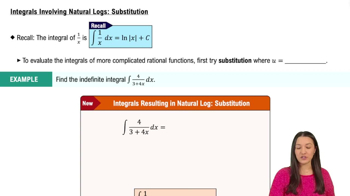
Integrals Involving Natural Logs: Substitution

Inverse Hyperbolic Functions

Integrals of the form ∫ dx / √(x² − a²) often result in inverse hyperbolic functions such as arcosh(x/a). Understanding these functions and their derivatives is essential for evaluating and expressing the integral's solution.
Recommended video:
4:49
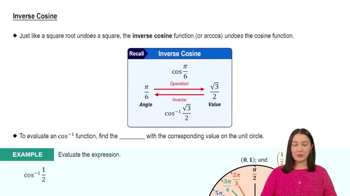
Inverse Cosine

Domain Restrictions and Absolute Values

The condition x > 3 ensures the expression under the square root is positive, affecting the integral's domain and the form of the solution. Recognizing domain restrictions helps avoid extraneous solutions and correctly apply absolute values in logarithmic or inverse hyperbolic expressions.
Recommended video:
5:10
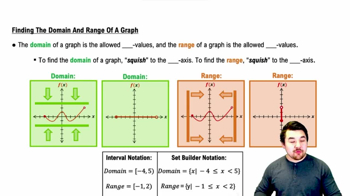
Finding the Domain and Range of a Graph
Related Practice
Textbook Question

Moore’s Law In 1965, Gordon Moore observed that the number of transistors that could be placed on an integrated circuit was approximately doubling each year, and he predicted that this trend would continue for another decade. In 1975, Moore revised the doubling time to every two years, and this prediction became known as Moore’s Law.


a. In 1979, Intel introduced the Intel 8088 processor; each of its integrated circuits contained 29,000 transistors. Use Moore’s revised doubling time to find a function y(t) that approximates the number of transistors on an integrated circuit t years after 1979.

85
views
Textbook Question

Caffeine An adult consumes an espresso containing 75 mg of caffeine. If the caffeine has a half-life of 5.5 hours, when will the amount of caffeine in her bloodstream equal 30 mg?

58
views
Textbook Question

2–9. Integrals Evaluate the following integrals.


∫₀¹ (x² / (9 − x⁶)) dx

58
views
Textbook Question

Wave velocity Use Exercise 73 to do the following calculations.

a. Find the velocity of a wave where λ = 50 m and d = 20 m.

53
views
Textbook Question

Population growth The population of a large city grows exponentially with a current population of 1.3 million and a predicted population of 1.45 million 10 years from now.


b. Find the doubling time of the population.

73
views
Textbook Question

Savings account A savings account advertises an annual percentage yield (APY) of 5.4%, which means that the balance in the account increases at an annual growth rate of 5.4%/yr.


b. What is the doubling time of the balance?

43
views