
Ch. 7 - Logarithmic, Exponential Functions, and Hyperbolic Functions
Briggs - Calculus: Early Transcendentals 3rd Edition
Briggs3rd EditionCalculus: Early TranscendentalsISBN: 9780136847243Not the one you use?Change textbook
Chapter 7, Problem 7.2.32a

Depreciation of equipment A large die-casting machine used to make automobile engine blocks is purchased for \$2.5 million. For tax purposes, the value of the machine can be depreciated by 6.8% of its current value each year.


a. What is the value of the machine after 10 years?

Verified step by step guidance
1
Identify the initial value of the machine, which is \$2.5 million. This will be our starting amount, denoted as \(V_0 = 2.5\) million.
Understand that the machine depreciates by 6.8% each year based on its current value. This means each year the machine retains 100% - 6.8% = 93.2% of its value from the previous year.
Express the value of the machine after \(n\) years using the exponential decay formula: \(V_n = V_0 \times (1 - r)^n\), where \(r\) is the depreciation rate as a decimal (6.8% = 0.068).
Substitute the known values into the formula: \(V_{10} = 2.5 \times (1 - 0.068)^{10}\) to represent the value after 10 years.
To find the value after 10 years, calculate the expression \(2.5 \times 0.932^{10}\). This will give the depreciated value of the machine after 10 years.

Verified video answer for a similar problem:

This video solution was recommended by our tutors as helpful for the problem above.
Video duration:
2m
Was this helpful?

Key Concepts

Here are the essential concepts you must grasp in order to answer the question correctly.

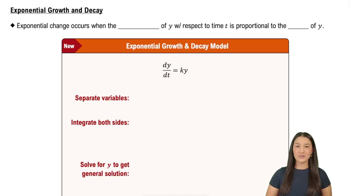
Exponential Decay

Exponential decay describes a process where a quantity decreases by a fixed percentage over equal time intervals. In this problem, the machine's value decreases by 6.8% each year, meaning its value after each year is multiplied by (1 - 0.068). This concept helps model the depreciation over multiple years.
Recommended video:
09:29
Exponential Growth & Decay

Depreciation

Depreciation is the reduction in the value of an asset over time, often due to wear and tear or obsolescence. Here, the machine’s value decreases annually by a fixed percentage, which is a common method for calculating tax deductions and understanding asset worth.

Compound Interest Formula

The compound interest formula, V = P(1 - r)^t, calculates the future value of an amount after repeated percentage decreases or increases. In depreciation, it models how the value diminishes year after year, where P is the initial value, r is the depreciation rate, and t is the number of years.
Recommended video:
Guided course
5:59
Recursive Formulas
Related Practice
Textbook Question

Oil consumption Starting in 2018 (t=0), the rate at which oil is consumed by a small country increases at a rate of 1.5%/yr, starting with an initial rate of 1.2 million barrels/yr.


b. Find the function that gives the amount of oil consumed between t=0 and any future time t.

51
views
Textbook Question

ln x is unbounded Use the following argument to show that lim (x → ∞) ln x = ∞ and lim (x → 0⁺) ln x = −∞.

a. Make a sketch of the function f(x) = 1/x on the interval [1, 2]. Explain why the area of the region bounded by y = f(x) and the x-axis on [1, 2] is ln 2.

104
views
Textbook Question

Evaluating hyperbolic functions Use a calculator to evaluate each expression or state that the value does not exist. Report answers accurate to four decimal places to the right of the decimal point.

a. coth 4

64
views
Textbook Question

61–62. Points of intersection and area

b. Compute the area of the region described.


f(x) = sinh x, g(x) = tanh x; the region bounded by the graphs of f, g, and x = ln 3

47
views
Textbook Question

Projection sensitivity

According to the 2014 national population projections published by the U.S. Census Bureau, the U.S. population is projected to be 334.4 million in 2020 with an estimated growth rate of 0.79%/yr.

a. Based on these figures, find the doubling time and the projected population in 2050. Assume the growth rate remains constant.

48
views
Textbook Question

Depreciation of equipment A large die-casting machine used to make automobile engine blocks is purchased for \$2.5 million. For tax purposes, the value of the machine can be depreciated by 6.8% of its current value each year.


b. After how many years is the value of the machine 10% of its original value?

91
views