
Ch. 7 - Logarithmic, Exponential Functions, and Hyperbolic Functions
Briggs - Calculus: Early Transcendentals 3rd Edition
Briggs3rd EditionCalculus: Early TranscendentalsISBN: 9780136847243Not the one you use?Change textbook
Chapter 7, Problem 7.2.26b

Oil consumption Starting in 2018 (t=0), the rate at which oil is consumed by a small country increases at a rate of 1.5%/yr, starting with an initial rate of 1.2 million barrels/yr.


b. Find the function that gives the amount of oil consumed between t=0 and any future time t.

Verified step by step guidance
1
Identify the type of growth described: since the rate of oil consumption increases at a constant percentage rate (1.5% per year), this suggests exponential growth. The rate function can be modeled as an exponential function.
Write the rate of oil consumption function as \(R(t) = R_0 \times e^{kt}\), where \(R_0\) is the initial rate, \(k\) is the growth rate expressed as a decimal, and \(t\) is time in years. Here, \(R_0 = 1.2\) million barrels/year and \(k = 0.015\) (since 1.5% = 0.015).
To find the total amount of oil consumed from time \(t=0\) to any future time \(t\), integrate the rate function \(R(t)\) with respect to time over the interval \([0, t]\). This gives the consumption function \(C(t) = \int_0^t R(s) \, ds\).
Set up the integral explicitly: \(C(t) = \int_0^t 1.2 \times e^{0.015s} \, ds\). This integral will give the total amount of oil consumed up to time \(t\).
Evaluate the integral by applying the formula for integrating an exponential function: \(\int e^{as} \, ds = \frac{1}{a} e^{as} + C\). Use this to express \(C(t)\) in terms of \(t\), including the constant of integration determined by the limits of integration.

Verified video answer for a similar problem:

This video solution was recommended by our tutors as helpful for the problem above.
Video duration:
3m
Was this helpful?

Key Concepts

Here are the essential concepts you must grasp in order to answer the question correctly.

Exponential Growth

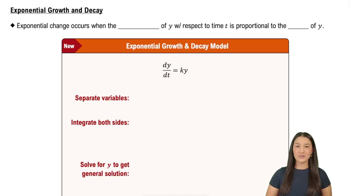
Exponential growth describes a process where a quantity increases at a rate proportional to its current value. In this problem, the oil consumption rate increases by 1.5% per year, meaning the rate grows exponentially over time, modeled by a function like R(t) = R_0 * e^(kt).
Recommended video:
09:29
Exponential Growth & Decay

Rate of Change and Integration

The rate of oil consumption is given as a function of time, and to find the total amount consumed over a period, we integrate this rate function. Integration accumulates the instantaneous rates over time, providing the total quantity consumed between two points.
Recommended video:
04:16
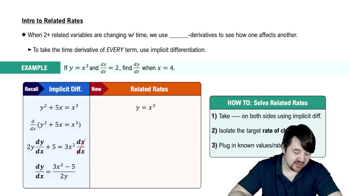
Intro To Related Rates

Initial Conditions in Differential Equations

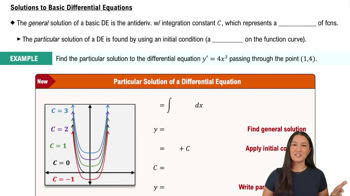
Initial conditions specify the starting value of a function, essential for solving differential equations uniquely. Here, the initial consumption rate at t=0 is 1.2 million barrels/year, which sets the constant in the exponential growth model for the rate.
Recommended video:
04:00
Solutions to Basic Differential Equations