
Surface area of a catenoid When the catenary y = a cosh x/a is revolved about the x-axis, it sweeps out a surface of revolution called a catenoid. Find the area of the surface generated when y = cosh x on [–ln 2, ln 2] is rotated about the x-axis.
Ch. 7 - Logarithmic, Exponential Functions, and Hyperbolic Functions
Briggs3rd EditionCalculus: Early TranscendentalsISBN: 9780136847243Not the one you use?Change textbook
All textbooks
Briggs 3rd Edition
Ch. 7 - Logarithmic, Exponential Functions, and Hyperbolic Functions
Problem 7.R.1c
Briggs 3rd Edition
Ch. 7 - Logarithmic, Exponential Functions, and Hyperbolic Functions
Problem 7.R.1cChapter 7, Problem 7.R.1c
Explain why or why not Determine whether the following statements are true and give an explanation or counterexample.
c. ln xy = (ln x)(ln y)
Verified step by step guidance1
Recall the logarithm property for the product of two positive numbers: \(\ln(xy) = \ln x + \ln y\). This is a fundamental identity in logarithms.
Compare the given statement \(\ln xy = (\ln x)(\ln y)\) with the known property. The statement suggests that the logarithm of a product equals the product of the logarithms, which differs from the sum in the known property.
To test the statement, consider specific positive values for \(x\) and \(y\), for example, \(x=2\) and \(y=3\). Calculate both sides: \(\ln(2 \times 3)\) and \((\ln 2)(\ln 3)\) to see if they are equal.
Since \(\ln(6)\) is approximately \(1.79\), and \((\ln 2)(\ln 3)\) is approximately \(0.48\), the two sides are not equal, providing a counterexample.
Conclude that the statement \(\ln xy = (\ln x)(\ln y)\) is false because the logarithm of a product is the sum of the logarithms, not their product.

Verified video answer for a similar problem:
This video solution was recommended by our tutors as helpful for the problem above.
Video duration:
1mWas this helpful?
Key Concepts
Here are the essential concepts you must grasp in order to answer the question correctly.
Properties of Logarithms
Logarithms have specific properties that simplify expressions, such as ln(xy) = ln(x) + ln(y). Understanding these properties helps determine the validity of logarithmic equations.
Recommended video:
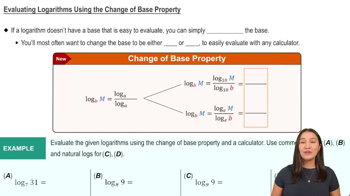
Change of Base Property
Difference Between Addition and Multiplication
In logarithmic identities, multiplication inside the log translates to addition outside, not multiplication. Recognizing this distinction is crucial to avoid incorrect assumptions like ln(xy) = (ln x)(ln y).
Recommended video:
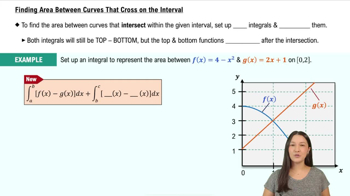
Finding Area Between Curves that Cross on the Interval
Counterexamples in Mathematical Proofs
A single counterexample disproves a general statement. Testing the equation with specific values of x and y can show whether ln(xy) = (ln x)(ln y) holds true or not.
Recommended video:
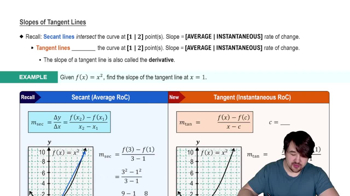
Slopes of Tangent Lines
Related Practice
Textbook Question
120
views
Textbook Question
63–66. Calculator limits Use a calculator to make a table similar to Table 7.1 to approximate the following limits. Confirm your result with l’Hôpital’s Rule.
limₕ→₀ (1 + 3h)^{2/h}
31
views
Textbook Question
10–19. Derivatives Find the derivatives of the following functions.
f(t) = cosh t sinh t
34
views
Textbook Question
27–28. Curve sketching Use the graphing techniques of Section 4.4 to graph the following functions on their domains. Identify local extreme points, inflection points, concavity, and end behavior. Use a graphing utility only to check your work.
f(x) = ln x – ln² x
69
views
Textbook Question
22–36. Derivatives Find the derivatives of the following functions.
f(x) = x sinh⁻¹ x − √(x² + 1)
94
views
Textbook Question
10–19. Derivatives Find the derivatives of the following functions.
f(x) = tanh⁻¹(cos x)
28
views