Ch. 7 - Logarithmic, Exponential Functions, and Hyperbolic Functions
Briggs - Calculus: Early Transcendentals 3rd Edition
Briggs3rd EditionCalculus: Early TranscendentalsISBN: 9780136847243Not the one you use?Change textbook
Chapter 7, Problem 7.RE.20b

Population growth The population of a large city grows exponentially with a current population of 1.3 million and a predicted population of 1.45 million 10 years from now.


b. Find the doubling time of the population.

Verified step by step guidance
1
Recognize that the population growth follows an exponential model of the form \(P(t) = P_0 \cdot e^{kt}\), where \(P_0\) is the initial population, \(k\) is the growth rate, and \(t\) is time in years.
Use the given information to find the growth rate \(k\). You know \(P_0 = 1.3\) million and \(P(10) = 1.45\) million, so set up the equation \(1.45 = 1.3 \cdot e^{10k}\).
Solve for \(k\) by dividing both sides by 1.3 and then taking the natural logarithm: \(\ln\left(\frac{1.45}{1.3}\right) = 10k\), which gives \(k = \frac{1}{10} \ln\left(\frac{1.45}{1.3}\right)\).
Recall that the doubling time \(T\) is the time it takes for the population to double, so \(P(T) = 2P_0\). Substitute into the model: \(2P_0 = P_0 \cdot e^{kT}\), which simplifies to \(2 = e^{kT}\).
Take the natural logarithm of both sides to solve for \(T\): \(\ln(2) = kT\), so \(T = \frac{\ln(2)}{k}\). Use the value of \(k\) found in step 3 to express the doubling time.

Verified video answer for a similar problem:

This video solution was recommended by our tutors as helpful for the problem above.
Video duration:
4m
Was this helpful?

Key Concepts

Here are the essential concepts you must grasp in order to answer the question correctly.

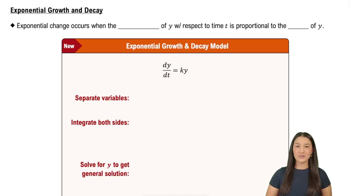
Exponential Growth Model

Exponential growth describes a process where the quantity increases at a rate proportional to its current value, often modeled by P(t) = P_0 * e^(kt). Here, P_0 is the initial population, k is the growth rate, and t is time. Understanding this model is essential to relate population changes over time.
Recommended video:
09:29
Exponential Growth & Decay

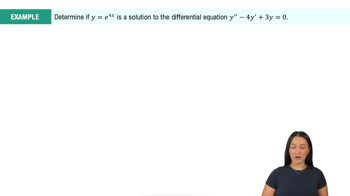
Doubling Time

Doubling time is the period required for a quantity growing exponentially to double in size. It can be found using the formula T = ln(2)/k, where k is the growth rate. This concept helps determine how quickly the population will reach twice its current size.
Recommended video:
02:32
Verifying Solutions of Differential Equations Example 3

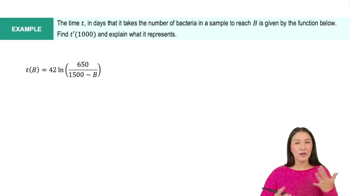
Natural Logarithm and Growth Rate Calculation

The natural logarithm (ln) is used to solve for the growth rate k in the exponential model by rearranging P(t) = P_0 * e^(kt). Calculating k involves taking ln of the ratio of populations and dividing by time, which is crucial for finding doubling time and making predictions.
Recommended video:
04:39
Derivative of the Natural Logarithmic Function Example 7