Back
Back
Problem 8.R.54
2–74. Integration techniques Use the methods introduced in Sections 8.1 through 8.5 to evaluate the following integrals.
54. ∫ dx/√(9x² - 25), x > 5/3
Problem 8.R.86
82-88. Improper integrals Evaluate the following integrals or show that the integral diverges.
86. ∫ (from -∞ to ∞) x³/(1 + x⁸) dx
Problem 8.R.89
89–91. Comparison Test Determine whether the following integrals converge or diverge.
89. ∫ (from 1 to ∞) dx/(x⁵ + x⁴ + x³ + 1)
Problem 8.R.60
2–74. Integration techniques Use the methods introduced in Sections 8.1 through 8.5 to evaluate the following integrals.
60. ∫ x² coshx dx
Problem 8.R.9
2–74. Integration techniques Use the methods introduced in Sections 8.1 through 8.5 to evaluate the following integrals.
9. ∫ (from 0 to π/4) cos⁵ 2x sin² 2x dx
Problem 8.R.84
82-88. Improper integrals Evaluate the following integrals or show that the integral diverges.
84. ∫ (from 0 to π) sec²x dx*(Note: Potential improperness at x = π/2)*
Problem 8.R.106
106. Arc length Find the length of the curve y = (x / 2) * sqrt(3 - x^2) + (3 / 2) * sin^(-1)(x / sqrt(3)) from x = 0 to x = 1.
Problem 8.R.118b
118. Two worthy integrals
b. Let f be any positive continuous function on the interval [0, π/2]. Evaluate
∫ from 0 to π/2 of [f(cos x) / (f(cos x) + f(sin x))] dx.
(Hint: Use the identity cos(π/2 − x) = sin x.)
(Source: Mathematics Magazine 81, 2, Apr 2008)
Problem 8.R.74
2–74. Integration techniques Use the methods introduced in Sections 8.1 through 8.5 to evaluate the following integrals.
74. ∫ dx/√(√(1 + √x))
Problem 8.R.120
120. Equal volumes
a. Let R be the region bounded by the graph of f(x) = x^(-p) and the x-axis, for x ≥ 1. Let V₁ and V₂ be the volumes of the solids generated when R is revolved about the x-axis and the y-axis, respectively, if they exist. For what values of p (if any) is V₁ = V₂?
b. Repeat part (a) on the interval [0, 1].
Problem 8.R.119b
119. {Use of Tech} Comparing volumes Let R be the region bounded by y = ln(x), the x-axis, and the line x = a, where a > 1.
b. Find the volume V₂(a) of the solid generated when R is revolved about the y-axis (as a function of a).
Problem 8.RE.48
2–74. Integration techniques Use the methods introduced in Sections 8.1 through 8.5 to evaluate the following integrals.
48. ∫ sin(3x) cos⁶(3x) dx
Problem 8.RE.32
2–74. Integration techniques Use the methods introduced in Sections 8.1 through 8.5 to evaluate the following integrals.
32. ∫ csc²(6x) cot(6x) dx
Problem 8.RE.6
2–74. Integration techniques Use the methods introduced in Sections 8.1 through 8.5 to evaluate the following integrals.
6. ∫ (2 − sin 2θ)/cos² 2θ dθ
Problem 8.RE.29
2–74. Integration techniques Use the methods introduced in Sections 8.1 through 8.5 to evaluate the following integrals.
29. ∫ cos⁴ x/sin⁶ x dx
Problem 8.RE.51
2–74. Integration techniques Use the methods introduced in Sections 8.1 through 8.5 to evaluate the following integrals.
51. ∫ (from 0 to π/4) sin⁵(4θ) dθ
Problem 8.RE.22
2–74. Integration techniques Use the methods introduced in Sections 8.1 through 8.5 to evaluate the following integrals.
22. ∫ tan³ 5θ dθ
Problem 8.7.86a
Arc length of a parabola Let L(c) be the length of the parabola f(x) = x² from x = 0 to x = c, where c ≥ 0 is a constant.
a. Find an expression for L.
Problem 8.2.60a
60. Two Methods
a. Evaluate ∫(x · ln(x²)) dx using the substitution u = x² and evaluating ∫(ln(u)) du.
Problem 8.8.41a
41-44. {Use of Tech} Nonuniform grids
Use the indicated methods to solve the following problems with nonuniform grids.
41. A curling iron is plugged into an outlet at time t = 0. Its temperature T in degrees Fahrenheit, assumed to be a continuous function that is strictly increasing and concave down on 0 ≤ t ≤ 120, is given at various times (in seconds) in the table.
a. Approximate (1/120)∫(0 to 120)T(t)dt in three ways using a left Riemann sum, using a right Riemann sum and using the Trapezoid Rule
Interpret the value of (1/120)∫(0 to 120)T(t)dt in the context of this problem.
Problem 8.8.70a
66–71. {Use of Tech} Estimating error Refer to Theorem 8.1 in the following exercises.
70. Let f(x) = e^(-x²).
a. Find a Simpson's Rule approximation to the integral from 0 to 3 of e^(-x²) dx using n = 30 subintervals.
Problem 8.8.69a
66–71. {Use of Tech} Estimating error Refer to Theorem 8.1 in the following exercises.
69. Let f(x) = sin(eˣ).
a. Find a Trapezoid Rule approximation to ∫[0 to 1] sin(eˣ) dx using n = 40 subintervals.
Problem 8.4.57a
57. Explain why or why not Determine whether the following statements are true and give an explanation or counterexample.
a. If x = 4 tanθ, then cscθ = 4/x.
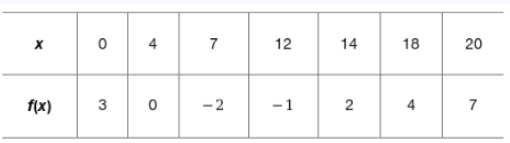
Problem 8.8.42a
42. Approximating integrals The function f is twice differentiable on (-∞, ∞). Values of f at various points on [0, 20] are given in the table.
a. Approximate ∫(0 to 120) f(x) dx in three way using a left Riemann sum, a right Riemann sum and the Trapezoid Rule
Problem 8.2.81a
81. Possible and impossible integrals
Let Iₙ = ∫ xⁿ e⁻ˣ² dx, where n is a nonnegative integer.
a. I₀ = ∫ e⁻ˣ² dx cannot be expressed in terms of elementary functions. Evaluate I₁.
Problem 8.8.53a
Explain why or why not Determine whether the following statements are true and give an explanation or counterexample.
a. Suppose ∫_a^b f(x) dx is approximated with Simpson’s Rule using n = 18 subintervals, where |f^(4)(x)| ≤ 1 on [a, b]. The absolute error E_S in approximating the integral satisfies E_S ≤ (Δx)^5 / 10.
Problem 8.8.68a
66–71. {Use of Tech} Estimating error Refer to Theorem 8.1 in the following exercises.
68. Let f(x) = e^(x²).
a. Find a Trapezoid Rule approximation to ∫[0 to 1] e^(x²) dx using n = 50 subintervals.
Problem 8.8.67a
66–71. {Use of Tech} Estimating error Refer to Theorem 8.1 in the following exercises.
67. Let f(x) = √(x³ + 1).
a. Find a Midpoint Rule approximation to ∫[1 to 6] √(x³ + 1) dx using n = 50 subintervals.
Problem 8.9.111a
Gamma function The gamma function is defined by Γ(p) = ∫ from 0 to ∞ of x^(p-1) e^(-x) dx, for p not equal to zero or a negative integer.
a. Use the reduction formula ∫ from 0 to ∞ of x^p e^(-x) dx = p ∫ from 0 to ∞ of x^(p-1) e^(-x) dx for p = 1, 2, 3, ...
to show that Γ(p + 1) = p! (p factorial).
Problem 8.9.91a
91. [Use of Tech] Regions bounded by exponentials Let a > 0 and let R be the region bounded by the graph of y = e^(-a·x) and the x-axis
on the interval [b, ∞).
a. Find A(a,b), the area of R as a function of a and b.