
Ch. 9 - Differential Equations
Briggs - Calculus: Early Transcendentals 3rd Edition
Briggs3rd EditionCalculus: Early TranscendentalsISBN: 9780136847243Not the one you use?Change textbook
Chapter 9, Problem 9.1.24

21–32. Finding general solutions Find the general solution of each differential equation. Use C,C1,C2... to denote arbitrary constants.
p'(x) = 16/x⁹ - 5 + 14x⁶

Verified step by step guidance
1
Identify the given differential equation: \(p'(x) = \frac{16}{x^{9}} - 5 + 14x^{6}\). This means the derivative of \(p(x)\) with respect to \(x\) is given by this expression.
To find the general solution \(p(x)\), integrate both sides of the equation with respect to \(x\): \(p(x) = \int \left( \frac{16}{x^{9}} - 5 + 14x^{6} \right) \, dx\).
Rewrite the integrand to make integration easier: \(\frac{16}{x^{9}} = 16x^{-9}\), so the integral becomes \(\int \left( 16x^{-9} - 5 + 14x^{6} \right) \, dx\).
Integrate each term separately using the power rule for integration: \(\int x^{n} \, dx = \frac{x^{n+1}}{n+1} + C\), where \(n \neq -1\).
After integrating each term, combine the results and add the arbitrary constant of integration \(C\) to express the general solution \(p(x)\).

Verified video answer for a similar problem:

This video solution was recommended by our tutors as helpful for the problem above.
Video duration:
2m
Was this helpful?

Key Concepts

Here are the essential concepts you must grasp in order to answer the question correctly.

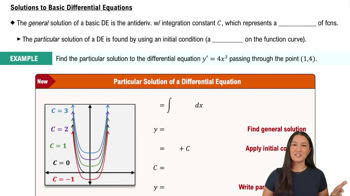
General Solution of a Differential Equation

The general solution of a differential equation includes all possible solutions and contains arbitrary constants representing the family of curves satisfying the equation. For first-order equations, integrating the derivative function yields the general solution plus a constant of integration.
Recommended video:
04:00
Solutions to Basic Differential Equations

Integration of Functions

Integration is the reverse process of differentiation and is used to find the original function from its derivative. To solve p'(x), integrate each term separately with respect to x, applying power rule integration and adding an arbitrary constant.
Recommended video:
05:11
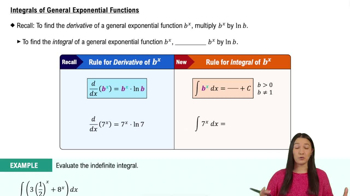
Integrals of General Exponential Functions

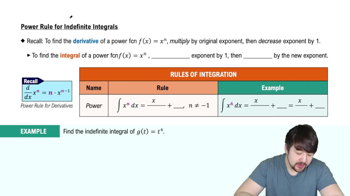
Power Rule for Integration

The power rule states that ∫x^n dx = (x^(n+1))/(n+1) + C for any real number n ≠ -1. This rule is essential for integrating terms like 16/x⁹ and 14x⁶ by rewriting negative exponents and applying the formula correctly.
Recommended video:
04:04
Power Rule for Indefinite Integrals
Related Practice
Textbook Question

33–38. {Use of Tech} Solutions in implicit form Solve the following initial value problems and leave the solution in implicit form. Use graphing software to plot the solution. If the implicit solution describes more than one function, be sure to indicate which function corresponds to the solution of the initial value problem.

z(x) = (z² + 4)/(x² + 16), z(4) = 2

43
views
Textbook Question

17–32. Solving initial value problems Determine whether the following equations are separable. If so, solve the initial value problem.

y'(t) = eᵗʸ, y(0) = 1

51
views
Textbook Question

Explain why the graph of the solution to the initial value problem y'(t) = t²/(1 - t), y(-1) = ln 2 cannot cross the line t = 1.

53
views
Textbook Question

5–16. Solving separable equations Find the general solution of the following equations. Express the solution explicitly as a function of the independent variable.

(t² + 1)³yy'(t) = t(y² + 4)

56
views
Textbook Question

33–38. {Use of Tech} Solutions in implicit form Solve the following initial value problems and leave the solution in implicit form. Use graphing software to plot the solution. If the implicit solution describes more than one function, be sure to indicate which function corresponds to the solution of the initial value problem.

y'(t) = 2t²/(y² − 1), y(0) = 0

41
views
Textbook Question

Case 2 of the general solution Solve the equation y′(t) = ky + b in the case that ky + b < 0 and verify that the general solution is y(t) = Ceᵏᵗ − b/k.

63
views