
Textbook Question
Explain how a stirred tank reaction works.
44
views

 Verified step by step guidance
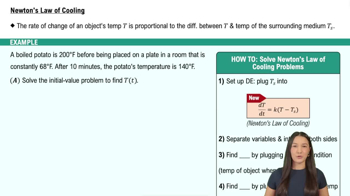
 10:44
10:44
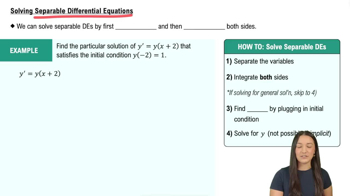 06:06
06:06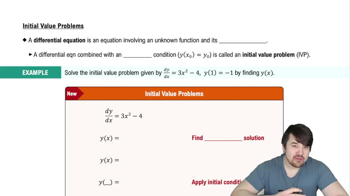 05:03
05:03Explain how a stirred tank reaction works.
25–28. Two steps of Euler’s method For the following initial value problems, compute the first two approximations u1 and u2 given by Euler’s method using the given time step.
y′(t) = 2−y, y(0) = 1; Δt = 0.1
12–16. Sketching direction fields Use the window [-2, 2] x [-2, 2] to sketch a direction field for the following equations. Then sketch the solution curve that corresponds to the given initial condition. A detailed direction field is not needed.
y(x) = sin y, y(−2) = 1/2
5–16. Solving separable equations Find the general solution of the following equations. Express the solution explicitly as a function of the independent variable.
u'(x) = e²ˣ⁻ᵘ
33–42. Solving initial value problems Solve the following initial value problems.
y'(x) = 4 sec² 2x, y(0) = 8
39–42. Special equations A special class of first-order linear equations have the form a(t)y'(t)+a'(t)y(t)=f(t), where a and f are given functions of t. Notice that the left side of this equation can be written as the derivative of a product, so the equation has the form
a(t)y'(t) + a'(t)y(t) = d/dt (a(t)y(t)) = f(t).
Therefore, the equation can be solved by integrating both sides with respect to t. Use this idea to solve the following initial value problems.
t³y′(t) + 3t²y = (1 + t)/t, y(1) = 6