
Ch. 9 - Differential Equations
Briggs - Calculus: Early Transcendentals 3rd Edition
Briggs3rd EditionCalculus: Early TranscendentalsISBN: 9780136847243Not the one you use?Change textbook
Chapter 9, Problem 9.RE.1a

Explain why or why not Determine whether the following statements are true and give an explanation or counterexample.
a. The differential equation y′+2y=t is first-order, linear, and separable.

Verified step by step guidance
1
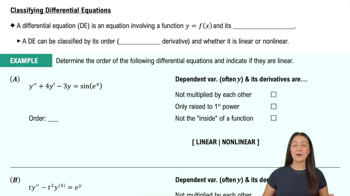
Identify the order of the differential equation \(y' + 2y = t\). Since the highest derivative present is \(y'\), this is a first-order differential equation.
Check if the equation is linear. A first-order linear differential equation can be written in the form \(y' + p(t)y = q(t)\), where \(p(t)\) and \(q(t)\) are functions of \(t\). Here, \(p(t) = 2\) and \(q(t) = t\), so the equation is linear.
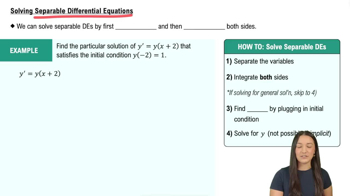
Determine if the equation is separable. A separable differential equation can be written as \(\frac{dy}{dt} = g(t)h(y)\), allowing the variables \(y\) and \(t\) to be separated on opposite sides of the equation.
Rewrite the given equation as \(y' = t - 2y\). Notice that the right side is \(t - 2y\), which is a sum of a function of \(t\) and a function of \(y\), not a product of separate functions of \(t\) and \(y\).
Since the right side cannot be expressed as a product \(g(t)h(y)\), the equation is not separable. Therefore, the equation is first-order and linear, but not separable.

Verified video answer for a similar problem:

This video solution was recommended by our tutors as helpful for the problem above.
Video duration:
2m
Was this helpful?

Key Concepts

Here are the essential concepts you must grasp in order to answer the question correctly.

First-Order Differential Equations

A first-order differential equation involves only the first derivative of the unknown function and no higher derivatives. It can be written in the form dy/dt = f(t, y), where the highest derivative is of order one. Recognizing the order helps classify and solve the equation.
Recommended video:
07:39
Classifying Differential Equations

Linear Differential Equations

A differential equation is linear if the unknown function and its derivatives appear to the first power and are not multiplied together. It can be expressed as y' + p(t)y = q(t), where p(t) and q(t) are functions of the independent variable. Linearity allows the use of specific solution methods like integrating factors.
Recommended video:
07:39
Classifying Differential Equations

Separable Differential Equations

A separable differential equation can be written so that all terms involving y are on one side and all terms involving t are on the other, allowing integration of each side separately. It has the form dy/dt = g(t)h(y). If the equation cannot be rearranged this way, it is not separable.
Recommended video:
06:06
Solving Separable Differential Equations
Related Practice
Textbook Question

{Use of Tech} Logistic equation for an epidemic When an infected person is introduced into a closed and otherwise healthy community, the number of people who contract the disease (in the absence of any intervention) may be modeled by the logistic equation

dP/dt=kP(1−P/A),P0=P_0,

where K is a positive infection rate, A is the number of people in the community, and P0 is the number of infected people at t=0. The model also assumes no recovery.

a. Find the solution of the initial value problem, for t≥0, in terms of K, A, and P0.

50
views
Textbook Question

2–10. General solutions Use the method of your choice to find the general solution of the following differential equations.

y′(t) = √(y/t)

34
views
Textbook Question

38–43. Equilibrium solutions A differential equation of the form y′(t)=f(y) is said to be autonomous (the function f depends only on y). The constant function y=y0 is an equilibrium solution of the equation provided f(y0)=0 (because then y'(t)=0 and the solution remains constant for all t). Note that equilibrium solutions correspond to horizontal lines in the direction field. Note also that for autonomous equations, the direction field is independent of t. Carry out the following analysis on the given equations.

a. Find the equilibrium solutions. 


y′(t) = y(2 - y)

84
views
Textbook Question

Explain why or why not Determine whether the following statements are true and give an explanation or counterexample.

d. The direction field for the differential equation y′(t)=t+y(t) is plotted in the ty-plane.

34
views
Textbook Question

27–30. Predator-prey models Consider the following pairs of differential equations that model a predator-prey system with populations x and y. In each case, carry out the following steps.

a. Identify which equation corresponds to the predator and which corresponds to the prey.


x′(t) = −3x + xy, y′(t) = 2y − xy

72
views
Textbook Question

Stirred tank reaction A 100-L tank is filled with pure water when an inflow pipe is opened and a sugar solution with a concentration of 20 gm/L flows into the tank at a rate of 0.5 L/min. The solution is thoroughly mixed and flows out of the tank at a rate of 0.5 L/min.


c. At what time does the mass of sugar reach 95% of its steady-state level?

52
views