
Textbook Question
Explain why or why not Determine whether the following statements are true and give an explanation or counterexample.
a. The differential equation y′+2y=t is first-order, linear, and separable.
47
views

 Verified step by step guidance
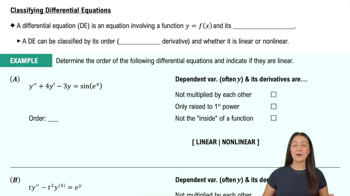
 07:39
07:39
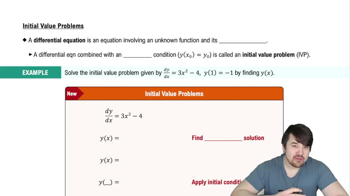 05:03
05:03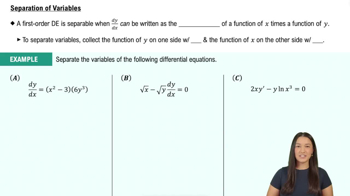 07:15
07:15Explain why or why not Determine whether the following statements are true and give an explanation or counterexample.
a. The differential equation y′+2y=t is first-order, linear, and separable.
Growth rate functions
a. Show that the logistic growth rate function f(P)=rP(1−P/K) has a maximum value of rK/4 at the point P=K/2.
29–32. {Use of Tech} Errors in Euler’s method Consider the following initial value problems.
a. Find the approximations to y(0.2) and y(0.4) using Euler’s method with time steps of Δt = 0.2, 0.1, 0.05, and 0.025.
y′(t) = y/2, y(0) = 2; y(t) = 2eᵗᐟ²
42–43. Implicit solutions for separable equations For the following separable equations, carry out the indicated analysis.
a. Find the general solution of the equation.
e⁻ʸᐟ²y'(x) = 4x sin x² − x; y(0) = 0, y(0) = ln(1/4), y(√(π/2)) = 0
38–43. Equilibrium solutions A differential equation of the form y′(t)=f(y) is said to be autonomous (the function f depends only on y). The constant function y=y0 is an equilibrium solution of the equation provided f(y0)=0 (because then y'(t)=0 and the solution remains constant for all t). Note that equilibrium solutions correspond to horizontal lines in the direction field. Note also that for autonomous equations, the direction field is independent of t. Carry out the following analysis on the given equations.
a. Find the equilibrium solutions.
y′(t) = y(2 - y)
27–30. Predator-prey models Consider the following pairs of differential equations that model a predator-prey system with populations x and y. In each case, carry out the following steps.
a. Identify which equation corresponds to the predator and which corresponds to the prey.
x′(t) = −3x + xy, y′(t) = 2y − xy