
Ch.12 - Parametric and Polar Curves
Briggs - Calculus: Early Transcendentals 3rd Edition
Briggs3rd EditionCalculus: Early TranscendentalsISBN: 9780136847243Not the one you use?Change textbook
Chapter 12, Problem 12.2.28

25–30. Converting coordinates Express the following polar coordinates in Cartesian coordinates.


(2, 7π/4)

Verified step by step guidance
1
Recall the formulas to convert polar coordinates \((r, \theta)\) to Cartesian coordinates \((x, y)\): \(x = r \cos(\theta)\) \(y = r \sin(\theta)\)
Identify the given polar coordinates: \(r = 2\) \(\theta = \frac{7\pi}{4}\)
Substitute the values into the conversion formulas: \(x = 2 \cos\left(\frac{7\pi}{4}\right)\) \(y = 2 \sin\left(\frac{7\pi}{4}\right)\)
Evaluate the trigonometric functions \(\cos\left(\frac{7\pi}{4}\right)\) and \(\sin\left(\frac{7\pi}{4}\right)\) using the unit circle or known values for these angles.
Multiply the results by \(r = 2\) to find the Cartesian coordinates \((x, y)\).

Verified video answer for a similar problem:

This video solution was recommended by our tutors as helpful for the problem above.
Video duration:
1m
Was this helpful?

Key Concepts

Here are the essential concepts you must grasp in order to answer the question correctly.

Polar Coordinates

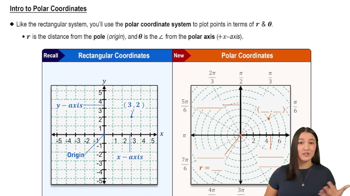
Polar coordinates represent a point in the plane using a distance from the origin (radius r) and an angle θ measured from the positive x-axis. They are expressed as (r, θ), where r ≥ 0 and θ is typically in radians.
Recommended video:
05:32
Intro to Polar Coordinates

Conversion Formulas from Polar to Cartesian Coordinates

To convert polar coordinates (r, θ) to Cartesian coordinates (x, y), use the formulas x = r cos(θ) and y = r sin(θ). These relate the radius and angle to the horizontal and vertical distances from the origin.
Recommended video:
05:32
Intro to Polar Coordinates

Trigonometric Values for Common Angles

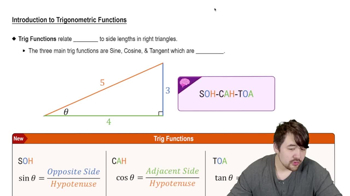
Understanding the sine and cosine values of common angles, such as 7π/4, is essential for conversion. For example, cos(7π/4) = √2/2 and sin(7π/4) = -√2/2, which help compute exact Cartesian coordinates.
Recommended video:
6:04
Introduction to Trigonometric Functions
Related Practice
Textbook Question

13–30. Graphing conic sections Determine whether the following equations describe a parabola, an ellipse, or a hyperbola, and then sketch a graph of the curve. For each parabola, specify the location of the focus and the equation of the directrix; for each ellipse, label the coordinates of the vertices and foci, and find the lengths of the major and minor axes; for each hyperbola, label the coordinates of the vertices and foci, and find the equations of the asymptotes.


x²/9 + y²/4 = 1

73
views
Textbook Question

45–60. Areas of regions Find the area of the following regions.


The region inside the lemniscate r² = 6 sin 2θ

30
views
Textbook Question

What is the polar equation of a circle of radius √(a²+b²) centered at (a, b)?

85
views
Textbook Question

33–40. Areas of regions Make a sketch of the region and its bounding curves. Find the area of the region.


The region inside the limaçon r = 2 + cos θ

52
views
Textbook Question

15–30. Working with parametric equations Consider the following parametric equations.

a. Eliminate the parameter to obtain an equation in x and y.

b. Describe the curve and indicate the positive orientation.


x = 3 cos t, y = 3 sin t; π ≤ t ≤ 2π

53
views
Textbook Question

13–30. Graphing conic sections Determine whether the following equations describe a parabola, an ellipse, or a hyperbola, and then sketch a graph of the curve. For each parabola, specify the location of the focus and the equation of the directrix; for each ellipse, label the coordinates of the vertices and foci, and find the lengths of the major and minor axes; for each hyperbola, label the coordinates of the vertices and foci, and find the equations of the asymptotes.


x² + y²/9 = 1

79
views