
Ch.12 - Parametric and Polar Curves
Briggs - Calculus: Early Transcendentals 3rd Edition
Briggs3rd EditionCalculus: Early TranscendentalsISBN: 9780136847243Not the one you use?Change textbook
Chapter 12, Problem 12.2.4

What is the polar equation of a circle of radius √(a²+b²) centered at (a, b)?

Verified step by step guidance
1
Recall that the Cartesian equation of a circle centered at \((a, b)\) with radius \(r\) is given by \((x - a)^2 + (y - b)^2 = r^2\). In this problem, the radius is \(\sqrt{a^2 + b^2}\), so the equation becomes \((x - a)^2 + (y - b)^2 = a^2 + b^2\).
Express the Cartesian coordinates \(x\) and \(y\) in terms of polar coordinates \(r\) and \(\theta\) using the relations \(x = r \cos \theta\) and \(y = r \sin \theta\). Substitute these into the circle equation to get \((r \cos \theta - a)^2 + (r \sin \theta - b)^2 = a^2 + b^2\).
Expand the squares on the left-hand side: \((r \cos \theta)^2 - 2 a r \cos \theta + a^2 + (r \sin \theta)^2 - 2 b r \sin \theta + b^2 = a^2 + b^2\).
Combine like terms and simplify. Notice that \((r \cos \theta)^2 + (r \sin \theta)^2 = r^2\), and \(a^2 + b^2\) appears on both sides, so they cancel out. This leaves the equation \(r^2 - 2 a r \cos \theta - 2 b r \sin \theta = 0\).
Factor out \(r\) from the terms involving it: \(r^2 = 2 r (a \cos \theta + b \sin \theta)\). Since \(r \neq 0\), divide both sides by \(r\) to get the polar equation of the circle: \(\boxed{r = 2 (a \cos \theta + b \sin \theta)}\).

Verified video answer for a similar problem:

This video solution was recommended by our tutors as helpful for the problem above.
Video duration:
4m
Was this helpful?

Key Concepts

Here are the essential concepts you must grasp in order to answer the question correctly.

Polar Coordinates

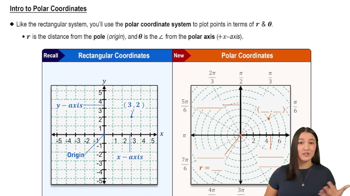
Polar coordinates represent points in the plane using a distance from the origin (r) and an angle (θ) from the positive x-axis. Unlike Cartesian coordinates (x, y), polar coordinates express location based on radius and direction, which is essential for converting equations of curves into polar form.
Recommended video:
05:32
Intro to Polar Coordinates

Equation of a Circle in Cartesian Coordinates

A circle centered at (a, b) with radius R has the Cartesian equation (x - a)² + (y - b)² = R². Understanding this standard form is crucial before converting it into polar coordinates, as it provides the geometric definition and parameters of the circle.
Recommended video:
05:32
Intro to Polar Coordinates

Conversion Between Cartesian and Polar Coordinates

To convert Cartesian equations to polar form, use x = r cos θ and y = r sin θ. Substituting these into the Cartesian equation allows rewriting the curve in terms of r and θ, enabling the derivation of the polar equation of the circle.
Recommended video:
05:32
Intro to Polar Coordinates