
Ch.12 - Parametric and Polar Curves
Briggs - Calculus: Early Transcendentals 3rd Edition
Briggs3rd EditionCalculus: Early TranscendentalsISBN: 9780136847243Not the one you use?Change textbook
Chapter 12, Problem 12.2.60

57–64. Graphing polar curves Graph the following equations. Use a graphing utility to check your work and produce a final graph.


r² = 4 sin θ  

Verified step by step guidance
1
Recognize that the given equation is in polar form: \(r^{2} = 4 \sin \theta\). Our goal is to understand the shape of this curve by analyzing and possibly converting it to Cartesian coordinates or by studying its behavior in polar coordinates.
Recall the relationships between polar and Cartesian coordinates: \(x = r \cos \theta\), \(y = r \sin \theta\), and \(r^{2} = x^{2} + y^{2}\). These will help us rewrite the equation in a more familiar form if needed.
Substitute \(r^{2} = x^{2} + y^{2}\) and \(\sin \theta = \frac{y}{r}\) into the equation: \(r^{2} = 4 \sin \theta\) becomes \(x^{2} + y^{2} = 4 \cdot \frac{y}{r}\). Multiply both sides by \(r\) to eliminate the denominator, remembering that \(r = \sqrt{x^{2} + y^{2}}\).
After multiplying, you get \((x^{2} + y^{2}) \cdot r = 4y\). Substitute \(r = \sqrt{x^{2} + y^{2}}\) back in to get \((x^{2} + y^{2}) \sqrt{x^{2} + y^{2}} = 4y\). This is a Cartesian form that can help identify the curve's shape.
Analyze the resulting equation or use the original polar form to plot points for various values of \(\theta\) between \(0\) and \(2\pi\). Note the symmetry and key points (like where \(r=0\) or \(r\) is maximum) to sketch the graph. Finally, use a graphing utility to verify your sketch.

Verified video answer for a similar problem:

This video solution was recommended by our tutors as helpful for the problem above.
Video duration:
4m
Was this helpful?

Key Concepts

Here are the essential concepts you must grasp in order to answer the question correctly.

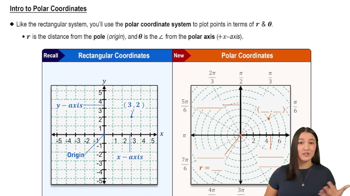
Polar Coordinates and Polar Equations

Polar coordinates represent points using a radius and an angle (r, θ) instead of Cartesian (x, y). Understanding how to interpret and plot equations in polar form, such as r² = 4 sin θ, is essential for graphing curves defined by radius as a function of angle.
Recommended video:
05:32
Intro to Polar Coordinates

Graphing Polar Curves

Graphing polar curves involves plotting points for various values of θ and corresponding r values, then connecting these points smoothly. Recognizing symmetry and key features like intercepts and maximum radius helps in sketching accurate graphs of polar equations.
Recommended video:
09:04
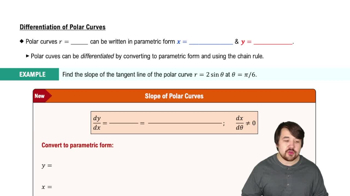
Slope of Polar Curves

Using Graphing Utilities for Polar Graphs

Graphing utilities can plot polar equations quickly and accurately, allowing verification of manual sketches. Familiarity with inputting polar equations and interpreting the resulting graphs aids in understanding the shape and behavior of complex polar curves.
Recommended video:
06:15
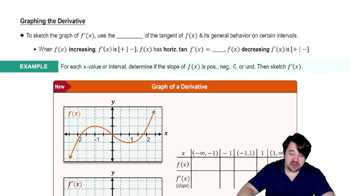
Graphing The Derivative
Related Practice
Textbook Question

53–56. Circular motion Find parametric equations that describe the circular path of the following objects. For Exercises 53–55, assume (x, y) denotes the position of the object relative to the origin at the center of the circle. Use the units of time specified in the problem. There are many ways to describe any circle.


A bicyclist rides counterclockwise with constant speed around a circular velodrome track with a radius of 50 m, completing one lap in 24 seconds.

47
views
Textbook Question

Given three polar coordinate representations for the origin.

89
views
Textbook Question

Second derivative Assume a curve is given by the parametric equations x=f(t) and y=g(t), where f and g are twice differentiable. Use the Chain Rule to show that y″x=(fʹ(t)g″(t)−gʹ(t)f″(t))/(fʹ(t))³.  

43
views
Textbook Question

Air drop—inverse problem A plane traveling horizontally at 100 m/s over flat ground at an elevation of 4000 m must drop an emergency packet on a target on the ground. The trajectory of the packet is given by

x = 100t, y = −4.9t² + 4000, t ≥ 0

where the origin is the point on the ground directly beneath the plane at the moment of the release. How many horizontal meters before the target should the packet be released in order to hit the target?

47
views
Textbook Question

63–74. Arc length of polar curves Find the length of the following polar curves.


{Use of Tech} The complete limaçon r=4−2cosθ

24
views
Textbook Question

25–30. Converting coordinates Express the following polar coordinates in Cartesian coordinates.


(4, 5π)

69
views