
Ch.12 - Parametric and Polar Curves
Briggs - Calculus: Early Transcendentals 3rd Edition
Briggs3rd EditionCalculus: Early TranscendentalsISBN: 9780136847243Not the one you use?Change textbook
Chapter 12, Problem 12.2.8

Given three polar coordinate representations for the origin.

Verified step by step guidance
1
Understand that the origin in polar coordinates is represented by the point where the radius \(r = 0\). This means the distance from the origin to the point is zero, regardless of the angle \(\theta\).
Recall that in polar coordinates, a point is given by \((r, \theta)\), where \(r\) is the radius (distance from the origin) and \(\theta\) is the angle measured from the positive x-axis.
Since the radius \(r = 0\) at the origin, the angle \(\theta\) can be any real number because the point is at the center and the direction does not affect its position.
Therefore, the three polar coordinate representations for the origin can be written as \((0, \theta_1)\), \((0, \theta_2)\), and \((0, \theta_3)\), where \(\theta_1\), \(\theta_2\), and \(\theta_3\) are any angles.
In summary, the key concept is that the origin in polar coordinates is always represented by \(r = 0\), and the angle \(\theta\) is arbitrary.

Verified video answer for a similar problem:

This video solution was recommended by our tutors as helpful for the problem above.
Video duration:
1m
Was this helpful?

Key Concepts

Here are the essential concepts you must grasp in order to answer the question correctly.

Polar Coordinates System

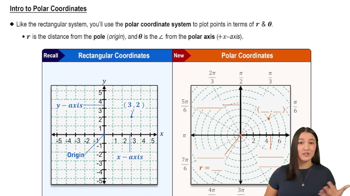
Polar coordinates represent points in a plane using a radius and an angle relative to a fixed direction, typically the positive x-axis. Each point is described by (r, θ), where r is the distance from the origin and θ is the angle measured in radians or degrees.
Recommended video:
05:32
Intro to Polar Coordinates

Multiple Representations of the Same Point

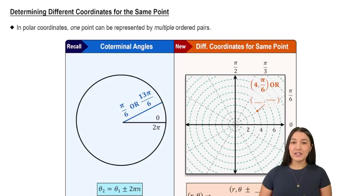
In polar coordinates, a single point can have multiple representations because adding or subtracting full rotations (2π radians) to the angle or using negative radius values can yield equivalent positions. For example, the origin (r=0) is represented by any angle θ.
Recommended video:
6:02
Determining Different Coordinates for the Same Point

The Origin in Polar Coordinates

The origin in polar coordinates is unique because its radius r is zero, making the angle θ arbitrary. This means the origin can be represented by infinitely many coordinate pairs (0, θ), highlighting the flexibility and special nature of the origin in this system.
Recommended video:
05:32
Intro to Polar Coordinates
Related Practice
Textbook Question

53–56. Circular motion Find parametric equations that describe the circular path of the following objects. For Exercises 53–55, assume (x, y) denotes the position of the object relative to the origin at the center of the circle. Use the units of time specified in the problem. There are many ways to describe any circle.


A bicyclist rides counterclockwise with constant speed around a circular velodrome track with a radius of 50 m, completing one lap in 24 seconds.

47
views
Textbook Question

31–38. Equations of parabolas Find an equation of the following parabolas. Unless otherwise specified, assume the vertex is at the origin.

A parabola that opens to the right with directrix x = -4

78
views
Textbook Question

81–88. Arc length Find the arc length of the following curves on the given interval.


x = sin t, y = t - cos t; 0 ≤ t ≤ π/2

85
views
Textbook Question

90–94. Focal chords A focal chord of a conic section is a line through a focus joining two points of the curve. The latus rectum is the focal chord perpendicular to the major axis of the conic. Prove the following properties.

Let L be the latus rectum of the parabola y ² =4px for p>0. Let F be the focus of the parabola, P be any point on the parabola to the left of L, and D be the (shortest) distance between P and L. Show that for all P, D+|FP|+ is a constant. Find the constant.

78
views
Textbook Question

Second derivative Assume a curve is given by the parametric equations x=f(t) and y=g(t), where f and g are twice differentiable. Use the Chain Rule to show that y″x=(fʹ(t)g″(t)−gʹ(t)f″(t))/(fʹ(t))³.  

43
views
Textbook Question

57–64. Graphing polar curves Graph the following equations. Use a graphing utility to check your work and produce a final graph.


r² = 4 sin θ  

54
views