
Ch.12 - Parametric and Polar Curves
Briggs - Calculus: Early Transcendentals 3rd Edition
Briggs3rd EditionCalculus: Early TranscendentalsISBN: 9780136847243Not the one you use?Change textbook
Chapter 12, Problem 12.3.81a

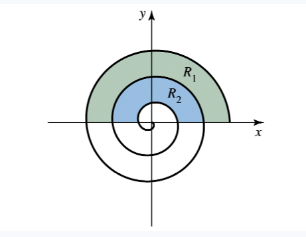
Regions bounded by a spiral: Let Rₙ be the region bounded by the nth turn and the (n+1)st turn of the spiral r = e⁻ᶿ in the first and second quadrants, for θ ≥ 0 (see figure).
a. Find the area Aₙ of Rₙ.


Spiral curve r = e^(-θ) with shaded regions R₁ and R₂ between consecutive turns in the first two quadrants.

Verified step by step guidance
1
Identify the spiral given by the polar equation \(r = e^{-\theta}\), where \(\theta \geq 0\). The regions \(R_n\) are bounded between the \(n\)th and \((n+1)\)st turns of the spiral, which correspond to \(\theta = n\pi\) and \(\theta = (n+1)\pi\) respectively, since one full turn corresponds to an increase of \(\pi\) in \(\theta\) (covering the first and second quadrants).
Recall the formula for the area of a region bounded by a polar curve between angles \(\alpha\) and \(\beta\): \(A = \frac{1}{2} \int_{\alpha}^{\beta} r^2 \, d\theta\)
Apply this formula to find the area \(A_n\) of the region \(R_n\) by integrating \(r^2 = (e^{-\theta})^2 = e^{-2\theta}\) from \(\theta = n\pi\) to \(\theta = (n+1)\pi\): \(A_n = \frac{1}{2} \int_{n\pi}^{(n+1)\pi} e^{-2\theta} \, d\theta\)
Evaluate the integral \(\int e^{-2\theta} \, d\theta\). Use the substitution method or recall that the integral of \(e^{ax}\) is \(\frac{1}{a} e^{ax}\), so here it becomes \(-\frac{1}{2} e^{-2\theta}\) plus a constant of integration.
Substitute the limits \(n\pi\) and \((n+1)\pi\) into the evaluated integral and multiply by \(\frac{1}{2}\) to express \(A_n\) in terms of \(n\). This will give the exact area of the region \(R_n\) bounded by the \(n\)th and \((n+1)\)st turns of the spiral.

Verified video answer for a similar problem:

This video solution was recommended by our tutors as helpful for the problem above.
Video duration:
4m
Was this helpful?

Key Concepts

Here are the essential concepts you must grasp in order to answer the question correctly.

Polar Coordinates and Curves

Polar coordinates represent points using a radius and angle (r, θ), which is essential for describing curves like spirals. The given spiral r = e^(-θ) is defined in terms of θ, making it natural to analyze areas bounded by turns using polar integration.
Recommended video:
05:32
Intro to Polar Coordinates

Area in Polar Coordinates

The area enclosed by a curve in polar coordinates between angles θ = a and θ = b is found using the integral A = 1/2 ∫[a to b] (r(θ))^2 dθ. This formula is crucial for calculating the area of regions bounded by consecutive turns of the spiral.
Recommended video:
05:32
Intro to Polar Coordinates

Understanding Regions Bounded by Spiral Turns

The region Rₙ lies between the nth and (n+1)st turns of the spiral, corresponding to θ values nπ/2 and (n+1)π/2 in the first and second quadrants. Identifying these angular bounds is key to setting up the integral for the area Aₙ.
Recommended video:
04:34
Area of Polar Regions Example 3