

Ch.12 - Parametric and Polar Curves
Briggs - Calculus: Early Transcendentals 3rd Edition
Briggs3rd EditionCalculus: Early TranscendentalsISBN: 9780136847243Not the one you use?Change textbook
Chapter 12, Problem 12.3.82b

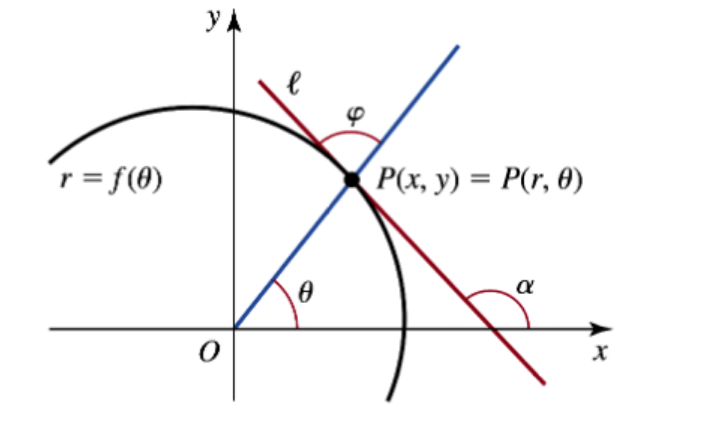
Tangents and normals: Let a polar curve be described by r = f(θ), and let ℓ be the line tangent to the curve at the point P(x,y) = P(r,θ) (see figure).
b. Explain why tan θ = y/x.


Graph of a polar curve r = f(θ) with point P(r, θ), tangent line ℓ, and angles θ, φ, and α marked.

Verified step by step guidance
1
Recall that the point P on the polar curve is given by the coordinates \(P(x,y) = P(r, \theta)\), where \(r = f(\theta)\) is the radius and \(\theta\) is the angle measured from the positive x-axis.
By definition of polar coordinates, the Cartesian coordinates \((x,y)\) of the point \(P\) are related to \(r\) and \(\theta\) by the formulas: \(x = r \cos(\theta)\) and \(y = r \sin(\theta)\).
To find \(\tan(\theta)\), use the ratio of \(y\) to \(x\): \(\tan(\theta) = \frac{y}{x}\).
Substitute the expressions for \(x\) and \(y\) in terms of \(r\) and \(\theta\): \(\tan(\theta) = \frac{r \sin(\theta)}{r \cos(\theta)}\).
Since \(r \neq 0\), the \(r\) cancels out, leaving \(\tan(\theta) = \frac{\sin(\theta)}{\cos(\theta)}\), which is the definition of \(\tan(\theta)\). Therefore, \(\tan(\theta) = \frac{y}{x}\).

Verified video answer for a similar problem:

This video solution was recommended by our tutors as helpful for the problem above.
Video duration:
2m
Was this helpful?

Key Concepts

Here are the essential concepts you must grasp in order to answer the question correctly.

Polar to Cartesian Coordinate Conversion

In polar coordinates, a point is represented as (r, θ), where r is the distance from the origin and θ is the angle from the positive x-axis. The Cartesian coordinates (x, y) can be found using x = r cos θ and y = r sin θ. This conversion is fundamental to relate polar and Cartesian systems.
Recommended video:
05:32
Intro to Polar Coordinates

Definition of the Tangent of an Angle in a Right Triangle

The tangent of an angle θ in a right triangle is defined as the ratio of the length of the side opposite θ to the length of the adjacent side. In the Cartesian plane, for a point (x, y), tan θ = y/x represents the slope of the line from the origin to the point, linking the angle θ to the coordinates.
Recommended video:
05:43
Definition of the Definite Integral

Geometric Interpretation of Angle θ in Polar Coordinates

Angle θ in polar coordinates is the angle between the positive x-axis and the line segment OP connecting the origin to point P. Since tan θ = opposite/adjacent = y/x, this directly follows from the right triangle formed by dropping a perpendicular from P to the x-axis, confirming why tan θ = y/x.
Recommended video:
05:32
Intro to Polar Coordinates
Related Practice