Back
Back
Problem 12.1.13a
11–14. Working with parametric equations Consider the following parametric equations.
a. Make a brief table of values of t, x, and y.
b. Plot the (x, y) pairs in the table and the complete parametric curve, indicating the positive orientation (the direction of increasing t).
x=−t+6, y=3t−3; −5≤t≤5
Problem 12.3.80a
Area of roses Assume m is a positive integer.
a. Even number of leaves: What is the relationship between the total area enclosed by the 4m-leaf rose r=cos(2mθ) and m?
Problem 12.2.108a
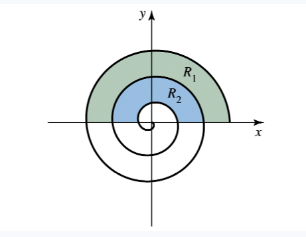
Channel flow Water flows in a shallow semicircular channel with inner and outer radii of 1 m and 2 m (see figure). At a point P(r,θ) in the channel, the flow is in the tangential direction (counterclock wise along circles), and it depends only on r, the distance from the center of the semicircles.
a. Express the region formed by the channel as a set in polar coordinates.
Problem 12.4.83a
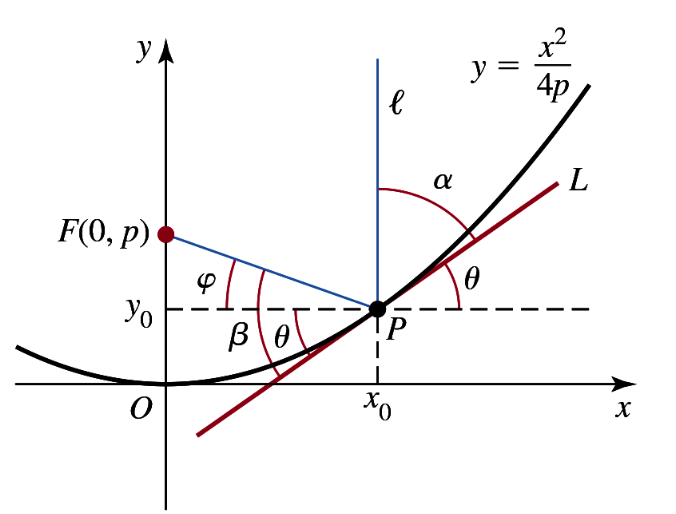
Reflection property of parabolas: Consider the parabola y = x²/(4p) with its focus at F(0, p). The goal is to show that the angle of incidence (α) equals the angle of reflection (β).
a. Let P(x₀, y₀) be a point on the parabola. Show that the slope of the tangent line at P is tan θ = x₀/(2p).
Problem 12.4.80a
Area of a sector of a hyperbola: Consider the region R bounded by the right branch of the hyperbola x²/a² - y²/b² = 1 and the vertical line through the right focus
a. What is the area of R?
Problem 12.2.85a
Navigating A plane is 150 miles north of a radar station, and 30 minutes later it is 60 degree east of north at a distance of 100 miles from the radar station. Assume the plane flies on a straight line and maintains constant altitude during this 30-minute period.
a. Find the distance traveled during this 30-minute period.
Problem 12.1.95a
Intersecting lines Consider the following pairs of lines. Determine whether the lines are parallel or intersecting. If the lines intersect, then determine the point of intersection.
a. x = 1 + s, y = 2s and x = 1 + 2t, y = 3t
Problem 12.4.78a
The ellipse and the parabola: Let R be the region bounded by the upper half of the ellipse x²/2 + y² = 1 and the parabola y = x²/√2
a. Find the area of R
Problem 12.1.67a
67–72. Derivatives Consider the following parametric curves.
a. Determine dy/dx in terms of t and evaluate it at the given value of t.
x = 2 + 4t, y = 4 − 8t; t = 2
Problem 12.4.81a
Volume of a hyperbolic cap Consider the region R bounded by the right branch of the hyperbola x²/a² - y²/b² = 1 and the vertical line through the right focus.
a. What is the volume of the solid that is generated when R is revolved about the x-axis?
Problem 12.2.77a
Explain why or why not Determine whether the following statements are true and give an explanation or counterexample.
a. The point with Cartesian coordinates (−2, 2) has polar coordinates (2√2, 3π/4), (2√2, 11π/4), (2√2, −5π/4), and (−2√2,−π/4).
Problem 12.1.69a
67–72. Derivatives Consider the following parametric curves.
a. Determine dy/dx in terms of t and evaluate it at the given value of t.
x = cos t, y = 8 sin t; t = π/2
Problem 12.1.71a
67–72. Derivatives Consider the following parametric curves.
a. Determine dy/dx in terms of t and evaluate it at the given value of t.
x = t + 1/t, y = t − 1/t; t = 1
Problem 12.2.106a
(Use of Tech) Finger curves: r = f(θ) = cos(aᶿ) - 1.5, where a = (1 + 12π)^(1/(2π)) ≈ 1.78933
a. Show that f(0) = f(2π) and find the point on the curve that corresponds to θ = 0 and θ = 2π.
Problem 12.3.81a
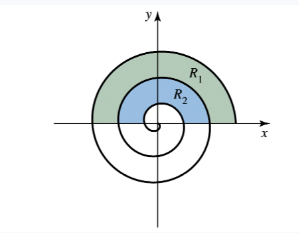
Regions bounded by a spiral: Let Rₙ be the region bounded by the nth turn and the (n+1)st turn of the spiral r = e⁻ᶿ in the first and second quadrants, for θ ≥ 0 (see figure).
a. Find the area Aₙ of Rₙ.
Problem 12.1.11a
11–14. Working with parametric equations Consider the following parametric equations.
a. Make a brief table of values of t, x, and y.
b. Plot the (x, y) pairs in the table and the complete parametric curve, indicating the positive orientation (the direction of increasing t).
x=2 t,y=3t−4;−10≤d≤10
Problem 12.3.82b
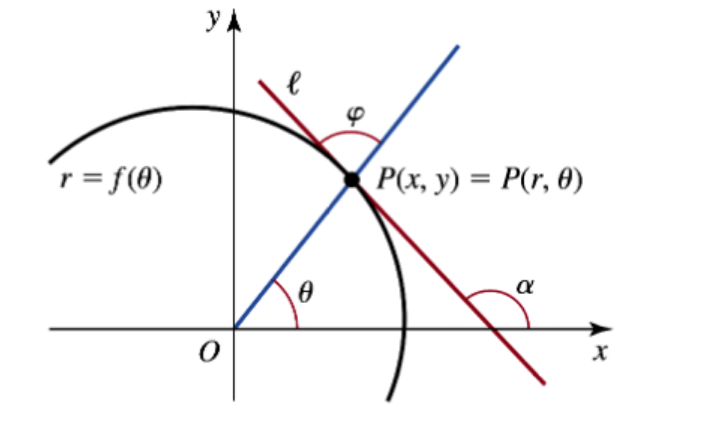
Tangents and normals: Let a polar curve be described by r = f(θ), and let ℓ be the line tangent to the curve at the point P(x,y) = P(r,θ) (see figure).
b. Explain why tan θ = y/x.
Problem 12.1.89b
Explain why or why not Determine whether the following statements are true and give an explanation or counterexample.
b. An object following the parametric curve x=2cos 2πt, y=2 sin 2πt circles the origin once every 1 time unit.
Problem 12.1.95b
Intersecting lines Consider the following pairs of lines. Determine whether the lines are parallel or intersecting. If the lines intersect, then determine the point of intersection.
b. x = 2 + 5s, y = 1 + s and x = 4 + 10t, y = 3 + 2t
Problem 12.4.51b
Explain why or why not Determine whether the following statements are true and give an explanation or counterexample.
b. On every ellipse, there are exactly two points at which the curve has slope s, where s is any real number.
Problem 12.4.81b
Volume of a hyperbolic cap Consider the region R bounded by the right branch of the hyperbola x²/a² - y²/b² = 1 and the vertical line through the right focus.
b. What is the volume of the solid that is generated when R is revolved about the y-axis?
Problem 12.1.67b
67–72. Derivatives Consider the following parametric curves.
b. Make a sketch of the curve showing the tangent line at the point corresponding to the given value of t.
x = 2 + 4t, y = 4 − 8t; t = 2
Problem 12.1.89c
Explain why or why not Determine whether the following statements are true and give an explanation or counterexample.
c. The parametric equations x=t, y=t², for t≥0, describe the complete parabola y=x².
Problem 12.3.81c
Regions bounded by a spiral: Let Rₙ be the region bounded by the nth turn and the (n+1)st turn of the spiral r = e⁻ᶿ in the first and second quadrants, for θ ≥ 0 (see figure).
c. Evaluate lim(n→∞) Aₙ₊₁/Aₙ.
Problem 12.1.13c
11–14. Working with parametric equations Consider the following parametric equations.
c. Eliminate the parameter to obtain an equation in x and y.
d. Describe the curve.
x=−t+6, y=3t−3; −5≤t≤5
Problem 12.3.78c
Spiral arc length Consider the spiral r=4θ, for θ≥0.
c. Show that L′(θ)>0. Is L″(θ) positive or negative? Interpret your answer.
Problem 12.1.11c
11–14. Working with parametric equations Consider the following parametric equations.
c. Eliminate the parameter to obtain an equation in x and y.
d. Describe the curve.
x=2 t,y=3t−4;−10≤t≤10
Problem 12.1.95c
Intersecting lines Consider the following pairs of lines. Determine whether the lines are parallel or intersecting. If the lines intersect, then determine the point of intersection.
c. x = 1 + 3s, y = 4 + 2s and x = 4 - 3t, y = 6 + 4t
Problem 12.4.51d
Explain why or why not Determine whether the following statements are true and give an explanation or counterexample.
d. The point on a parabola closest to the focus is the vertex.
Problem 12.2.77d
Explain why or why not Determine whether the following statements are true and give an explanation or counterexample.
d. The point (3,π/2) lies on the graph of r=3 cos 2θ.