Back
Back
Problem 2.8c
Limits and Continuity
On what intervals are the following functions continuous?
c. h(x) = cos x / x―π
Problem 2.2.54c
Suppose limx→4 f(x) = 0 and lim x→4 g(x) = −3. Find
c. limx→4 (g(x))²
Problem 2.48d
Horizontal and Vertical Asymptotes
Use limits to determine the equations for all horizontal asymptotes.
_________
/ x² + 9
d. y = / -------------
√ 9x² + 1
Problem 2d
Finding Limits Graphically
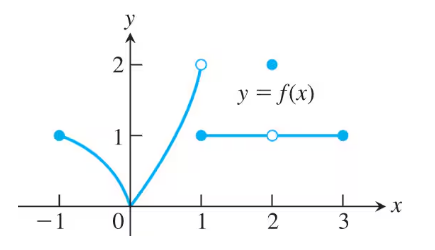
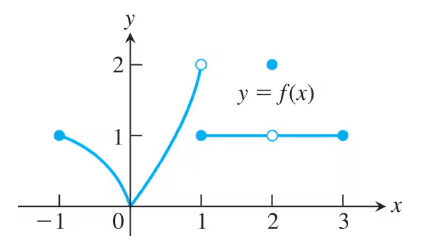
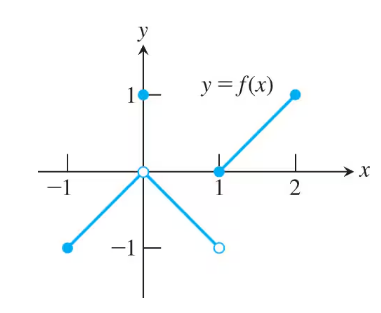
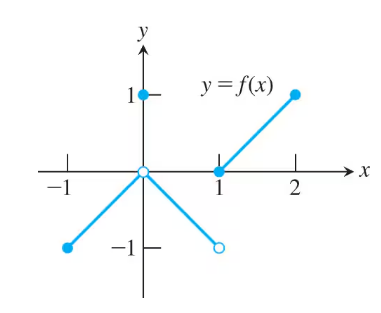
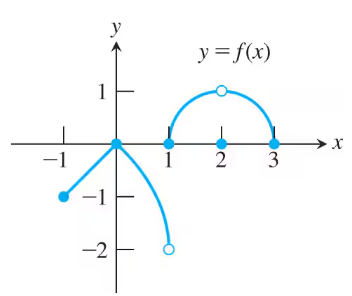
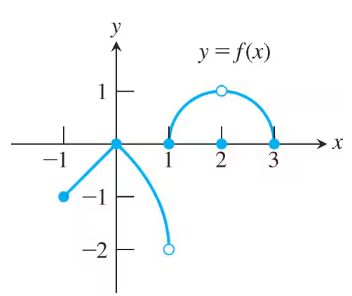
Which of the following statements about the function y = f(x) graphed here are true, and which are false?
d. limx→1− f(x) = 2
Problem 2.8d
Limits and Continuity
On what intervals are the following functions continuous?
d. k(x) = sin x / x
Problem 2.4.10d
Finding Limits Graphically
Graph the functions in Exercises 9 and 10. Then answer these questions.
f(x) = {x,−1 ≤ x < 0, or 0 < x ≤ 1
1, x = 0
0, x < −1 or x > 1
d. At what points does the right-hand limit exist but not the left-hand limit?
Problem 2.7d
Limits and Continuity
On what intervals are the following functions continuous?
d. k(x) = x⁻¹/⁶
Problem 2e
Finding Limits Graphically
Which of the following statements about the function y = f(x) graphed here are true, and which are false?
e. limx→1+ f(x) = 1
Problem 2.4.2g
Finding Limits Graphically
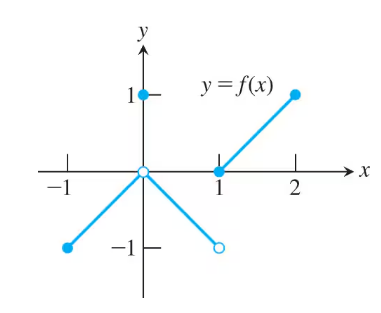
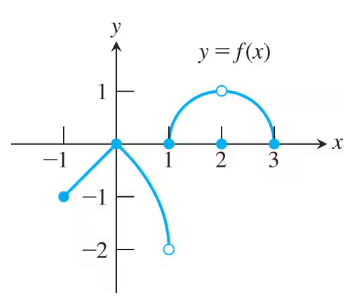
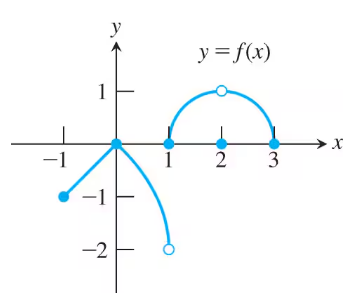
Which of the following statements about the function y = f(x) graphed here are true, and which are false?
<IMAGE>
g. limx→0+ f(x) = limx→0− f(x)
Problem 2.6.1h
Finding Limits
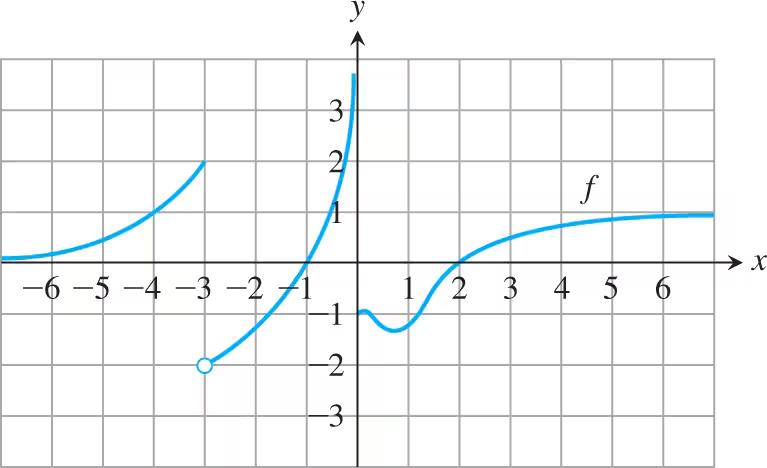
For the function f whose graph is given, determine the following limits. Write ∞ or −∞ where appropriate.
h. lim x → ∞ f(x)
Problem 2.2.3h
Which of the following statements about the function y=f(x) graphed here are true, and which are false?
h. f(0)=0
Problem 2.4.2k
Finding Limits Graphically
Which of the following statements about the function y = f(x) graphed here are true, and which are false?
<IMAGE>
k. limx→3+ f(x) does not exist.
Problem 3e
Limits and Continuity
Suppose that ƒ(t) and ƒ(t) are defined for all t and that lim t → t₀ ƒ(t) = ―7 and lim (t → t₀) g (t) = 0 . Find the limit as t → t₀ of the following functions.
e. cos (g(t))
Problem 3f
Limits and Continuity
Suppose that ƒ(t) and ƒ(t) are defined for all t and that lim t → t₀ ƒ(t) = ―7 and lim (t → t₀) g (t) = 0 . Find the limit as t → t₀ of the following functions.
f. | ƒ(t) |
Problem 3g
Which of the following statements about the function y=f(x) graphed here are true, and which are false?
g. limx→1 f(x) does not exist.
Problem 3h
Limits and Continuity
Suppose that ƒ(t) and ƒ(t) are defined for all t and that lim t → t₀ ƒ(t) = ―7 and lim (t → t₀) g (t) = 0 . Find the limit as t → t₀ of the following functions.
h. 1 / ƒ(t)
Problem 3i
Which of the following statements about the function y=f(x) graphed here are true, and which are false?
i. f(0)=1
Problem 4a
Which of the following statements about the function y=f(x) graphed here are true, and which are false?
a. limx→2 f(x) does not exist.
Problem 4b
Which of the following statements about the function y=f(x) graphed here are true, and which are false?
b. limx→2 f(x)=2
Problem 4c
Which of the following statements about the function y=f(x) graphed here are true, and which are false?
c. limx→1 f(x) does not exist.
Problem 4d
Which of the following statements about the function y=f(x) graphed here are true, and which are false?
d. limx→c f(x) exists at every point c in (-1,1).
Problem 4e
Limits and Continuity
Suppose the functions ƒ(x) and g(x) are defined for all x and that lim (x → 0) ƒ(x) = 1/2 and lim (x → 0) g(x) = √2. Find the limits as x → 0 of the following functions.
e. x + ƒ(x)
Problem 4f
Limits and Continuity
Suppose the functions ƒ(x) and g(x) are defined for all x and that lim (x → 0) ƒ(x) = 1/2 and lim (x → 0) g(x) = √2. Find the limits as x → 0 of the following functions.
f. [ƒ(x) • cos x ] / x―1
Problem 5
Limits and Continuity
In Exercises 5 and 6, find the value that lim (x→0) g(x) must have if the given limit statements hold.
lim ((4―g(x)) / x ) = 1
x→0
Problem 6
Limits and Continuity
In Exercises 5 and 6, find the value that lim (x→0) g(x) must have if the given limit statements hold.
lim (x lim g(x)) = 2
x→-4 x→0
Problem 9
Finding Deltas Graphically
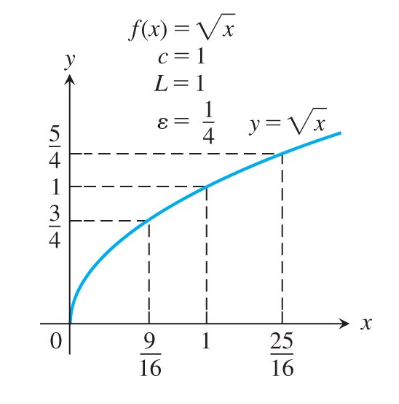
In Exercises 7–14, use the graphs to find a δ>0 such that |f(x)−L| <ε whenever 0< |x−c| <δ.
Problem 12
Finding Limits
In Exercises 9–24, find the limit or explain why it does not exist.
lim x→a (x² ― a²)/(x⁴ ― a⁴)
Problem 13
Finding Limits
In Exercises 9–24, find the limit or explain why it does not exist.
lim h →0 ((x + h)² ― x²)/h
Problem 20
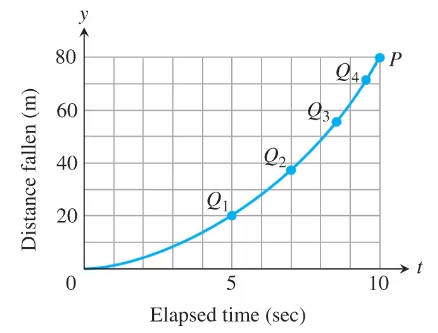
The accompanying figure shows the plot of distance fallen versus time for an object that fell from the lunar landing module a distance 80 m to the surface of the moon.
a. Estimate the slopes of the secant lines PQ₁, PQ₂, PQ₃, and PQ₄, arranging them in a table like the one in Figure 2.6.
b. About how fast was the object going when it hit the surface?
Problem 21
Finding Limits
In Exercises 9–24, find the limit or explain why it does not exist.
lim x →π sin (x/2 + sin x)