Back
Back
Problem 22
Finding Limits
In Exercises 9–24, find the limit or explain why it does not exist.
lim x →π cos² (x― tan x)
Problem 24
[Technology Exercise] Let f(t) = 1/t for t≠0.
a. Find the average rate of change of f with respect to t over the intervals (i) from t=2 to t=3, and (ii) from t=2 to t=T.
b. Make a table of values of the average rate of change of f with respect to t over the interval [2,T], for some values of T approaching 2, say T = 2.1, 2.01, 2.001, 2.0001, 2.00001, and 2.000001.
c. What does your table indicate is the rate of change of f with respect to t at t=2?
Problem 25b
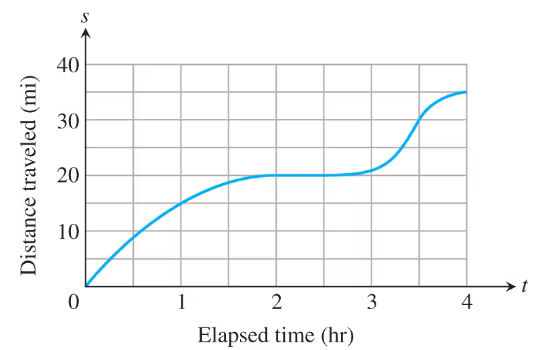
The accompanying graph shows the total distance s traveled by a bicyclist after t hours.
b. Estimate the bicyclist’s instantaneous speed at the times t=1/2, t=2, and t=3.
Problem 26c
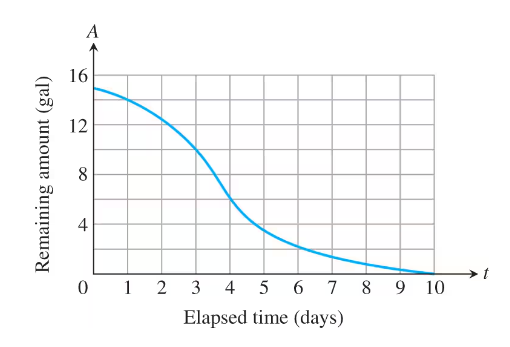
The accompanying graph shows the total amount of gasoline A in the gas tank of an automobile after it has been driven for t days.
c. Estimate the maximum rate of gasoline consumption and the specific time at which it occurs.
Problem 27
Finding Deltas Algebraically
Each of Exercises 15–30 gives a function f(x) and numbers L, c, and ε>0. In each case, find the largest open interval about c on which the inequality |f(x)−L| <ε holds. Then give a value for δ>0 such that for all x satisfying 0 < |x−c| < δ, the inequality |f(x)−L| < ε holds.
f(x) = mx, m > 0, L = 2m, c = 2, ε = 0.03
Problem 29b
[Technology Exercise] Roots
Let ƒ(𝓍) = 𝓍³ ―𝓍― 1.
b. Solve the equation ƒ(𝓍) = 0 graphically with an error of magnitude at most 10⁻⁸ .
Problem 29c
[Technology Exercise] Roots
Let ƒ(𝓍) = 𝓍³ ―𝓍― 1.
c. It can be shown that the exact value of the solution in part (b) is
(1/2 + √69/18)¹/³ + (1/2 ― √69/18)¹/³
Evaluate this exact answer and compare it with the value you found in part (b).
Problem 32
Continuous Extension
Explain why the function ƒ(𝓍) = sin(1/𝓍) has no continuous extension to 𝓍 = 0.
Problem 34
[Technology Exercise] In Exercises 33–36, graph the function to see whether it appears to have a continuous extension to the given point a. If it does, use Trace and Zoom to find a good candidate for the extended function’s value at a. If the function does not appear to have a continuous extension, can it be extended to be continuous from the right or left? If so, what do you think the extended function’s value should be?
g(θ) = 5 cos θ / (4θ ― 2π) , a = π/2
Problem 50
Find the limits in Exercises 49–52. Write ∞ or −∞ where appropriate.
lim x→(−π/2)⁺ sec x
Problem 52
Find the limits in Exercises 49–52. Write ∞ or −∞ where appropriate.
lim θ→0 (2 − cot θ)
Problem 54d
Find the limits in Exercises 53–58. Write ∞ or −∞ where appropriate.
lim x/(x² − 1) as
d. x→−1⁻
Problem 55
[Technology Exercise] Grinding engine cylinders Before contracting to grind engine cylinders to a cross-sectional area of 9in², you need to know how much deviation from the ideal cylinder diameter of c = 3.385in. you can allow and still have the area come within 0.01in² of the required 9in². To find out, you let A=π(x/2)² and look for the largest interval in which you must hold x to make |A − 9| ≤ 0.01. What interval do you find?
Problem 55b
Find the limits in Exercises 53–58. Write ∞ or −∞ where appropriate.
lim (x²/2 − 1/x) as
b. x→0⁻
Problem 55d
Find the limits in Exercises 53–58. Write ∞ or −∞ where appropriate.
lim (x²/2 − 1/x) as
d. x→−1
Problem 56b
Find the limits in Exercises 53–58. Write ∞ or −∞ where appropriate.
lim (x² − 1) / (2x + 4) as
b. x→−2⁻
Problem 57a
Find the limits in Exercises 53–58. Write ∞ or −∞ where appropriate.
lim (x² − 3x + 2) / (x³ − 2x²) as
a. x→0⁺
Problem 57d
Find the limits in Exercises 53–58. Write ∞ or −∞ where appropriate.
lim (x² − 3x + 2) / (x³ − 2x²) as
d. x→2
Problem 58b
Find the limits in Exercises 53–58. Write ∞ or −∞ where appropriate.
lim (x² − 3x + 2) / (x³ − 4x) as
b. x→−2⁺
Problem 59a
Find the limits in Exercises 59–62. Write ∞ or −∞ where appropriate.
lim (2 − 3 / t¹/³) as
a. t → 0⁺
Problem 75
Theory and Examples
If x⁴ ≤ f(x) ≤ x² for x in [−1,1] and x² ≤ f(x) ≤ x⁴ for x < - 1 and x > 1, at what points c do you automatically know limx→c f(x)? What can you say about the value of the limit at these points?
Problem 76
Theory and Examples
Suppose that g(x) ≤ f(x) ≤ h(x) for all x≠2 and suppose that lim x→2 g(x) = lim x→2 h(x) = −5. Can we conclude anything about the values of f, g, and h at x = 2? Could f(2) = 0? Could limx→2 f(x)=0? Give reasons for your answers.
Problem 100
Use the formal definitions from Exercise 97 to prove the limit statements in Exercises 98–102.
lim x→2⁻ (1 / (x − 2)) = −∞
Problem 103
Oblique Asymptotes
Graph the rational functions in Exercises 103–108. Include the graphs and equations of the asymptotes.
y = x² / (x − 1)
Problem 105
Oblique Asymptotes
Graph the rational functions in Exercises 103–108. Include the graphs and equations of the asymptotes.
y = (x² − 4) / (x − 1)
Problem 107
Oblique Asymptotes
Graph the rational functions in Exercises 103–108. Include the graphs and equations of the asymptotes.
y = (x² − 1) / x
Problem 110
Additional Graphing Exercises
[Technology Exercise] Graph the curves in Exercises 109–112. Explain the relationship between the curve’s formula and what you see.
y = −1 / √(4 − x²)
Problem 113a
[Technology Exercise] Graph the functions in Exercises 113 and 114. Then answer the following questions.
a. How does the graph behave as x → 0⁺?
Give reasons for your answers.
y = (3/2)(x − (1 / x))²/³
Problem 113c
[Technology Exercise] Graph the functions in Exercises 113 and 114. Then answer the following questions.
c. How does the graph behave near x = 1 and x = −1?
Give reasons for your answers.
y = (3/2)(x − (1 / x))²/³
Problem 114b
[Technology Exercise] Graph the functions in Exercises 113 and 114. Then answer the following questions.
b. How does the graph behave as x → ±∞?
Give reasons for your answers.
y = (3/2)(x / (x − 1))²/³