Back
Back
Problem 3.4.34e
Analyzing Motion Using Graphs
[Technology Exercise] Exercises 31–34 give the position function s = f(t) of an object moving along the s-axis as a function of time t. Graph f together with the velocity function v(t) = ds/dt = f'(t) and the acceleration function a(t) = d²s/dt² = f''(t). Comment on the object’s behavior in relation to the signs and values of v and a. Include in your commentary such topics as the following:
e. When is it moving fastest (highest speed)? Slowest?
s = 4 - 7t + 6t² - t³, 0 ≤ t ≤ 4
Problem 3.4.10e
Lunar projectile motion A rock thrown vertically upward from the surface of the moon at a velocity of 24 m/sec (about 86 km/h) reaches a height of s = 24t − 0.8t² m in t sec.
e. How long is the rock aloft?
Problem 3.6.75f
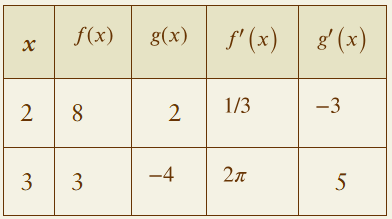
Suppose that functions f and g and their derivatives with respect to x have the following values at x = 2 and x = 3.
Find the derivatives with respect to x of the following combinations at the given value of x.
f. √f(x), x = 2
Problem 3.4.33f
Analyzing Motion Using Graphs
[Technology Exercise] Exercises 31–34 give the position function s = f(t) of an object moving along the s-axis as a function of time t. Graph f together with the velocity function v(t) = ds/dt = f'(t) and the acceleration function a(t) = d²s/dt² = f''(t). Comment on the object’s behavior in relation to the signs and values of v and a. Include in your commentary such topics as the following:
f. When is it farthest from the axis origin?
s = t³ - 6t² + 7t, 0 ≤ t ≤ 4
Problem 3.6.76f
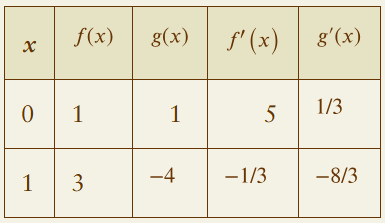
Suppose that the functions f and g and their derivatives with respect to x have the following values at x = 0 and x = 1.
Find the derivatives with respect to x of the following combinations at the given value of x.
f. (x¹¹ + f(x))⁻², x = 1
Problem 3.57g
Suppose that functions ƒ(x) and g(x) and their first derivatives have the following values at x = 0 and x = 1.
x ƒ(x) g(x) ƒ'(x) g'(x)
0 1 1 -3 1/2
1 3 5 1/2 -4
Find the first derivatives of the following combinations at the given value of x.
g. ƒ(x + g(x)), x = 0
Problem 3.6.75g
Suppose that functions f and g and their derivatives with respect to x have the following values at x = 2 and x = 3.
Find the derivatives with respect to x of the following combinations at the given value of x.
g. 1 / g²(x), x = 3
Problem 3.6.76g
Suppose that the functions f and g and their derivatives with respect to x have the following values at x = 0 and x = 1.
Find the derivatives with respect to x of the following combinations at the given value of x.
g. f(x + g(x)), x = 0
Problem 3.6.75h
Suppose that functions f and g and their derivatives with respect to x have the following values at x = 2 and x = 3.
Find the derivatives with respect to x of the following combinations at the given value of x.
h. √(f²(x) + g²(x)), x = 2
Problem 5
Finding Derivative Functions and Values
Using the definition, calculate the derivatives of the functions in Exercises 1–6. Then find the values of the derivatives as specified.
p(θ) = √3θ; p′(1), p′(3), p′(2/3)
Problem 13
Slopes and Tangent Lines
In Exercises 13–16, differentiate the functions and find the slope of the tangent line at the given value of the independent variable.
f(x) = x + 9/x, x = −3
Problem 16
Slopes and Tangent Lines
In Exercises 13–16, differentiate the functions and find the slope of the tangent line at the given value of the independent variable.
y = (x + 3)/(1 – x), x = −2
Problem 17a
Understanding Motion from Graphs
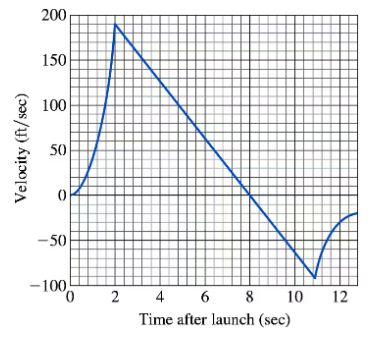
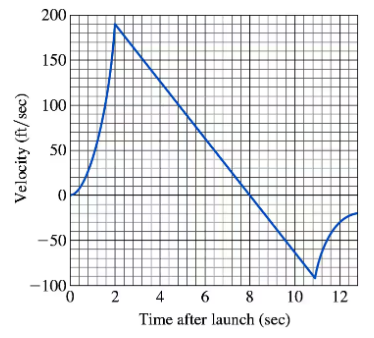
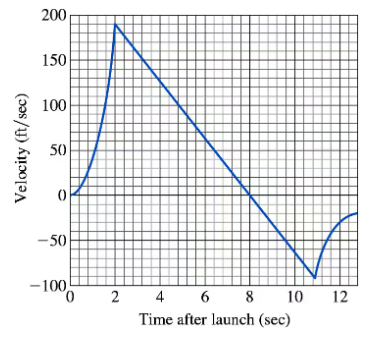
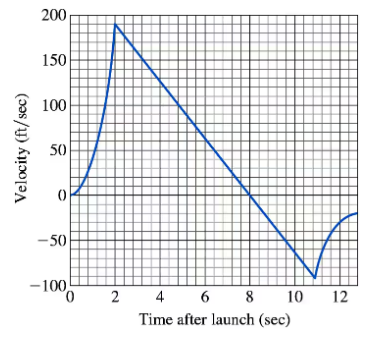
Launching a Rocket When a model rocket is launched, the propellant burns for a few seconds, accelerating the rocket upward. After burnout, the rocket coasts upward for a while and then begins to fall. A small explosive charge pops out a parachute shortly after the rocket starts down. The parachute slows the rocket to keep it from breaking when it lands.
The figure here shows velocity data from the flight of the model rocket. Use the data to answer the following.
a. How fast was the rocket climbing when the engine stopped?
Problem 17b
Understanding Motion from Graphs
Launching a Rocket When a model rocket is launched, the propellant burns for a few seconds, accelerating the rocket upward. After burnout, the rocket coasts upward for a while and then begins to fall. A small explosive charge pops out a parachute shortly after the rocket starts down. The parachute slows the rocket to keep it from breaking when it lands.
The figure here shows velocity data from the flight of the model rocket. Use the data to answer the following.
b. For how many seconds did the engine burn?
Problem 17c
Understanding Motion from Graphs
Launching a Rocket When a model rocket is launched, the propellant burns for a few seconds, accelerating the rocket upward. After burnout, the rocket coasts upward for a while and then begins to fall. A small explosive charge pops out a parachute shortly after the rocket starts down. The parachute slows the rocket to keep it from breaking when it lands.
The figure here shows velocity data from the flight of the model rocket. Use the data to answer the following.
c. When did the rocket reach its highest point? What was its velocity then?
Problem 17d
Understanding Motion from Graphs
Launching a Rocket When a model rocket is launched, the propellant burns for a few seconds, accelerating the rocket upward. After burnout, the rocket coasts upward for a while and then begins to fall. A small explosive charge pops out a parachute shortly after the rocket starts down. The parachute slows the rocket to keep it from breaking when it lands.
The figure here shows velocity data from the flight of the model rocket. Use the data to answer the following.
d. When did the parachute pop out? How fast was the rocket falling then?
Problem 17f
Understanding Motion from Graphs
Launching a Rocket When a model rocket is launched, the propellant burns for a few seconds, accelerating the rocket upward. After burnout, the rocket coasts upward for a while and then begins to fall. A small explosive charge pops out a parachute shortly after the rocket starts down. The parachute slows the rocket to keep it from breaking when it lands.
The figure here shows velocity data from the flight of the model rocket. Use the data to answer the following.
f. When was the rocket’s acceleration greatest?
Problem 18a
Understanding Motion from Graphs
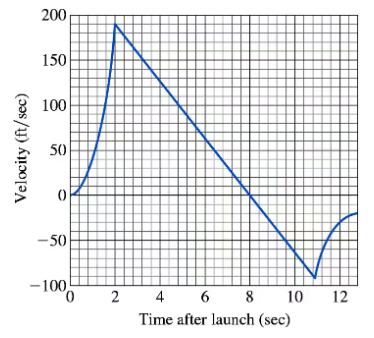
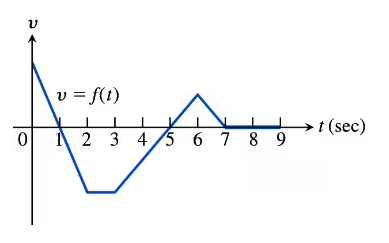
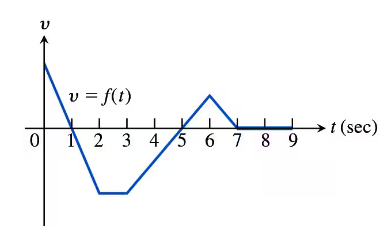
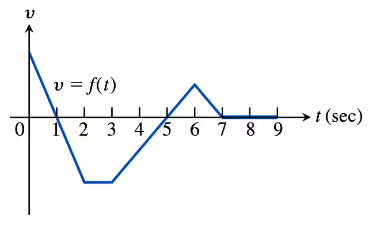
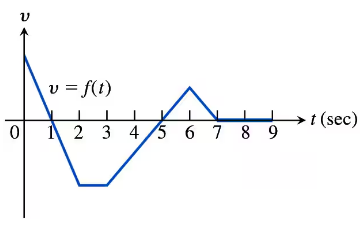
The accompanying figure shows the velocity v = f(t) of a particle moving on a horizontal coordinate line.
a. When does the particle move forward? Move backward? Speed up? Slow down?
Problem 18b
Understanding Motion from Graphs
The accompanying figure shows the velocity v = f(t) of a particle moving on a horizontal coordinate line.
b. When is the particle’s acceleration positive? Negative? Zero?
Problem 18c
Understanding Motion from Graphs
The accompanying figure shows the velocity v = f(t) of a particle moving on a horizontal coordinate line.
c. When does the particle move at its greatest speed?
Problem 18d
Understanding Motion from Graphs
The accompanying figure shows the velocity v = f(t) of a particle moving on a horizontal coordinate line.
d. When does the particle stand still for more than an instant?
Problem 21
In Exercises 19–22, find the values of the derivatives.
dr/dθ |θ₌₀ if r = 2/√(4 – θ)
Problem 21a
Economics
Marginal cost Suppose that the dollar cost of producing x washing machines is c(x) = 2000 + 100x − 0.1x².
a. Find the average cost per machine of producing the first 100 washing machines.
Problem 21c
Economics
Marginal cost Suppose that the dollar cost of producing x washing machines is c(x) = 2000 + 100x − 0.1x².
c. Show that the marginal cost when 100 washing machines are produced is approximately the cost of producing one more washing machine after the first 100 have been made, by calculating the latter cost directly.
Problem 22b
Economics
Marginal revenue
Suppose that the revenue from selling x washing machines is
r(x) = 20000(1 − 1/x) dollars.
b. Use the function r'(x) to estimate the increase in revenue that will result from increasing production from 100 machines a week to 101 machines a week.
Problem 22c
Economics
Marginal revenue
Suppose that the revenue from selling x washing machines is
r(x) = 20000(1 − 1/x) dollars.
c. Find the limit of r'(x) as x → ∞. How would you interpret this number?
Problem 23
Additional Applications
Bacterium population
When a bactericide was added to a nutrient broth in which bacteria were growing, the bacterium population continued to grow for a while, but then stopped growing and began to decline. The size of the population at time t (hours) was b = 10⁶ + 10⁴t − 10³t². Find the growth rates at
a. t = 0 hours.
b. t = 5 hours.
c. t = 10 hours.
Problem 24
Using the Alternative Formula for Derivatives
Use the formula
f'(x) = lim (z → x) (f(z) − f(x)) / (z − x)
to find the derivative of the functions in Exercises 23–26.
f(x) = x² − 3x + 4
Problem 25a
[Technology Exercise]
Draining a tank It takes 12 hours to drain a storage tank by opening the valve at the bottom. The depth y of fluid in the tank t hours after the valve is opened is given by the formula
y = 6(1 - t/12)² m.
a. Find the rate dy/dt (m/h) at which the tank is draining at time t.
Problem 25b
[Technology Exercise]
Draining a tank It takes 12 hours to drain a storage tank by opening the valve at the bottom. The depth y of fluid in the tank t hours after the valve is opened is given by the formula
y = 6(1 - t/12)² m.
b. When is the fluid level in the tank falling fastest? Slowest? What are the values of dy/dt at these times?