Back
Back
Problem 3.9.55b
Quadratic approximations
b. Find the quadratic approximation to f(x) = 1/(1 − x) at x = 0.
Problem 3.95b
Right circular cylinder The total surface area S of a right circular cylinder is related to the base radius r and height h by the equation S = 2πr² + 2πrh.
b. How is dS/dt related to dh/dt if r is constant?
Problem 3.8.23b
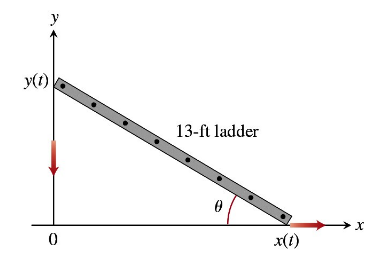
A sliding ladder
A 13-ft ladder is leaning against a house when its base starts to slide away. By the time the base is 12 ft from the house, the base is moving at the rate of 5 ft/sec.
b. At what rate is the area of the triangle formed by the ladder, wall, and ground changing then?
Problem 3.9.6b
Common linear approximations at x = 0 Find the linearizations of the following functions at x = 0.
b. cos x
Problem 3.7.62b
Computer Explorations
Use a CAS to perform the following steps in Exercises 55–62.
b. Using implicit differentiation, find a formula for the derivative dy/dx and evaluate it at the given point P.
x√(1 + 2y) + y = x², P(1,0)
Problem 3.3.32b
Recovering a function from its derivative
b. Repeat part (a), assuming that the graph starts at (−2, 0) instead of (−2, 3).
Problem 3.3.62b
The Reciprocal Rule
b. Show that the Reciprocal Rule and the Derivative Product Rule together imply the Derivative Quotient Rule.
Problem 3.8.18b
Diagonals If x, y, and z are lengths of the edges of a rectangular box, then the common length of the box’s diagonals is s = √(x² + y² + z²).
b. How is ds/dt related to dy/dt and dz/dt if x is constant?
Problem 3.2.31b
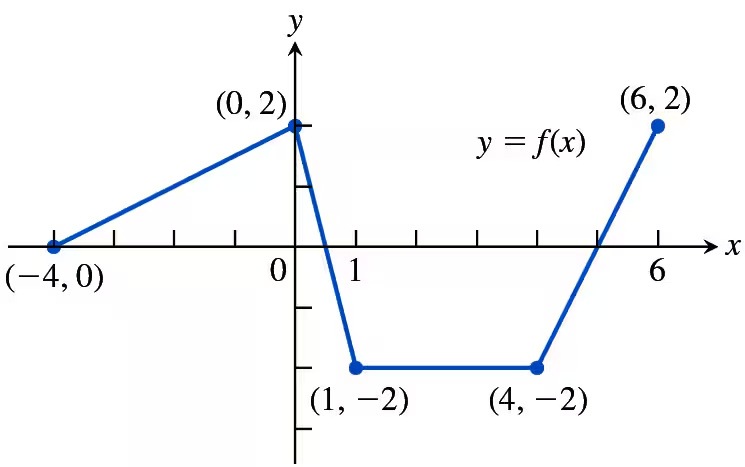
Consider the function f graphed here. The domain of f is the interval [−4, 6] and its graph is made of line segments joined end to end.
b. Graph the derivative of f. The graph should show a step function.
Problem 3.3.63b
Generalizing the Product Rule The Derivative Product Rule gives the formula
d/dx (uv) = u (dv/dx) + (du/dx) v
for the derivative of the product uv of two differentiable functions of x.
b. What is the formula for the derivative of the product u₁u₂u₃u₄ of four differentiable functions of x?
Problem 3.8.19b
Area The area A of a triangle with sides of lengths a and b enclosing an angle of measure θ is
A = (1/2) ab sinθ.
b. How is dA/dt related to dθ/dt and da/dt if only b is constant?
Problem 3.5.34b
Find y⁽⁴⁾ = d⁴y/dx⁴ if:
b. y = 9 cos x
Problem 3.4.7c
Particle motion At time t, the position of a body moving along the s-axis is s = t³ − 6t² + 9t m.
c. Find the total distance traveled by the body from t = 0 to t = 2.
Problem 3.2.51c
Theory and Examples
In Exercises 51–54,
c. For what values of x, if any, is f' positive? Zero? Negative?
y = −x²
Problem 3.4.6c
Motion Along a Coordinate Line
Exercises 1–6 give the positions s = f(t) of a body moving on a coordinate line, with s in meters and t in seconds.
c. When, if ever, during the interval does the body change direction?
s = 25/(t + 5), −4 ≤ t ≤ 0
Problem 3.6.76c
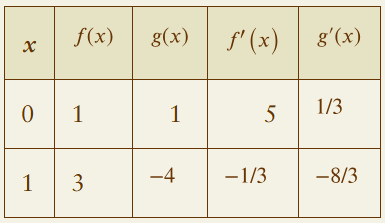
Suppose that the functions f and g and their derivatives with respect to x have the following values at x = 0 and x = 1.
Find the derivatives with respect to x of the following combinations at the given value of x.
c. f(x) / (g(x) + 1), x = 1
Problem 3.95c
Right circular cylinder The total surface area S of a right circular cylinder is related to the base radius r and height h by the equation S = 2πr² + 2πrh.
c. How is dS/dt related to dr/dt and dh/dt if neither r nor h is constant?
Problem 3.2.47c
Differentiability and Continuity on an Interval
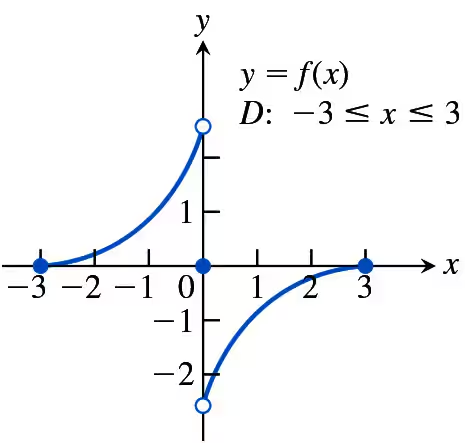
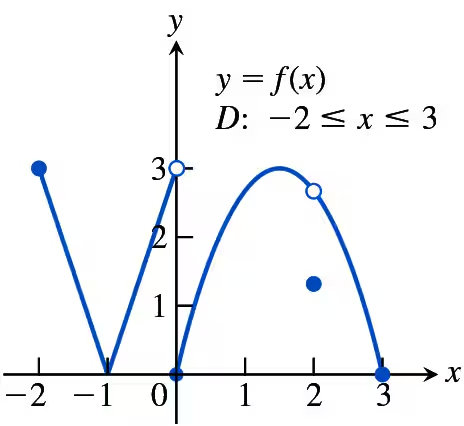
Each figure in Exercises 45–50 shows the graph of a function over a closed interval D. At what domain points does the function appear to be
c. neither continuous nor differentiable?
Give reasons for your answers.
Problem 3.57c
Suppose that functions ƒ(x) and g(x) and their first derivatives have the following values at x = 0 and x = 1.
x ƒ(x) g(x) ƒ'(x) g'(x)
0 1 1 -3 1/2
1 3 5 1/2 -4
Find the first derivatives of the following combinations at the given value of x.
c. ƒ(x) , x = 1
g(x) + 1
Problem 3.4.32c
Analyzing Motion Using Graphs
[Technology Exercise] Exercises 31–34 give the position function s = f(t) of an object moving along the s-axis as a function of time t. Graph f together with the velocity function v(t) = ds/dt = f'(t) and the acceleration function a(t) = d²s/dt² = f''(t). Comment on the object’s behavior in relation to the signs and values of v and a. Include in your commentary such topics as the following:
c. When does it change direction?
s = t² - 3t + 2, 0 ≤ t ≤ 5
Problem 3.7.46c
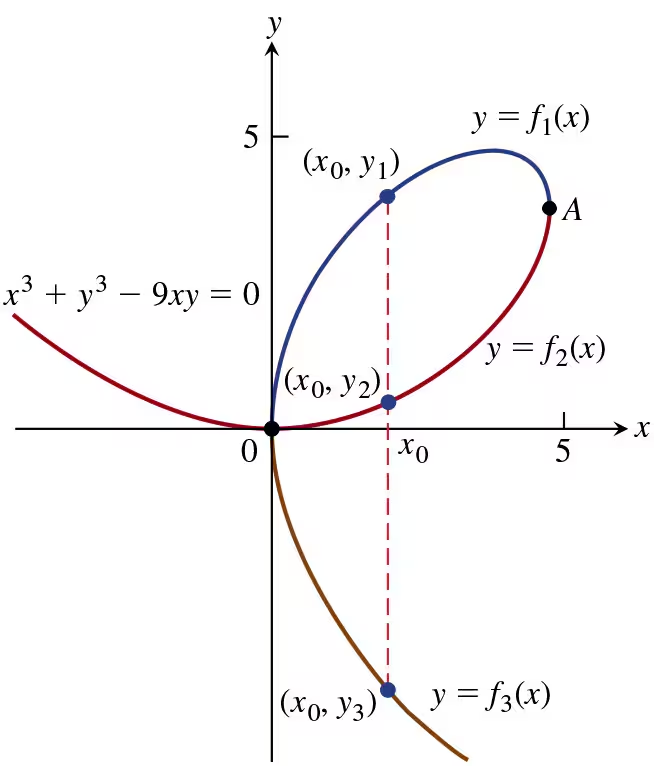
The folium of Descartes (See Figure 3.27)
c. Find the coordinates of the point A in Figure 3.29 where the folium has a vertical tangent line.
Problem 3.8.18c
Diagonals If x, y, and z are lengths of the edges of a rectangular box, then the common length of the box’s diagonals is s = √(x² + y² + z²).
c. How are dx/dt, dy/dt, and dz/dt related if s is constant?
Problem 3.5.53c
By computing the first few derivatives and looking for a pattern, find the following derivatives.
c. d⁷³/dx⁷³ (x sin x)
Problem 3.2.48c
Differentiability and Continuity on an Interval
Each figure in Exercises 45–50 shows the graph of a function over a closed interval D. At what domain points does the function appear to be
c. neither continuous nor differentiable?
Give reasons for your answers.
Problem 3.4.33d
Analyzing Motion Using Graphs
[Technology Exercise] Exercises 31–34 give the position function s = f(t) of an object moving along the s-axis as a function of time t. Graph f together with the velocity function v(t) = ds/dt = f'(t) and the acceleration function a(t) = d²s/dt² = f''(t). Comment on the object’s behavior in relation to the signs and values of v and a. Include in your commentary such topics as the following:
d. When does it speed up and slow down?
s = t³ - 6t² + 7t, 0 ≤ t ≤ 4
Problem 3.57d
Suppose that functions ƒ(x) and g(x) and their first derivatives have the following values at x = 0 and x = 1.
x ƒ(x) g(x) ƒ'(x) g'(x)
0 1 1 -3 1/2
1 3 5 1/2 -4
Find the first derivatives of the following combinations at the given value of x.
d. ƒ(g(x)), x = 0
Problem 3.2.52d
Theory and Examples
In Exercises 51–54,
d. Over what intervals of x-values, if any, does the function y = f(x) increase as x increases? Decrease as x increases? How is this related to what you found in part (c)? (We will say more about this relationship in Section 4.3.)
y = −1/x
Problem 3.95d
Right circular cylinder The total surface area S of a right circular cylinder is related to the base radius r and height h by the equation S = 2πr² + 2πrh.
d. How is dr/dt related to dh/dt if S is constant?
Problem 3.2.53d
Theory and Examples
In Exercises 51–54,
d. Over what intervals of x-values, if any, does the function y = f(x) increase as x increases? Decrease as x increases? How is this related to what you found in part (c)? (We will say more about this relationship in Section 4.3.)
y = x³/3
Problem 3.2.36d
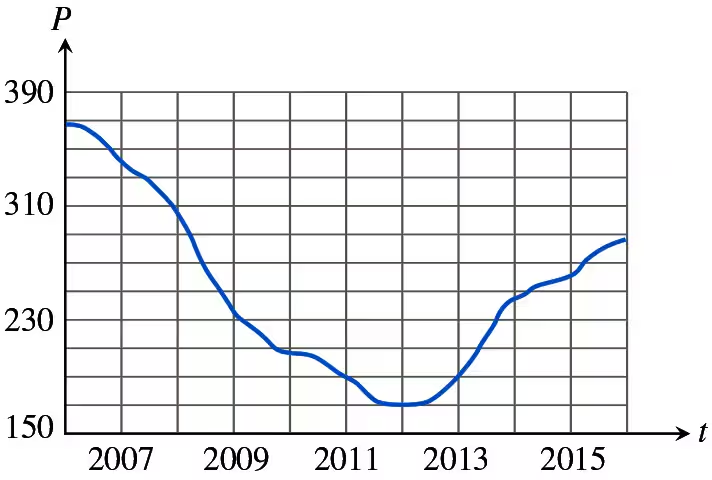
Average single-family home prices P (in thousands of dollars) in Sacramento, California, are shown in the accompanying figure from the beginning of 2006 through the end of 2015.
d. During what year did home prices drop most rapidly and what is an estimate of this rate?