Back
Back
Problem 26
The number of gallons of water in a tank t minutes after the tank has started to drain is Q(t) = 200(30 - t)². How fast is the water running out at the end of 10 min? What is the average rate at which the water flows out during the first 10 min?
Problem 27
Vehicular stopping distance Based on data from the U.S. Bureau of Public Roads, a model for the total stopping distance of a moving car in terms of its speed is s = 1.1v + 0.054v², where s is measured in ft and v in mph. The linear term 1.1v models the distance the car travels during the time the driver perceives a need to stop until the brakes are applied, and the quadratic term 0.054v² models the additional braking distance once they are applied. Find ds/dv at v = 35 and v = 70 mph, and interpret the meaning of the derivative.
Problem 29
Airplane takeoff Suppose that the distance an aircraft travels along a runway before takeoff is given by D = (10/9)t², where D is measured in meters from the starting point and t is measured in seconds from the time the brakes are released. The aircraft will become airborne when its speed reaches 200 km/h. How long will it take to become airborne, and what distance will it travel in that time?
Problem 41b
Slopes and Tangent Lines
b. Smallest slope What is the smallest slope on the curve? At what point on the curve does the curve have this slope?
Problem 42a
Slopes and Tangent Lines
a. Horizontal tangent lines Find equations for the horizontal tangent lines to the curve y = x³ − 3x − 2. Also find equations for the lines that are perpendicular to these tangent lines at the points of tangency.
Problem 44
Find by implicit differentiation.
x² + xy + y² - 5x = 2
Problem 46
Quadratics having a common tangent line The curves y = x² + ax + b and y = cx − x² have a common tangent line at the point (1,0). Find a, b, and c.
Problem 48
Find by implicit differentiation.
x²y² = 1
Problem 49
Find all points (x, y) on the graph of y = x/(x − 2) with tangent lines perpendicular to the line y = 2x + 3.
Problem 51
Assume that functions f and g are differentiable with f(1) = 2, f'(1) = −3, g(1) = 4, and g'(1) = −2. Find the equation of the line tangent to the graph of F(x) = f(x)g(x) at x = 1.
Problem 52
In Exercises 51 and 52, find dp/dq.
q = (5p² + 2p)⁻³/²
Problem 54
a. Find an equation for the line that is tangent to the curve y = x³ − 6x² + 5x at the origin.
[Technology Exercise] b. Graph the curve and tangent line together. The tangent line intersects the curve at another point. Use Zoom and Trace to estimate the point’s coordinates.
[Technology Exercise] c. Confirm your estimates of the coordinates of the second intersection point by solving the equations for the curve and tangent line simultaneously.
Problem 54a
When the length L of a clock pendulum is held constant by controlling its temperature, the pendulum’s period T depends on the acceleration of gravity g. The period will therefore vary slightly as the clock is moved from place to place on Earth’s surface, depending on the change in g. By keeping track of ΔT, we can estimate the variation in g from the equation T = 2π(L/g)¹/² that relates T, g, and L.
a. With L held constant and g as the independent variable, calculate dT and use it to answer parts (b) and (c).
Problem 54b
When the length L of a clock pendulum is held constant by controlling its temperature, the pendulum’s period T depends on the acceleration of gravity g. The period will therefore vary slightly as the clock is moved from place to place on Earth’s surface, depending on the change in g. By keeping track of ΔT, we can estimate the variation in g from the equation T = 2π(L/g)¹/² that relates T, g, and L.
b. If g increases, will T increase or decrease? Will a pendulum clock speed up or slow down? Explain.
Problem 55a
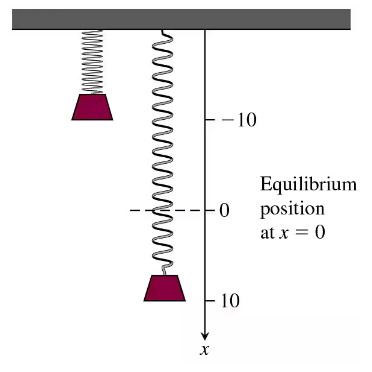
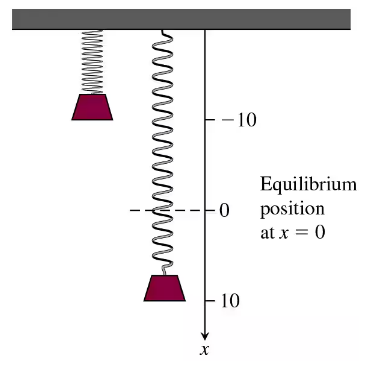
A weight is attached to a spring and reaches its equilibrium position (x = 0). It is then set in motion resulting in a displacement of x = 10 cos t, where x is measured in centimeters and t is measured in seconds. See the accompanying figure.
Find the spring’s displacement when t = 0, t = π/3, and t = 3π/4.
Problem 55b
A weight is attached to a spring and reaches its equilibrium position (x = 0). It is then set in motion resulting in a displacement of x = 10 cos t, where x is measured in centimeters and t is measured in seconds. See the accompanying figure.
b. Find the spring’s velocity when t = 0, t = π/3, and t = 3π/4.
Problem 55c
Quadratic approximations
[Technology Exercise] c. Graph f(x) = 1/(1 − x) and its quadratic approximation at x = 0. Then zoom in on the two graphs at the point (0,1). Comment on what you see.
Problem 55d
Quadratic approximations
d. Find the quadratic approximation to g(x) = 1/x at x = 1. Graph g and its quadratic approximation together. Comment on what you see
Problem 55e
Quadratic approximations
[Technology Exercise] e. Find the quadratic approximation to h(x) = √(1 + x) at x = 0. Graph h and its quadratic approximation together. Comment on what you see.
Problem 56a
Assume that a particle’s position on the x-axis is given by
x = 3 cos t + 4 sin t,
where x is measured in feet and t is measured in seconds.
a. Find the particle’s position when t = 0, t = π/2, and t = π.
Problem 56b
Assume that a particle’s position on the x-axis is given by
x = 3 cos t + 4 sin t,
where x is measured in feet and t is measured in seconds.
b. Find the particle’s velocity when t = 0, t = π/2, and t = π.
Problem 59
Find the value of dy/dt at t = 0 if y = 3 sin 2x and x = t² + π.
Problem 61
[Technology Exercise]
Graph y = 1/(2√x) in a window that has 0 ≤ x ≤ 2. Then, on the same screen, graph
y = (√(x + h) − √x)/h
for h = 1, 0.5, 0.1. Then try h = −1, −0.5, −0.1. Explain what is going on.
Problem 63
Derivative of y = |x| Graph the derivative of f(x) = |x|. Then graph y = (|x| − 0)/(x − 0) = |x|/x. What can you conclude?
Problem 64
If x¹/³ + y¹/³ = 4, find d²y/dx² at the point (8, 8).
Problem 91
Temperature and the period of a pendulum For oscillations of small amplitude (short swings), we may safely model the relationship between the period T and the length L of a simple pendulum with the equation:
T = 2π√(L/g),
where g is the constant acceleration of gravity at the pendulum’s location. If we measure g in centimeters per second squared, we measure L in centimeters and T in seconds. If the pendulum is made of metal, its length will vary with temperature, either increasing or decreasing at a rate that is roughly proportional to L. In symbols, with u being temperature and k the proportionality constant,
dL/du = kL.
Assuming this to be the case, show that the rate at which the period changes with respect to temperature is kT/2.
Problem 95a
The total surface area S of a right circular cylinder is related to the base radius r and height h by the equation S = 2πr² + 2πrh.
a. How is dS/dt related to dr/dt if h is constant?
Problem 96a
The lateral surface area S of a right circular cone is related to the base radius r and height h by the equation S = πr√(r² + h²).
a. How is dS/dt related to dr/dt if h is constant?
Problem 96c
Right circular cone The lateral surface area S of a right circular cone is related to the base radius r and height h by the equation
______
S = πr √ r² + h².
c. How is dS/dt related to dr/dt and dh/dt if neither r nor h is constant?
Problem 99
Resistors connected in parallel If two resistors of R₁ and R₂ ohms are connected in parallel in an electric circuit to make an R-ohm resistor, the value of R can be found from the equation
1/R = 1/R₁ + 1/R₂
<IMAGE>
If R₁ is decreasing at the rate of 1ohm/sec and R₂ is increasing at the rate of 0.5 ohm/sec, at what rate is R changing when R₁ = 75 ohms and R₂ = 50 ohms?