Back
Back
Problem 3.1.33
Show that the line y = mx + b is its own tangent line at any point (x₀, mx₀ + b).
Problem 3.8.6
If x = y³ – y and dy/dt = 5, then what is dx/dt when y = 2?
Problem 3.9.47
Tolerance The height and radius of a right circular cylinder are equal, so the cylinder’s volume is V = πh³. The volume is to be calculated with an error of no more than 1% of the true value. Find approximately the greatest error that can be tolerated in the measurement of h, expressed as a percentage of h.
Problem 3.7.16
Find dr/dθ in Exercises 15–18.
r – 2√θ = (3/2)θ²/³ + (4/3)θ³/⁴
Problem 3.86
In Exercises 83–88, find equations for the lines that are tangent, and the lines that are normal, to the curve at the given point.
(y - x)² = 2x + 4, (6, 2)
Problem 3.6.5
Derivative Calculations
In Exercises 1–8, given y = f(u) and u = g(x), find dy/dx = f'(g(x)) g'(x).
y = √u, u = sin x
Problem 3.17
Find the derivatives of the functions in Exercises 1–42.
______
𝓻 = √2θ sinθ
Problem 3.3.55
For Exercises 55 and 56, evaluate each limit by first converting each to a derivative at a particular x-value.
lim (x → 1) (x⁵⁰ − 1) / (x − 1)
Problem 3.5.61
Slopes on the graph of the tangent function Graph y = tan x and its derivative together on (−π/2, π/2). Does the graph of the tangent function appear to have a smallest slope? A largest slope? Is the slope ever negative? Give reasons for your answers.
Problem 3.9.23
Derivatives in Differential Form
In Exercises 17–28, find dy.
y = sin(5√x)
Problem 3.3.59
The general polynomial of degree n has the form
P(x) = aₙxⁿ + aₙ₋₁xⁿ⁻¹ + ... + a₂x² + a₁x + a₀,
where aₙ ≠ 0. Find P'(x).
Problem 3.7.23
Second Derivatives
In Exercises 19–26, use implicit differentiation to find dy/dx and then d²y/dx². Write the solutions in terms of x and y only.
2√y = x – y
Problem 3.6.46
In Exercises 41–58, find dy/dt.
y = (t⁻³/⁴ sin(t))⁴/³
Problem 3.8.3
Assume that y = 5x and dx/dt = 2. Find dy/dt
Problem 3.7.14
Differentiating Implicitly
Use implicit differentiation to find dy/dx in Exercises 1–14.
x cos(2x + 3y) = y sin x
Problem 3.6.54
In Exercises 41–58, find dy/dt.
y = 4 sin(√(1 + √t))
Problem 3.9.33
Approximation Error
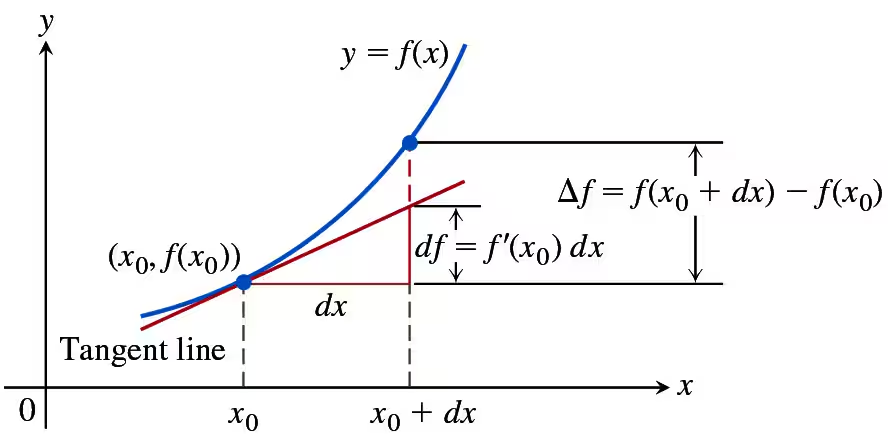
In Exercises 29–34, each function f(x) changes value when x changes from x₀ to x₀ + dx. Find
a. the change Δf = f(x₀ + dx) − f(x₀);
b. the value of the estimate df = fʹ(x₀) dx; and
c. the approximation error |Δf − df|.
f(x) = x⁻¹, x₀ = 0.5, dx = 0.1
Problem 3.5.31
Derivatives
In Exercises 27–32, find dp/dq.
p = (q sin q) / (q² − 1)
Problem 3.8.36
Moving along a parabola A particle moves along the parabola y = x² in the first quadrant in such a way that its x-coordinate (measured in meters) increases at a steady 10 m/sec. How fast is the angle of inclination θ of the line joining the particle to the origin changing when x = 3 m?
Problem 3.7.45
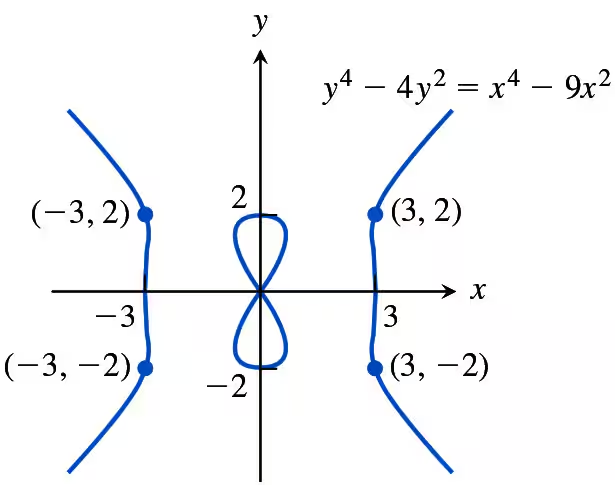
The devil’s curve (Gabriel Cramer, 1750) Find the slopes of the devil’s curve y⁴ – 4y² = x⁴ – 9x² at the four indicated points.
Problem 3.3
Find the derivatives of the functions in Exercises 1–42.
𝔂 = x³ - 3 (x² + π²)
Problem 3.1.14
In Exercises 11–18, find the slope of the function’s graph at the given point. Then find an equation for the line tangent to the graph there.
g(x) = 8 / x², (2, 2)
Problem 3.2.42
In Exercises 41–44, determine whether the piecewise-defined function is differentiable at x = 0.
g(x) = { x²/³, x ≥ 0
x¹/³, x < 0
Problem 3.3.44
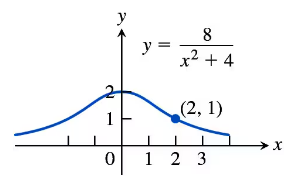
Find the tangent line to the Witch of Agnesi (graphed here) at the point (2,1).
Problem 3.9.13
Show that the linearization of f(x) = (1 + x)ᵏ at x = 0 is L(x) = 1 + kx.
Problem 3.5.35
Tangent Lines
In Exercises 35–38, graph the curves over the given intervals, together with their tangent lines at the given values of x. Label each curve and tangent line with its equation.
y = sin x, −3π/2 ≤ x ≤ 2π
x = −π, 0, 3π/2
Problem 3.67
a. Graph the function
ƒ(x) = { x², -1 ≤ x < 0
{ -x², 0 ≤ x ≤ 1.
b. Is ƒ continuous at x = 0?
c. Is ƒ differentiable at x = 0?
Give reasons for your answers.
Problem 3.31
Find the derivatives of the functions in Exercises 1–42.
__
𝔂 = ( √ x )²
( 1 + x )
Problem 3.47
In Exercises 43–50, find by implicit differentiation.
__
√xy = 1
Problem 3.9.27
Derivatives in Differential Form
In Exercises 17–28, find dy.
y = 3 csc(1 − 2√x)